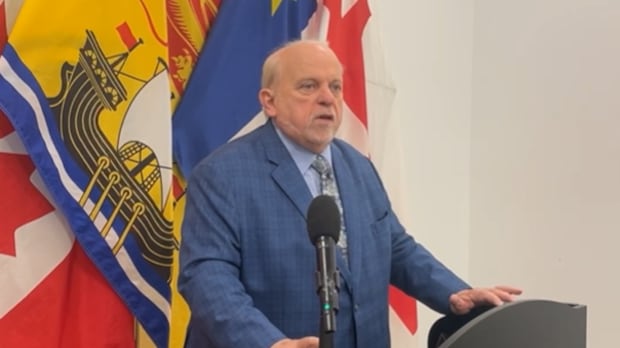
New BrunswickSustainable energy advocate Ralph Torrie says N.B. Power is making a mistake with plans for a new gas plant in Tantramar, which the utility says is needed to meet growing demand for electricity. Queen’s University’s Warren Mabee says it’s hard to predict the best investment, because technologies are changing so rapidly. Utility risks being stuck with ‘older technology’ in the long term, prof saysErica Butler · CBC News · Posted: Oct 24, 2025 3:20 PM EDT | Last Updated: 3 hours agoRalph Torrie, director of research with Corporate Knights, says batteries, not gas turbines, are the way to go to support N.B. Power’s future renewables plans. (Josh O’Donnell)N.B. Power could be taking a “backwards step” with its proposal for a new major gas-fired power plant, according to the author of an upcoming report on Canada’s path away from fossil fuels. Ralph Torrie said that N.B. Power’s decision to sign a 25-year agreement with ProEnergy Canada is a commitment to 20th-century technology. “And we’re facing a 21st century challenge here,” said the director of research with Corporate Knights, a sustainable economy advocacy group. “You could end up with a plant that will be obsolete before it even has a chance to pay for itself,” he said. Torrie was in New Brunswick this week to address students at St Thomas University, meet with MLAs, and deliver a public session at the Fredericton Public Library.N.B. Power has not released the details of its agreement with ProEnergy, but officials recently indicated the cost would reach at least $1 billion over 25 years. The plan to hire the U.S.-based company to design, build and operate the 400-500 MW power plant in rural Tantramar will go before the New Brunswick Energy and Utilities board in the coming months, after N.B. Power’s attempt to bypass the regulatory body was rejected last week.Stabilizing the gridThe stated rationale behind the project is twofold. On one hand, N.B. Power has dubbed the project Renewables Integration and Grid Security, explaining the gas-diesel turbines would be used to complement the planned expansion of renewable energy in New Brunswick. Not only would gas turbines help fill in gaps caused by intermittency in wind and solar, but the turbines would operate 85 per cent of the time as synchronous condensers, according to ProEnergy Canada president John MacIsaac. ProEnergy Canada vice-president John MacIsaac told Tantramar councillors that a gas-fired power plant in their municipality would not burn fuel 85 per cent of the time. (Municipality of Tantramar/Youtube)During that time, they would not burn fuel but simply spin under electrical power, to provide rotating inertia and stability to the grid.While Torrie acknowledged voltage stability is an issue as inverter-based power sources such as wind and solar ramp up, he said that’s not a reason to build a gas plant. “If you need synchronous condensers, just build them,” Torrie said. “You can build them for a fraction of the cost of building a gas plant.”Torrie said there are other emerging technologies for providing voltage stability being tested in other countries, but “in Canada, the penetration of renewables is still at a low enough level that this issue has not become front and centre.”When the wind doesn’t blowWarren Mabee, a professor at Queen’s University with a specialization in energy and environmental policy, said he understands N.B. Power’s need for a “back-up system” as wind and solar power supplies grow.But Mabee said he was struck by the size of the proposed gas plant. He said there should be, “questions about whether this scale of a plant is really necessary in the long term.”He also wondered whether N.B. Power can bring large amounts of wind and solar power online quickly.Queen’s University professor Warren Mabee said there’s a lot of work to be done implementing N.B. Power’s plan for new renewables. (Queen’s University)“I think New Brunswick has a very ambitious plan for new renewables, but there’s a lot of work to be done to deliver on that plan. The risk is that you get this plant built, but the renewables don’t follow, or they’re slowed down.”“You might end up with more capacity than needed, or the plant might become more of a base load provider … and that just means sticking with an older technology for a much longer period.”Try efficiency firstBrad Coady, a vice-president at N.B. Power, recently told MLAs about the other impetus behind the proposed gas plant. He and his staff had come to the conclusion that, “we are very quickly running out of electricity in New Brunswick,” Coady said. The utility predicts possible shortages of base load as early as 2028.Torrie said he doesn’t see a need to panic. While there’s “no doubt that the amount of electricity we need is going up,” it’s also true that, “there are huge opportunities to moderate that growth.”Torrie called for “much greater emphasis on efficiency,” in particular, converting the many New Brunswick homes that rely on electric baseboard heat to more efficient heat pumps. “If that was done as aggressively as it could be, we wouldn’t need to be talking about a new fossil fuel plant,” Torrie said.Clashing on costs When it comes to the growth of renewables, Torrie said, N.B. Power’s plan is “in the right direction,” with its emphasis on wind generation. But when it comes to the need for complementary power sources to cover gaps in future renewables, batteries, not gas turbines, are the way to go, he said.“Batteries are the way to deal with the intermittency of wind energy and solar energy, without question. The decline in battery prices has brought this clearly into focus.” Torrie is also convinced that electric vehicles will soon be one of the best sources to cover intermittency of renewable energy, by providing energy back to the grid during times of peak demand. N.B. Power CEO Lori Clark says battery storage options are cost-prohibitive for the utility. (Silas Brown/CBC)N.B. Power CEO Lori Clark seems to have come to a different conclusion, having told MLAs that, “as it relates to batteries, the technology just isn’t there to provide us, in our climate, the security that we need or the duration that we need. And it’s at a cost that would just be cost-prohibitive.”Torrie said Clark’s cost analysis “does not align with the conclusion that we’re seeing around the world from utilities.””There’s no way that a new gas plant represents the cheapest way to expand the supply of electricity in New Brunswick.”Fast moving technologiesUltimately the argument may not be settled before decisions need to be made.“This is an area where it’s really hard to predict the best investment, the winners, if you like,” said Mabee. “It’s because those technologies are moving so fast.” There’s been significant decreases in the costs of solar, wind, and battery storage, said Mabee, and new technologies are “in flux, with lots of new things coming out.”ABOUT THE AUTHORErica Butler is a reporter with CBC New Brunswick. She lives in Sackville and works out of the Moncton newsroom. You can send story tips to erica.butler@cbc.ca.
2 energy experts question N.B. Power plans for large gas plant