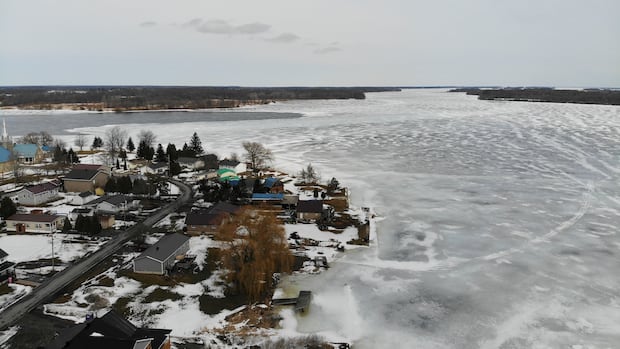
OttawaTwo local conservation authorities say they disagree with the provincial government’s plan to reduce the number of agencies across Ontario by merging the existing ones. Representatives said the municipalities who fund and rely on RCAs for clean water could lose their voice in the process. Control could fall to the biggest cities, representatives worryCBC News · Posted: Nov 30, 2025 6:44 PM EST | Last Updated: 2 hours agoListen to this articleEstimated 4 minutesThe audio version of this article is generated by text-to-speech, a technology based on artificial intelligence.The ice-covered St. Lawrence River flows past the Mohawk community of Akwesasne in this photo from March 2022. Under the Ford government’s proposed legislation, all of the Ontario conservation authorities covering the watershed that flows into the St. Lawrence would be merged into one. (Seth Wenig/Associated Press)Two local conservation authorities say they disagree with the Ford government’s plan to reduce the number of agencies across Ontario by merging the existing ones.”We’ve done everything they’ve asked us to do,” said Sally McIntyre, general manager of the Mississippi Valley Conservation Authority. “This just seems to be a situation where it doesn’t matter what we do.”Across Ontario, regional conservation authorities (RCAs) monitor water levels and erosion, manage recreation, teach people about the environment and more.On Oct. 31, Environment Minister Todd McCarthy announced that the government will introduce legislation that merges Ontario’s 36 RCAs into just seven, while creating a new agency to oversee them. Under the plan, the existing 13 conservation authorities in eastern Ontario would become two: the Eastern Lake Ontario RCA and the St. Lawrence RCA.But representatives from local RCAs told CBC Radio’s Ottawa Morning that the municipalities that fund and rely on them for clean water could lose their voice in the process. The detailed plans have been posted for public comment until late December. Cutting out municipalities?McCarthy said that since 100 Ontario municipalities fall in the boundaries of two or more RCAs, the change will reduce unnecessary overlap. “Right now, Ontario has 36 conservation authorities operating largely on their own, with fragmented and outdated data systems and a patchwork of standards and service delivery,” he said.But McIntyre fears that small municipalities will actually be forced out of decision-making. “In theory, municipalities are to continue to have some sort of governance and oversight role, but then everything else [the province issues] really undermines that premise,” she said. “As it’s mapped out in legislation, this new [oversight agency] would have over 70 representatives, and I think everybody would agree that would be totally impractical.” Sally McIntyre, general manager of the Mississippi Valley Conservation Authority, is seen in August 2025. ‘The core mandade to the RCA is to protect people and property from natural hazards,’ she said. ‘We truly do act in the public interest.’ (Francis Ferland/CBC)McIntyre said she thinks smaller municipalities will have to go without representation, while noting that RCAs are primarily funded by municipalities and get only three per cent of their budgets from the province. “If [municipalities] don’t have a say at the table, but are being asked to pay, that’s a big issue for all of us. Because we’re all taxpayers,” she said.’Waiting for another disaster’The fear is that the eastern Ontario RCAs will be “controlled by Kingston, Ottawa and Cornwall,” said Adrian Wynands, vice-chair of the South Nation Conservation Authority’s board of directors and deputy mayor of Augusta Township.Wynands pointed to the Clean Water Act — enacted nearly two decades ago after a devastating E. coli outbreak in Walkerton, Ont., and which South Nation helps enforce — as an example of how the work of RCAs directly affects farmers.Local farmers get funding through South Nation to ensure the water on their property meets certain cleanliness standards, he said.”We can’t lose boots on the ground waiting for another disaster,” Wynands said.A spokesperson for the minister told CBC that the RCAs mandate will be unchanged, their boards will still be municipally appointed, and there will be no job losses.Under the new model, RCAs would be able to work faster and more efficiently, they added.Ontario Minister of the Environment, Conservation and Parks Todd McCarthy said the government is committed to ensuring that the RCAs are strong and effective. (Laura Proctor/The Canadian Press)To ensure there would be no job losses, McCarthy said in October that employees in some management positions will be “redeployed” to front-line roles.”The implication of what he’s saying is that we’re inefficient today,” added McIntyre. “We turn around our applications within the target timelines 96 per cent of the time,” she said. “And I would question whether the province could say that about its approvals.” LISTEN | McIntyre and Wynands speak to CBC’s Elyse Skura on Ottawa Morning:Ottawa Morning10:05Should Ontario amalgamate its 36 conservation authorities?Two local conservation authorities disagree with the Minister of Environment’s proposal to amalgamate its 36 conservation authorities to seven. Hear from Adrian Wynands of the South Nation Conservation Authority and Sally McIntyre with the Mississippi Valley Conservation Authority.With files from Olivia Robinson
2 eastern Ontario conservation authorities disagree with province’s merger plan