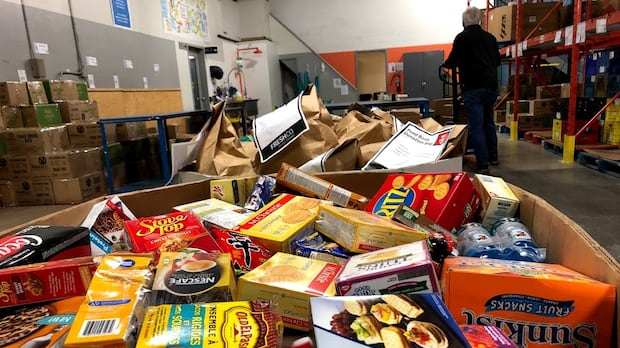
For the ninth year in a row, the number of people accessing food banks in Ontario has grown.The annual Hunger Report from Feed Ontario released Monday says more than one million people made 8.7 million visits between April 2024 and March of this year.That’s a one per cent increase from last year and an 87 per cent increase since the 2020 Hunger Report.But as concerning as those numbers are, Feed Ontario CEO Carolyn Stewart says the bigger issue now is seeing how food insecurity in the province is spreading out and impacting other facets of life, including how people access housing, health care and their communities.“We’re hoping that this report serves as an alarm bell for the interconnected issues of poverty and the reality we’re seeing out there,” Stewart said.“Strong communities start when everyone’s basic needs are being met and when that doesn’t happen, poverty starts to weaken communities and it erodes the trust that people have in the systems, institutions that are really meant to be there to keep them safe and support them and support their well-being.”By the numbersFeed Ontario is an advocacy organization that represents more than 1,200 food banks and hunger-relief organizations in the province. A quick look at the numbers in the report, which covers between April 1, 2024 and March 31 of this year, shows:1,007,441 people visited a food bank for a total of 8,712,897 visits.76 per cent of people who visited a food bank are rental tenants.61 per cent were people on social assistance.23 per cent were employed.29 per cent were children.In the report, 34 per cent of people said they made their first visit to a food bank in this last year. This is down from 43 per cent in 2023-24, which the Hunger Report notes seems like good news, but there are still concerns.“With fewer new people seeking support, food bank use year-over-year has continued to rise,” the Hunger Report says. “This indicates that although there are fewer new people and families turning to food banks for help, those who already need this support are relying on food bank services for longer periods of time.”Stewart said the number of times people are visiting is up. Where people used to visit five to six times a year, now it’s nine to 10 times.WATCH | This North York food bank helps people do more than access a meal:How this North York food bank is helping clients ‘build a better future’ As the number of people accessing food banks continues to rise, a North York food bank is striving to do more. As CBC’s Talia Ricci reports, they are not only supplying food, but also helping to create pathways to stable jobs and mobilizing clients to fight for policy changes. Ontario food banks report increasesRecent reports from food banks across the province have painted a picture already this year of how much need is on the rise.In July, the town of Cochrane declared a food insecurity emergency after the food bank said over the last three years data shows its usage rates increased by 106 per cent.Ardis Proulx-Chedore, general manager of the Cochrane Food Bank, told town councillors they served just under 4,000 people in the community of 5,500 in 2024, a number she calls “scary” and “insane.”The Ottawa Food Bank says it has seen close to 600,000 visits to local food programs this year.WATCH | Ottawa Food Bank reports increasing need:Ottawa Food Bank sees historic spike in visitsThere have been close to 600,000 visits to local food programs this year, stretching resources and the staff that run them thin.A community impact report by The Food Bank of Waterloo Region released in October showed there were close to 622,000 total visits to food hamper programs in the past year — a new record high.The numbers also showed 7,000 households accessed a hamper program more than eight times, which is a 21 per cent increase from the year before.Food bank CEO Kim Wilhelm called those numbers “deeply concerning.”“Food assistance is no longer just a short-term safety net. High housing costs, stagnant wages, and inadequate social supports are forcing more people to rely on emergency food programs long-term,” Wilhelm said.Impact on bills, housingThe Hunger Report says as food insecurity grows, it’s going to impact communities on a wider scale.The report notes it’s not surprising that people who are homeless often rely on food banks and hunger-relief organizations.But the report also points to a 2022 report from McMaster University in Hamilton, done in conjunction with Hamilton Food Share, that found four per cent of people who used the food bank that year had stable housing.When asked what impact the food bank was having on their lives, 46 per cent of those with stable housing said they would “most likely be homeless without food bank support” and they were able to use money they would spend on food toward rent and housing.April Mercier of the Regional Food Distribution Association, which distributes food to food banks and food programs in Thunder Bay and the region, said people often have an idea in their mind of the people who need to access food, but it’s not always accurate.“It is people who are employed. It’s families with two parents. It’s widespread across the community and it’s people showing up to the food banks for the first time ever,” Mercier told CBC Thunder Bay.Volunteers at the Thunder Bay Regional Food Distribution Association (RFDA) work to prep carrots that were used in meals that went to families in need. (RFDA Thunder Bay Regional Food Distribution Association/Facebook)Len Kutchaw, who is with the food bank in Elliott Lake, says he’s talked to people who are starting to give up certain things to afford the necessities.“I had a couple of experiences here where people have come in to sign in and now they’re talking about having to give up their internet or give up their television service because they have to make a choice,” he told CBC Sudbury’s Morning North. “Incomes have frozen, but everything else is going up exponentially.”Colleen Hill, the executive director of Manitoulin Family Resources, said sometimes it�’s going beyond those “extras.”“They’re actually losing their homes or not being able to afford rent and having to make those really difficult decisions that no one should have to make, whether you’re going to pay your rent, pay your utilities or purchase food,” she told CBC Sudbury.“Manitoulin Island has this very picturesque reputation and it is a beautiful place; however, there are people that are under-housed and homeless that are living and are community members on this island.”Link between food and healthThe Hunger Report also points to the increasing strain food insecurity will have on the health-care system, saying it will lead to higher costs and longer hospital wait times.Vanessa Hurley is a public health nutritionist and registered dietitian with the Simcoe Muskoka District Health Unit and says food and health are intrinsically linked.When people can’t access nutritious food, they have “heightened nutritional vulnerability,” she said.“We know that diet plays a key role in chronic disease prevention,” she said. “Those that are unable to access adequate nutritious food, they have increased rates of some chronic diseases like diabetes and heart disease as well as infectious and non-communicable diseases. They are more at risk for injuries and chronic pain,” she said.Lack of nutritious food can lead to depression, anxiety, and other mental and physical health problems, Hurley explained.“Food insecurity contributes to that kind of cycle of poverty and reduced overall community well-being. So when people struggle to meet their needs, it impacts everyone,” Hurley said.’Look after the community’Mike O’Dah ziibing Ashkewe has volunteered at Chalmers Centre in Guelph, which offers a café and emergency food program, as well as a program called Step-by-Step which provides hot meals on weekends.Mike O’Dah ziibing Ashkewe has volunteered with food programs in Guelph, including most recently with Step-by-Step which provides warm meals to people in need on weekends. He says he finds the work is about more than giving people a meal, but it’s also giving them a sense of community and belonging. (Mike O’Dah ziibing Ashkewe)He said at Chalmers, people would come in with dietary restrictions and would tell him they couldn’t afford the right food to make sure they were eating properly.“There was a guest I saw recently who was having some pretty severe issues with pain,” he said, adding volunteers always aim to get people what they need or connect them with other services.Ashkewe said so many food banks are becoming more than a place to get a hot meal or some food to take home. For many who visit, they may feel stigmatized, and so being among people can feel like it’s the last link to their community.The people coming in at Chalmers “were individuals and part of my Indigenous teachings is to look after the community,” he said.“I always saw interacting with them as contributing my little part,” he said, adding how it seemed to mean a lot to people and bring them comfort when he would just sit and talk to them or do a puzzle along with them. “They need basic food to keep them going but it’s so much more beyond that.”Will need continue to rise?The biggest concern for most food banks is about what’s next — will the upwards trend continue for a 10th year?Wilhelm at The Food Bank of Waterloo Region says she expects the need will keep increasing.“I think 2026 is going to continue to be rough,” she said. “We’re going to continue to head into difficult times and the economy is still very unstable.”Mercier of the Regional Food Distribution Association says they have to find new ways to continue to meet the growing need.“It’s a lot of work for us. We have to get creative with how we can fundraise. We have to get creative with making our presence known in the community,” she said.“While we’re keeping up, there comes a point where it becomes not sustainable. And what are the alternatives? I mean, we ask for more donations. We try to develop partnerships to keep food on the shelves. But it’s scary when we have to talk about what’s going to happen if the food bank runs out of food or we have to turn somebody away.”
More than 1 million people in Ontario needed a food bank in the past year: Hunger Report