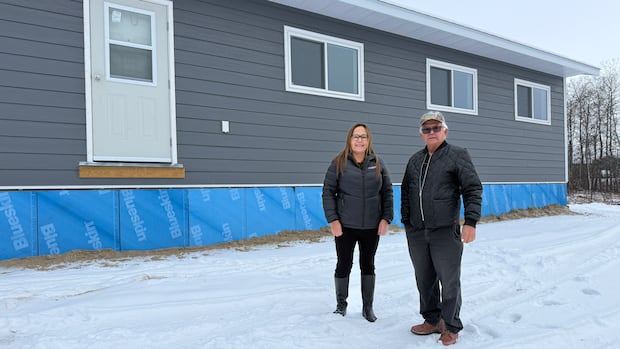
SaskatchewanThe Lac La Ronge Indian Band in northern Saskatchewan has begun replacing homes lost in June 2025 when the Pisew wildfire ripped through its settlements. Ready-to-move homes are coming from three Saskatchewan suppliers.’Communities can save their own communities,’ says Chief Tammy Cook-SearsonLisa Risom · CBC News · Posted: Nov 28, 2025 6:00 AM EST | Last Updated: November 28Listen to this articleEstimated 4 minutesThe audio version of this article is generated by text-to-speech, a technology based on artificial intelligence.Chief Tammy Cook-Searson stands with Miles Ratt at the site of Ratt’s new ready-to-move home. (Lisa Risom/CBC)Miles Ratt, 74, was living with his wife, his granddaughter and three great-grandchildren when the Pisew wildfire forced the evacuation of Sucker River, their home community in northern Saskatchewan.He was far away at the time, trying to save his trapper’s cabin from the flames. His family’s home burned to the ground, leaving six people with nowhere to live.Ratt is among the first people to receive one of the ready-to-move replacement homes purchased by Lac La Ronge Indian Band as the community rebuilds, with support from Indigenous Services Canada.The five-bedroom bungalow was recently placed on a new foundation near the site of their former home.“They always come through, helping us. That’s the good thing about this band. They are always there for us,” Ratt said.WATCH | Drone video shows cleanup in Denare Beach 5 months after wildfire:Drone video shows cleanup in Denare Beach, Sask., nearly 5 months after destructive wildfireA wildfire tore through the northern community of Denare Beach, Sask., at the beginning of June 2025, wiping out 230 homes. Nearly five months later, the rubble and ash is mostly cleared away and rebuilding has begun.He still feels the loss, and lives with memories of what happened back in June.“I had lots of stuff in there, pictures and sentimental memories, and they all burned,” Ratt said of his former home.He and his two grandsons did manage to save the cabin, using some of their own equipment as well as pumps and sprinklers supplied by the Saskatchewan Public Safety Agency, he said.But the fire took two quads, two snow machines, two outboard boat motors, a lawn mower and chainsaws, none of which were insured. The band lost 12 homes in Sucker River, eight in Hall Lake, and one near the band office in the town of La Ronge. Two northern businesses, Robertson Trading Post and Rona, were destroyed, as was the wooden Clam Bridge and the Sucker River garbage truck.“We were worried about the school, the clinic, all the homes. Like the fire was really relentless. It just kept coming,” recalled Lac La Ronge Indian Band Chief Tammy Cook-Searson. The band sent buses to Sucker River to help transport people out of the community on June 2. That same day, the provincial public safety agency issued an evacuation notice for La Ronge, Air Ronge and LLRIB. Approximately 15,000 people fled from Wadin Bay, English Bay, Nemeiben Lake, and Eagle Point. The intermittent closure of Highway 2 because of fire north of Weyakwin caused a “bottleneck” of vehicles trying to get south, Cook-Searson said. “Our No. 1 priority is always human life. And then the communities.”She said most of the band members displaced by the wildfires are staying in LLRIB communities with family. The band’s child and family services department has also given up its transitional housing units and some staff accommodations to temporarily house fire casualties, she said.The Clam Bridge has been rebuilt.A house and this wooden bridge at the Clam Bridge settlement in northern Saskatchewan were lost in rapidly spreading wildfires in June 2025. Residents of Sikachu Lake and Clam Bridge were relocated to Hall Lake as a precaution. (Photo provided by Norman Ross)The band’s housing and public works departments are working to clean up the sites of the burned homes, and contractors are preparing new foundations for more than 20 ready-to-move houses purchased from three Saskatchewan suppliers. After the homes are set on foundations, it takes about two months to insulate them and connect utilities. The band aims to have all of the homes replaced by March 31, 2026.Cook-Searson said she would like more local people to be trained in wildfire suppression and setting up sprinkler systems. If more people were allowed to stay behind, they may have been able to save more property, she said.“Communities can save their own communities. If they are trained, have the proper equipment, they can deploy as soon as an emergency comes up or you see a threat coming.”The Lac La Ronge Indian Band is working to rebuild. Foundations are under construction for replacement homes. (Lisa Risom/CBC)ABOUT THE AUTHORLisa Risom has two decades of multimedia journalism experience in northeast Saskatchewan. She joined CBC Prince Albert in 2025.
After the flames: Lac La Ronge Indian Band begins replacement of homes destroyed by wildfire