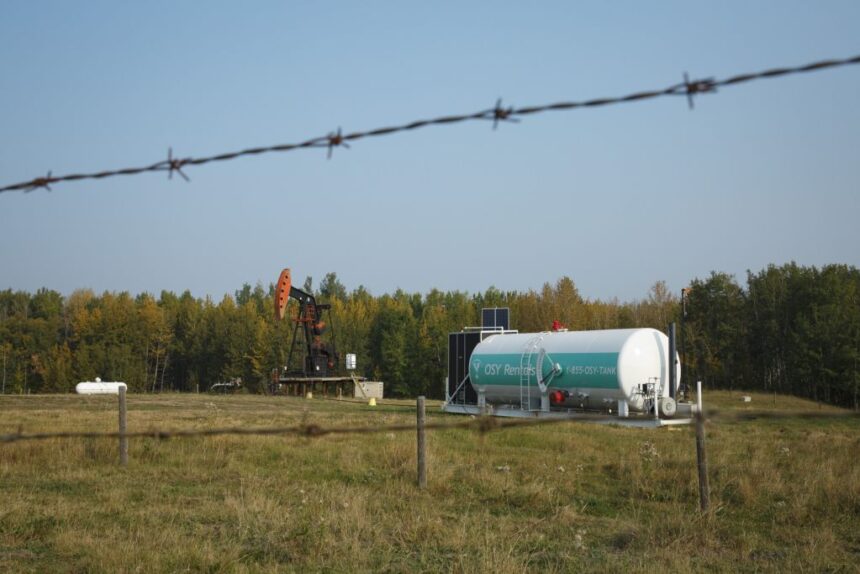
Grand bargain is a phrase that’s being tossed around a lot lately. Nationally, it’s framing the debate around fossil fuel development and emissions reductions — support an industrial carbon tax, get a pipeline! In rural Alberta, however, it’s about the balance between landowner rights and oil and gas exploration. Increasingly in rural Alberta, it’s a fragile balance. It works like this: in Alberta, landowners aren’t allowed to block oil and gas companies from accessing their property to drill there. In exchange, companies must pay the landowner for the loss of that land. And, crucially, if the company stops paying, the government has long promised it will pay on the company’s behalf. But the grand bargain is fraying. Decades of poor regulation have allowed companies without the finances, or the intention of living up to their obligations, to proliferate — snapping up cheap existing wells to pull as much wealth out of them as possible while not paying their due. Many of these wells are either inactive — not pulling anything from the ground (but they might one day … or so the story goes) — or are what’s known as marginal wells, those that are only pumping a relatively small amount. But those wells come at a bargain, so still attract small oil and gas operators looking to get a foot in the door. More than 175,000 inactive and marginal wells dot the landscape, bringing with them their own environmental risks and potential nuisances for farmers and landowners. Old oil and gas wells can languish on the land for years — or decades — with the promise that they might once again be brought into production. Often they are available to be purchased for relatively low prices. Photo: Theresa Tayler / The Narwhal Meanwhile, the Alberta government dishes out millions of dollars each year to cover the unpaid leases for solvent companies. Add in unpaid municipal taxes and cleanup costs that stretch past $100 billion and it helps to explain why rural Albertans are increasingly calling into question the grand bargain that bought their support in the first place. Lost in those grand debates, however, is clarity over just what it is we’re talking about, so let’s dive in. What’s an oil or gas surface lease? It might be easier to think of it as land rent. The oil and gas companies will determine an area where they want to drill, sign an agreement with the landowner setting out the terms of the lease and then fence off the area around a well or facility. The agreement includes the amount to be paid to the landowner for loss of access to that land until the well is decommissioned and then certified as reclaimed. Unlike rent for something like an apartment, where landlords generally choose their tenants, landowners can’t say no to an oil and gas company that wants to set up shop on their land. So, what’s the problem? If the cheques keep coming, the arrangement usually works, assuming there aren’t any leaks, spills or other issues. When the cheques stop coming, you hear about it. Companies in financial distress, or bad actors, often cut costs by halting their lease payments. It’s an easy expense to drop immediately and, as we’ll discuss, there are government backstops for the landowners. Sometimes it’s a company that is struggling financially, but sometimes it’s a company that snaps up a lot of wells for next to nothing and then immediately stops paying the leases. Doesn’t the Alberta Energy Regulator have rules about this? They do. The Alberta Energy Regulator insists it has improved monitoring for bad actors and companies in distress to prevent them from taking over new licences. But it is unclear what information the regulator collects and even more unclear what information it uses. What is clear is the regulations aren’t working and some companies in financial distress are still able to acquire new licences. What happens when an oil and gas company doesn’t pay their lease? Well, it can impact the company’s ability to acquire new licences, but that doesn’t do much to help the landowners with the existing wells on their property. The regulator says it considers unpaid leases in its “holistic assessment” to determine whether a company is on sound financial footing. That can result in restrictions or suspension of operations, but it’s unclear how often that happens. What does happen is landowners can apply to a government board called the Land and Property Rights Tribunal to be reimbursed by the government. It’s part of that grand bargain. If a company fails to pay its leases, the government will cover the entire cost of that lease every month, or year, it’s not paid — a critical component for getting landowner buy-in for oil and gas development. Payouts on behalf of companies in 2024 were up 4,500 per cent since 2010 and the government paid out $30 million last year alone. Albertan landowners who are owed money by delinquent oil and gas companies can apply to be reimbursed by a provincial agency. But some landowners question why their own tax dollars should be used to cover the obligations of private corporations. Photo: Isabella Falsetti Okay, but the Alberta government gets that money back from oil and gas companies, right? In short, no. In 2024, for example, the government had only collected $167,000 — 0.06 per cent. Do oil and gas companies pay municipal taxes? Yes, municipal taxes are property taxes, just like someone pays on their home or business. Those taxes go to local governments where oil and gas companies operate and help pay for things like schools and roads. This is another big issue in rural Alberta, where municipalities are owed approximately $254 million in unpaid taxes, according to Rural Municipalities of Alberta. The organization, which advocates for towns and counties across the provinces, says its members have written off an additional $200 million in debts, meaning it will never be collected. Approximately $100 million of the outstanding amount is owed by 201 companies that are still operating. According to a survey of its member municipalities, many were forced to raise taxes on individuals and other companies to make up the shortfall. Okay, are there consequences if a company doesn’t pay its taxes? Well. According to a ministerial order, the Alberta Energy Regulator is supposed to prevent the transfer of new licences to any company that owes more than $30,000 in unpaid municipal taxes, but there are serious questions about enforcement of that requirement. And while the Municipal Government Act, the legislation that sets out the rules for how municipalities operate in Alberta, does give the power to seize property from delinquent companies, gaps in other legislation and regulations prevent that from happening. In short, municipalities are essentially powerless. More than 175,000 inactive and marginal oil and gas wells can be found throughout Alberta. It will cost tens of billions of dollars to clean them up. Photo: Amber Bracken / The Narwhal So wait, is this on top of the billions of dollars in oil and gas well cleanup fees? Yes.For conventional oil and gas — your traditional oil and gas well (think of a pumpjack sitting in a field) — the regulator estimates it would cost around $37 billion to clean up all of the infrastructure and remediate the land. Some estimates put that figure north of $60 billion. That figure, of course, doesn’t include the oilsands, where the official estimate is around $53 billion.Those estimates are likely low. The regulator’s own internal figures, obtained by the media in 2018, show the problem could exceed $100 billion — $260 billion including the oilsands and pipelines — and the number has been continually revised upward since more accurate monitoring of cleanup costs began. Companies are required to spend a minimum amount of money each year on closing and cleaning up old wells and to pay into the industry-funded Orphan Well Association, which cleans up sites left behind by bankrupt companies. Not everyone fulfills those obligations and can face restrictions on operations if they do so. But they’ve collected security deposits for this, right? RIGHT!? Er. No. Not really. There is the Orphan Well Association, which acts as a sort of collective security deposit. The regulator has also started collecting security deposits from the companies it deems to be on shaky financial footing when approving licence transfers, but the amounts are small. According to its latest liability management report, operators determined to have “less capability” were transferred assets — i.e. they were able to take on wells and more — with $197 million in environmental liabilities. The regulator collected $500,000 in security, or about 0.3 per cent. New companies put down more money to get into the business, according to the same report. With a collective $274 million in liabilities, the regulator collected $25 million in security, or about 10 per cent. When it comes to the oilsands, well. Out of that official $53-billion estimate, the regulator has collected $2.6 billion — about five per cent — with 2025 marking the first year a company was required to start paying yearly amounts for a mine determined to be nearing the end of its life. This year also marked a nearly $5-billion reduction in oilsand liability estimates, although it’s not clear what justifies that dramatic decrease, according to researchers Drew Yewchuk and Martin Olszynski. Recent Posts ‘Balance it out’: First Nations call for protected area as Doug Ford signs Ring of Fire deal The province is funding infrastructure improvements in communities along proposed Ring of Fire roads, but… Breaking down the bills some Alberta oil and gas companies aren’t paying From lease payments owed to landowners to mounting municipal tax bills and more, we break… If you’re angry about the Cowichan decision, lay the blame where it belongs Nov. 28, 2025 12 min. read For more than a century, provincial and federal governments have tried to dodge the issue…
Breaking down the bills some Alberta oil and gas companies arent paying