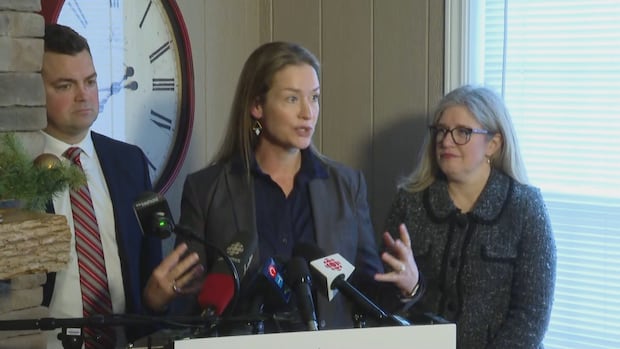
New BrunswickThe province will provide $6.3 million in annual operating costs for a new residential, 50-bed substance use treatment centre in southern New Brunswick. New facility will double province’s capacity for adult, live-in treatment, officials saySam Farley · CBC News · Posted: Dec 01, 2025 3:33 PM EST | Last Updated: 2 hours agoListen to this articleEstimated 3 minutesThe audio version of this article is generated by text-to-speech, a technology based on artificial intelligence.From left, Rob McKee, minister responsible for addictions, Christina Basedow, chief operating officer of Edgewood Health Network Canada, and Premier Susan Holt, were on the Kingston Peninsula Monday to announce a new rehab centre being built along the river. (Silas Brown/CBC)The province will provide $6.3 million in annual operating costs for a new residential, 50-bed substance use treatment centre in southern New Brunswick. It will be located on Carters Point on the Kingston Peninsula, just north of Saint John, and is slated to open in late summer 2026. “Right now in New Brunswick, people suffering from addiction don’t all have access to what they need, when they need it,” said Premier Susan Holt at the announcement on Monday.“It is something we want to address, because at any given time, we have about 200 people on a waitlist for treatment options.”That could mean a wait of up to nine months, Holt said.A plan for a new 50-bed facility was started in 2024 by the previous Blaine Higgs government, but was not finished before the Liberals won the election that fall. WATCH | Building’s ‘natural surroundings’ can help with recovery, says Edgewood Health:Province reveals location for 50-bed addiction treatment centreNew Brunswick is working with Edgewood Health Network to open a recovery centre in the Saint John region for people living with behavioural addictions and substance use. Rob McKee, the minister responsible for addictions, said the “serene” riverside location of the treatment centre — at what is currently Eagles Eye View Cottages — will be “a place of healing, recovery and hope.”He said the centre will follow a therapeutic community model with a group-based approach where residents will live with and support each other through their recovery.Residents will typically stay four to six months, and the centre will likely be able to serve over 100 people each year, he said. McKee said with the addition of this facility, the province is doubling its capacity for adult live-in treatment. He said this centre will have bilingual service and be culturally inclusive.The province is partnering with Edgewood Health Network Canada to establish the centre. Holt said the province’s funding will be for annual operations, while Edgewood will cover the cost for building the space.The centre will be built on an existing camp property on the Kingston Peninsula. (Silas Brown/CBC)“The new therapeutic community that will be built here will ensure that individuals can receive treatment close to home, at no cost to clients,” said Christina Basedow, Edgewood’s chief operating officer.“Our shared goal is simple but powerful — remove barriers to treatment, reduce wait times so that people truly can begin their recovery journey without delay.”Edgewood already operates 11 other facilities across Canada but this would be its first in New Brunswick, Basedow said. She said there will be 24/7 nursing staff on site and Edgewood will contract other provincial health-care providers for additional support for clients. She said the existing cabins on the site helped reduce the need to construct an entirely new building.Pointing to the scenic views from the property, Basedow said people in the program can benefit from being close to natural spaces around them during recovery.“Clients [who] are coming into care and trying to find recovery often talk to us just about how important the environment is and how they’ve come from never being able to feel peace before [to finding] a place of hope,” she said. ABOUT THE AUTHORSam Farley is a Fredericton-based reporter at CBC New Brunswick. Originally from Boston, he is a journalism graduate of the University of King’s College in Halifax. He can be reached at sam.farley@cbc.ca
Province to open 50-bed rehab centre on Kingston Peninsula in summer 2026