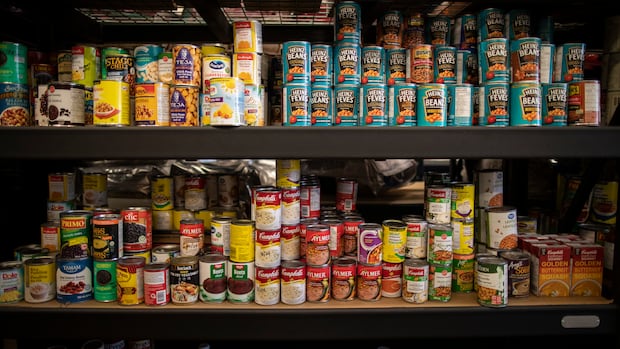
British ColumbiaThe organization representing 111 hunger relief agencies across B.C. says visits for food have increased nine per cent in a year, with more than 1.3 million British Columbians experiencing food insecurity as charities struggle to meet demand.Organization representing 111 hunger relief agencies says visits up 9 per centChad Pawson · CBC News · Posted: Dec 01, 2025 6:58 PM EST | Last Updated: 11 hours agoListen to this articleEstimated 4 minutesThe audio version of this article is generated by text-to-speech, a technology based on artificial intelligence.Groceries, including food and household items, are pictured at the Guru Nanak Food Bank in Delta, B.C., on April 19, 2024. A new report found that overall visits to food banks have increased 79 per cent since 2019. (Ben Nelms/CBC)The organization representing 111 hunger relief agencies across B.C. says visits for food have increased nine per cent in a year, with more than 1.3 million British Columbians experiencing food insecurity as charities struggle to meet demand.In releasing the report on Monday, Dan Huang-Taylor, executive director of Food Banks B.C., described the “relentless” rise in demand at food banks.“For an increasing number of people, the food bank is no longer a temporary supplement during a difficult period, but a necessary, entrenched support lifeline,” he said in a release.Join CBC to help Make the Season Kind for Canadians this winterTo compare year-over-year increases, Food Banks B.C. looked at individual visits in the month of March 2024 to March of this year.In 2024, it recorded 104,017 individuals served at food banks. In 2025 the number was 113,606.The report said 24 per cent of British Columbians are now experiencing food insecurity while more than 10 per cent of the food banks in the province have had to turn away someone seeking food because their shelves were bare.’No wiggle room’In speaking with CBC News before the new report was made public, Tyson Elder, operations manager with Saanich Peninsula Lions Food Bank, said visits have been steadily increasing since the pandemic.“Within two weeks … in the month of August we’d served more than we’d served in July,” he said about a month of the year usually associated with fewer visits.He said the growth in demand has continued into the fall and now is affecting a special type of food aid.“We had to close registrations for our Christmas hampers a week early because we’d already hit our maximum allotted for the Christmas hamper,” he said. “We have no wiggle room.”Food organized at the Share Family & Community Services Food Bank in Port Moody on Friday Nov. 17, 2023. (Justine Boulin/CBC News)Food Banks B.C.’s report found that overall visits have increased 79 per cent since 2019. It also found more food bank users than ever have income from employment, and almost one-third of total food bank visitors are children.Huang-Taylor said the crisis is not something charities should shoulder alone, saying the root problems of food insecurity needs to be addressed.”Many charitable organizations, particularly in rural communities, are facing an existential crisis,” he wrote in the foreward to the report.”We hope that our policy recommendations … will advance our mission of alleviating hunger today and preventing hunger tomorrow, lessening the burden on our sector before it is too late.”The recommendations include having the province strengthen local food systems and infrastructure, ensure stable and multi-year funding for food banks, and find ways to improve household incomes.Both mandate letters for the Ministry for Social Development and Poverty Reduction and Agriculture and Food have directions to address this issue.This fall Education Minister Lisa Beare said 90 per cent of schools in B.C. are operating school food programs since the province introduced an initiative called Feeding Futures.B.C.’s 2024 Poverty Reduction Strategy says the province has increased the B.C. Family Benefit. It is also developing affordable rental housing for families, independent seniors and individuals through the Community Housing Fund, and increasing minimum wage and indexing increases to inflation, among other initiatives.On June 1, 2025, B.C.’s general minimum wage increased from $17.40 to $17.85 per hour, a 2.6 per cent increase.CBC B.C. is hosting its annual Make the Season Kind campaign in support of Food Banks in B.C. on Friday, Dec. 5, featuring a day full of special programming. Anyone wishing to make a donation as part of the campaign can go to cbc.ca/kindbc, where a drop-down menu will direct your donation to any of the 111 food banks that are part of Food Banks B.C.With files from Rachel Adams
New report says entrenched food bank use in B.C. is unsustainable