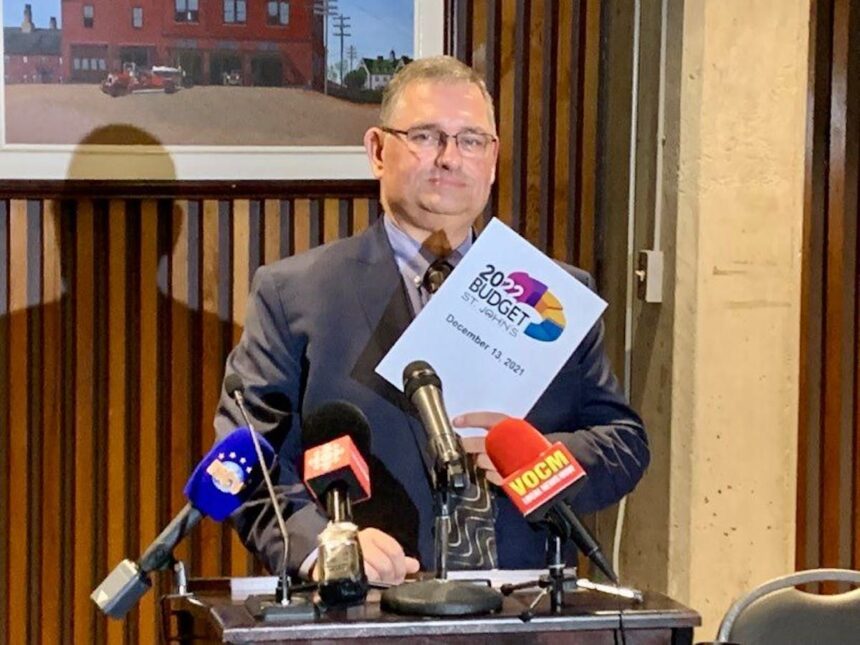
Caught between rising costs and increased demand for programs and services, deputy mayor Ron Ellsworth says “We have some big expenses coming down the road”Published Dec 02, 20256 minute readCoun. Ron Ellsworth delivered the City of St. John’s Budget 2022 Monday, Dec. 13, during council’s weekly meeting at St. John’s City Hall. – Rosie MullaleyArticle contentWith the annual municipal budget scheduled to be presented in just two weeks, the City of St. John’s has found itself in a bit of a challenging position.THIS CONTENT IS RESERVED FOR SUBSCRIBERS ONLY.Subscribe now to access this story and more:Unlimited access to the website and appExclusive access to premium content, newsletters and podcastsFull access to the e-Edition app, an electronic replica of the print edition that you can share, download and comment onEnjoy insights and behind-the-scenes analysis from our award-winning journalistsSupport local journalists and the next generation of journalistsSUBSCRIBE TO UNLOCK MORE ARTICLES.Subscribe or sign in to your account to continue your reading experience.Unlimited access to the website and appExclusive access to premium content, newsletters and podcastsFull access to the e-Edition app, an electronic replica of the print edition that you can share, download and comment onEnjoy insights and behind-the-scenes analysis from our award-winning journalistsSupport local journalists and the next generation of journalistsRegister to unlock more articles.Create an account or sign in to continue your reading experience.Access additional stories every monthShare your thoughts and join the conversation in our commenting communityGet email updates from your favourite authorsSign In or Create an AccountorArticle contentKnowing the municipality is caught in a tight squeeze between rising costs and increased expectations, some St. John’s residents have grown fearful of a potential tax increase and have already started stashing away extra cash, as online rumours have fuelled speculation that a tax increase in the neighbourhood of eight per cent could be in the cards for 2026.Article contentArticle contentArticle contentWhile Deputy Mayor Ron Ellsworth says council hasn’t yet decided if a mill rate increase is to be expected when the budget is tabled on Dec. 15, he says this year’s city budget is likely to reflect these mounting municipal pressures.Article content“I know we get criticized for not caring and not being in touch, and I appreciate those comments,” Ellsworth told The Telegram.Article content“Our finance department, our individual departments, and our staff who are assigned to look after budgets, they work very hard to manage their budgets, be creative and find ways to maximize the dollars. Every dollar spent or any increase is evaluated and looked at. Article content“Council started the budget process in May and it’s not something we take lightly. We do have a strong lens on how it impacts our taxpayers. We are very conscientious about the balance of increased revenue versus impacts on services and programs. We work very hard to try to balance that out.”Article contentArticle content‘We have mandatory components we have to provide’Article content St. John’s City Council will deliver its 2026 budget on December 15 at St. John’s City Hall. Photo by Cameron Kilfoy /The TelegramArticle contentArticle contentCreating a city budget is no easy task. Article contentIt is a legal requirement for municipalities in the province to present a balanced budget as per the Municipalities Act of 1999. Article contentBeyond simply balancing the books, the rising costs of infrastructure, construction materials, diesel fuel and electricity continue to eat away at the city’s bottom line, all as demand for increased supports and services continues to soar, leaving Ellsworth and council with the near-impossible task of separating the municipality’s ‘needs’ from its ‘wants’.Article content“With any budget, we have mandatory components we have to provide to the community,” Ellsworth explained.Article content“Those are things like snow clearing, clean drinking water, wastewater, garbage collection, recycling, recreation facilities and then some. All of those things are mandatory things that we don’t have any control over. Then you look at the things you do to make your community a place people want to live, and can enjoy living to enable a quality of life.”Article contentEllsworth, who is entering his 13th ‘budget season’ with the City of St. John’s, says the demand for new and enhanced community services is as strong as ever Article contentWhile he pointed to recent Metrobus upgrades, increased sidewalk snow clearing and improved recreation facilities as meaningful programs and services that serve the community well, these services come at a cost, which presents a tricky proposition when trying to justify adding additional programs and services.Article content “Generally, I don’t think any of our residents want us reducing the programs and services that we have,” he said.Article content“If you’re not somebody who uses the recreation facilities, you might want to cut that back. If you’re not somebody who uses the Loop to go skating with their family, you might say to reduce the number of hours and save some money. I get that. Article content“Every time we have to ask taxpayers for additional funds, for a portion of our taxpayers, that becomes very difficult and we understand that. It’s a balance of trying to balance that out while trying to balance out the programs and services we’re trying to provide to all of our consumers so that they have an opportunity to avail of programs and services at a cost that allows them to.”Article contentArticle content‘I’ve never been a fan of kicking the can down the road’Article content With more Metrobus expenditures expected in 2026 as a part of a multi-year improvement plan, it may be an expensive year for the City of St. John’s. Photo by File photoArticle contentReading between the lines, 2026 could be an expensive year for the City of St. John’s. Article contentWith a Metrobus multi-year improvement plan and other pricey capital projects on the books for the year ahead, Ellsworth says the city is doing what it can to mitigate those expenses by reducing its debt.Article content“Any small surpluses we have, we use to either pay down debt or apply to capital items so we don’t have to borrow,” he said.Article content“Our debt servicing ratio is less than 14 per cent, and that’s crucial because we have some big expenses coming down the road. The waste treatment plant on Southside Road, in order to meet federal regulatory requirements, that’s going to be roughly a $500 million project.” Article contentBeyond reducing its debt, Ellsworth explained that the city has already significantly reduced its workforce in recent years. While payroll costs can be a significant municipal expense, the deputy mayor admits it would be a tough area to make further cuts, especially amidst high demand for programs and services. Article contentArticle content“Back in 2016 and 2017, we went through a deep dive analysis of our programs and services and staffing,” Ellsworth explained.Article content“At that point in time, we removed almost 80 full-time equivalent positions, we changed over operational pieces and we’re still operating under that review. Everything you go to add back in has to be validated. There has to be a reason for it. If we’re adding staff, it has to be validated. For example, when we added the Paul Reynolds, we needed more staff for those programs and services. We added a new community centre in Kenmount Terrace and the new Mews Centre with more programs and services.”Article contentEven amid an affordability crisis, Ellsworth admits it’s hard for the municipality to consider not spending money, as penny-pinching has a way to come back and bite governments that have deferred critical spending.Article content“I’ve never been a fan of kicking the can down the road for it to be somebody else’s problem and we see that happening provincially and federally and the damage that’s doing,” Ellsworth said.Article content“We have assets and infrastructure that we have to manage… For example, two years ago, approximately 60 per cent of our snow-clearing equipment was down because of the age of the equipment, because previous councils decided not to invest in the equipment, yet they were making commitments on snow clearing and timelines for snow clearing without putting the infrastructure in place to manage it.”Article contentWhile expenses may be mounting, Ellsworth says he and his colleagues haven’t lost focus on keeping its programs accessible and affordable.Article content“That is a huge component in our community,” he said.Article content“Our summer camps, for a lot of families who can’t get space elsewhere, this becomes a lifeline for them when their kids are out of school. Then we have our seniors’ programs, where we try to keep them very manageable and affordable for our seniors, so they have an opportunity to partake in programs and services in our community with offset costs from the city. All those things come into play.” Article contentArticle content‘Go in and look at your assessed value’Article content There were no residential mill rate increases during last year’s budget presentation. As of today, the residential mill rate in St. John’s sits at 9.1. Photo by Cameron Kilfoy /The TelegramArticle contentWhile Ellsworth wouldn’t confirm whether or not the city’s mounting pressures will amount to any residential or commercial mill rate increases in two weeks, he suggests that residents who are worried about their 2026 tax bills can get a better idea of their upcoming tax obligation by looking at their home’s assessed value for the year ahead. Article content“Council has not made any final decisions at this point,” Ellsworth said of a possible mill rate increase.Article content“While some are talking about an eight per cent tax increase, it’s not that easy. We have 50,000 residential addresses. Each property owner needs to go and look at how it will impact them… Go in and look at your assessed value for 2025 and your assessed value for 2026, multiply out your current mill rate, and you’ll have an idea. Looking at individual tax components is what you really need to do.”Article contentArticle contentHowever, even if mill rates remain the same, that doesn’t necessarily mean that residents’ tax bills are guaranteed to remain the same for 2026.Article contentWith an ongoing housing crisis continuing to drive up housing prices, Ellsworth says there will be residents who will be receiving a larger tax bill in 2026 as a result of an increase in their property’s value.Article content“Assessed values are all market-driven,” he said.Article content“It’s what properties in your geographic area are selling for. It’s not necessarily about your individual property or any improvements you may have made, but it could be a factor. Geographically, assessments are looked at based on what’s happening in real estate in your neighbourhood.” Article content
Should St. Johns residents expect a tax increase in 2026?