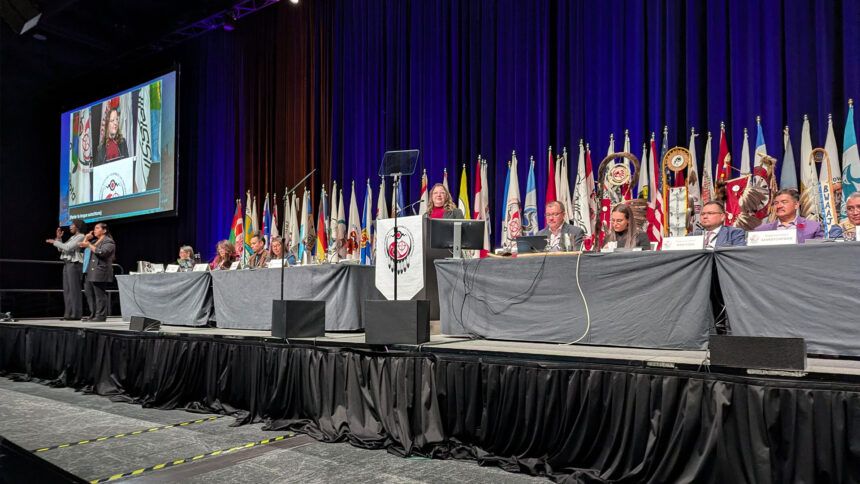
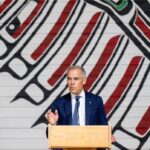
Opening the 2025 edition of the Assembly of First Nations Special Chiefs Assembly in Ottawa this morning, National Chief Cindy Woodhouse Nepinak reflected on a year marked by struggle. She saluted Ontario chiefs for fighting against the Progressive Conservative government’s Bill 5, Protect Ontario by Unleashing our Economy Act, 2025, which aims to deregulate mining, resource, and infrastructure development. At the same time, she noted many of those chiefs were fighting a second front against wildfires encroaching upon their Nations. “Those communities demonstrated that First Nations can be counted on during difficult times,” she said. Woodhouse Nepinak also saluted veterans in the room, noting First Nations have also supported Canada during the most challenging moments in its history. “Right from the creation of this country, from the War of 1812, to World Wars, to Quebec referendums that try to split this country apart, Afghanistan, the pandemic,” she said, “and now it’s another one of those times. To the south, Canada’s under threat from Trump.” The National Chief characterized the moment as one of pressure from many sources. Beyond the challenge of Trump’s policies, she pointed to the increasing devastation of the effects of climate change, along with rekindled talk of separation from politicians in both Quebec and Alberta. But, she also argued that First Nations are key players in resolving all these circumstances. “First Nations are leading the way,” she argued. “We’re standing up for the environment to protect all Canadians, not just First Nations. Alberta and Quebec Chiefs have been the most vocal opponents of provincial separatists. And First Nations have always been shoulder-to-shoulder with Canadians against Trump’s illegal tariffs.” Woodhouse Nepinak characterized this moment as a “critical and uncertain time” in the relationship between First Nations and the Canadian state. “Our rights are being threatened in new ways,” she said, “but we are not afraid. Far from it. First Nations across this country are stronger than we have ever been. Our ancestors have fought on this land to protect our rights, as peoples and as nations. When Parliament and our provincial legislatures have dishonoured the Crown, we have fought in the colonial courts and we’ve won, over and over again,” she said. “Sadly, First Nations continue to be forced to keep fighting in court. And rightfully, we have kept winning. Nothing has been given to us and we are not going back.” National Chief lauds $23 billion settlement Taking a moment to celebrate a major accomplishment, the National Chief brought up the $23-billion settlement negotiated in 2023 with Justin Trudeau’s government to resolve discrimination in the First Nations Child and Family Services Program and Jordan’s Principle. “In July,” she said, “we announced approximately 40,000 claims have been received since we opened the application portal in March. And shortly after, we confirmed that the first payments have started to roll. So today we’re announcing that over 88,000 claims are in and more than $265 million has been distributed to claimants.” However, there was more defiance than celebration in Woodhouse Nepinak’s remarks. She discussed the federal government’s decision to push Bill C-5, the One Canadian Economy Act, through parliament in 20 days without any of the consultation with First Nations Prime Minister Carney promised to make central to his relationship with Indigenous peoples. The National Chief said she’d hoped the budget would soften some of the blow of C-5, but was ultimately disappointed by it. “Last month’s budget was an opportunity to demonstrate through deeds that First Nations’ voices matter to this new administration,” she contended. “Sadly, the 2025 federal budget represents a significant setback.” While she applauded the budget measures to expand First Nations finance authority and protect the $47.8 billion the AFN negotiated with the federal government last year for the child and family welfare system, she decried $2-3 billion cuts to Indigenous Services Canada. “We know that there’s a problem,” she noted, “especially when provincial transfers for health, for education, and social services have gone up by five per cent. Sadly, instead of closing the gap between First Nations and Canadians, this budget makes things more difficult.” The Carney government introduced its budget on the anniversary of the death of Justice Murray Sinclair, respected jurist and member of the Truth and Reconciliation Commission. Quoting Sinclair, Woodhouse Nepinak said, “Education got us into this mess and education will get us out.” While First Nations are the youngest demographic in Canada, she noted half of First Nations schools are overcrowded, and 50 per cent of education needs go unfunded. “For the next generation,” she said, “education must be a tool that empowers First Nations youth and uplifts our children. More than half of the [Truth and Reconciliation] Commission’s calls to action were focused on education. To mark the 10th anniversary of the Commission’s final report this month, we call on Canada to make generational budget investments in First Nations education, training, and languages because Canada talked a lot about generational investments in the lead-up to the budget.” Equally pressing is the need to reform policing and justice on reserve. “Positive change to our justice system […] means revitalizing First Nations laws and legal systems,” she said. “It means reforming the Canadian criminal justice system. And it means prioritizing First Nations policing as an essential service in this country, just like it is everywhere else.” Woodhouse Nepinak also praised efforts to “finally end the Indian Act’s discriminatory second-generation cutoff.” The goal, she said, was to remove Ottawa’s power determine who is an “Indian.” “Our people are entitled to belong to our people,” she said, “and they are entitled to rights according to First Nation laws. First Nations must be in control of our own membership. We know who our ancestors are.” The more successful First Nations become, and the more they assert their rights, said the National Chief, the more hate rises against them, particularly women. It was cause for celebration, she said, that Manitoba elected an NDP government led by a First Nations Premier, Wab Kinew. It was also cause for celebration that he appointed two Indigenous cabinet ministers—Nahanni Fontaine and Bernadette Smith. However, she noted, both Fontaine’s and Smith’s constituency offices have recently been firebombed. “Vandalism and this kind of violence against First Nations is just not acceptable,” she stressed. “So we look forward to First Nations testifying in Parliament over the coming months on proposed hate crime legislation. It’s got to stop, including towards residential school survivors.” Exclusion of First Nations from MOU discussions concerning Finally, she turned toward the Memorandum of Understanding (MOU) that Prime Minister Carney signed last week with Alberta Premier Danielle Smith to create a bitumen pipeline from Alberta to the BC coast. The MOU has provoked vocal outrage from a variety of First Nations leaders, including the Union of B.C. Indian Chiefs. The deal was so controversial within Carney’s own cabinet that Greenpeace–activist–turned–former Environment Minister Stephen Guilbault resigned from cabinet in protest. “We see many First Nations excluded from these discussions, particularly on the Pacific coast,” said Woodhouse Nepinak. “The truth is that Canada can create all the MOUs, project offices, advisory groups that they want, but Chiefs are united. When it comes to approving large national projects on First Nations’ lands, there will not be getting-around rights holders.” Perhaps reacting to news that the Metis Settlements of Alberta has signaled interest in purchasing a stake in the eventual pipeline, the National Chief dismissed their capacity to make claims over the land the pipeline will occupy. “Another reason outstanding First Nations’ treaty rights must be reconciled before others,” she said, “[is that] Métis rights do not include rights over First Nations’ lands, territories and resources. First Nations, with the exception of the Inuit, are the only true landowners of these traditional territories. We have governed these lands since time immemorial.” Reaching the end of her speech, the National Chief warned a long climb lay ahead for all parties involved in all these struggles. “Everyone in this room, every parliamentarian that’s here, every province that’s also listening, and every Canadian,” she said. “No matter how much federal and provincial governments try to ignore and avoid First Nations’ rights, we must come back tomorrow and keep doing the work for our people.” She closed by again invoking the memory of Murray Sinclair. “In Justice Sinclair’s name, we must keep imagining a world where all of us have medicines, food, and a safe place to live. Not just a few, but truly all of us.” Tags: AFN, AFN National Chief Cindy Woodhouse Nepinak, agreements, Alberta, Assembly of First Nations Special Chiefs Assembly, MOU, Ottawa, Pipeline, Quebec, separatism, settlement, Trump Continue Reading
National Chief reflects on difficult year on first day of the AFN Special Chiefs assembly

Leave a Comment