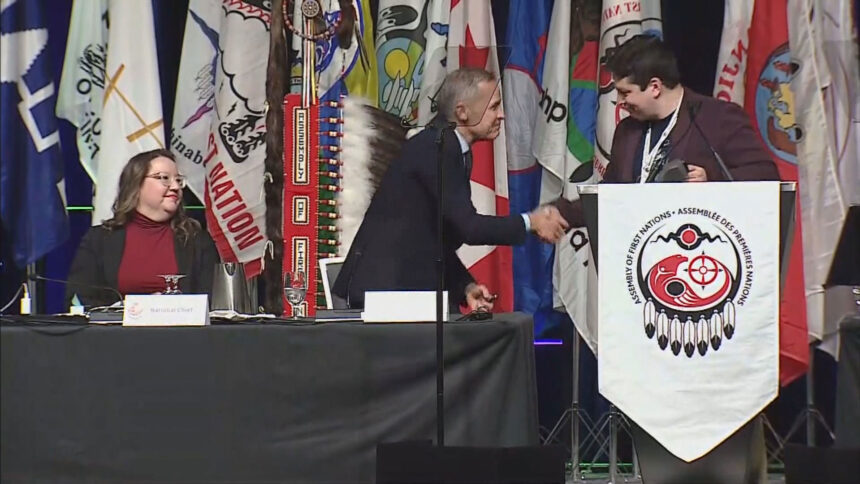
In addressing the Assembly of First Nations’ Special Chiefs Assembly in Ottawa this afternoon, Prime Minister Mark Carney stressed principles of construction, trust, and partnership with First Nations. “Canada’s new government is committed to working directly with you to build stronger nation-to-nation relationships,” he told the assembled chiefs. “It’s only by working together that we can build stronger, more prosperous First Nations communities and a stronger, more resilient Canada. In a more dangerous and divided world, Canada is choosing to build from major national projects to local infrastructure, including in housing and water.” Carney framed the need for building as a positive endeavour, suggesting that rather being defined by opposition, First Nations and the federal government should consider what they can accomplish together. This process of building, he said, “must be informed by and can only move forward with First Nations.” In imagining future First Nations partnerships with Ottawa, Carney said they must be founded on common understanding. “Indigenous equity and participation [are] a priority when it comes to building our country,” he said. “First Nations leadership, prosperity and opportunity must be foundational.” The prime minister said he intended to build partnerships between his government and First Nations based on engagement, and pointed to the three summits he held during the summer with First Nations, Métis, and Inuit leadership. The first summit, with First Nations chiefs, was held in July in the Canadian Museum of History, and was a contentious event, during which some chiefs stressed the meeting did not constitute consultation. Carney alluded to the criticisms aired during that meeting. “During this summit,” he told the AFN, “I clearly heard that this partnership must include respect for our determination and continued commitment to the Declaration of the United Nations on the Rights of Indigenous Peoples, as well as real and clear free consent.” Carney said that support for First Nations and other Indigenous communities was now the law, as a consequence of part of the controversial Bill C-5, the One Canadian Economy Act. Carney’s government rushed through the passage of Bill C-5 in late June amid accusations of a lack of consultation with Indigenous rightsholders. In his speech, Carney argued the Building Canada Act portion of C-5 was a guarantee for First Peoples. “Under the Building Canada Act,” he said, “for a project to be in Canada’s national interest, it must strengthen our country’s autonomy, resilience and security. It must contribute to clean growth and align with our climate change objectives. And it must, by law, advance the interests of Indigenous Peoples.” Noting the act created the Major Projects Office (MPO), and with it the guiding Indigenous Advisory Council, Carney said the MPO has pursued regional engagements in order to encourage First Nations’ involvement and partnership. “But let me be absolutely clear,” he said. “None of this engagement counts as consultation. That process of consultation only starts once projects are referred as possibilities to the Major Projects Office. Under the legislation, there must be consultation, consistent with free, prior and informed consent, before a project can be designated in Canada’s national interest. And none have been so far.” “But even once one is designated, there must be additional consultations on the conditions necessary for that project to succeed. These conditions, these issues, would naturally include requirements for Indigenous ownership, Indigenous economic benefits and environmental protections.” Carney said he intended his projects to create thousands of careers and foster prosperity, stability, and security in First Nations by creating long-term wealth “through equitable and integrated participation.” “These projects have the potential to act as a source of autonomous and reliable income for communities,” he argued, “a source of wealth necessary for the realization of new priorities. To empower First Nations to own and lead major projects, our government has doubled the Indigenous Loan Guarantee Program to $10 billion.” He introduced the newly created agency Build Canada Homes, which will partner with First Nations to “supercharge” home-building, and claimed the agency would use “new factory technologies that cut building times by 50 per cent, reduce costs by 20 per cent and lower emissions by 20 per cent.” Carney’s aim for Build Canada Homes, he said, was to incorporate Indigenous-led projects with innovative construction methods. “It’s our vision that Build Canada Homes will incorporate Indigenous housing providers’ knowledge and their leadership in these housing projects,” he said. “In addition, I asked the Minister of Indigenous Services to collaborate with you over the next year to find a better way to meet your needs in housing, especially in the reserve. “We want to build housing where First Nations families live. And to support the around two-thirds of First Nations peoples that live off-reserve, we have committed $2.8 billion in Budget 2025 for off-reserve urban, rural and northern Indigenous housing. And we confirmed $1.7 billion to build on-reserve housing.” Calling clean water “foundational,” Carney took a moment to celebrate the Trudeau Liberal government’s success in lifting 85 per cent of on-reserve drinking water advisories, and said his government was committed to ending the remaining 38 boil-water advisories through a $2.3-billion budget allocation. Carney added he has asked Indigenous Services Minister Mandy Gull-Masty to introduce legislation guaranteeing clean water on reserve in Spring of 2026. The Trudeau government’s Bill C-61, the First Nations Clean Water Act, was abandoned when Justin Trudeau stepped down as prime minister earlier in the year. Additionally, Carney promised to host a joint federal-provincial-territorial-First Nations meeting early in the new year, on which, he said, First Nations Chiefs “will set the agenda.” He stressed that ensuring coordination on ending boil-water advisories would be a key item for discussion. Another subject the prime minister promised to reform was child and family services, which he said would also be overseen by Minister Gull-Masty. “Our approach to child welfare will be First Nations-led, community-led, and it will be supported by significant additional funding,” he said. All of these projects, Carney argued, will only succeed if they are based on trust. He acknowledged trust is never a given, and could only be generated through consistent action over time. Addressing his recent budget, whose austerity measures prompted criticism from the AFN National Chief as well as some Regional Chiefs, Carney argued that cuts will not affect basic needs. “We’ve protected the essential programs of Indigenous Services Canada and the work of Crown-Indigenous Relations,” he said. “Core services, such as health care, community safety, child and family services, education, and mental wellness, all of these will continue to progress.” Carney trumpeted the previous Liberal government’s 400 per cent increase in investment in Indigenous communities in the past decade. However, he added, “We recognize, that while outcomes have in many cases improved, there has not been as much progress as any of us would want. And certainly not enough progress, especially for the children who deserve it the most.” The answer, he argued, was to more accurately focus, scale, and optimize investments in Indigenous communities. “And that should mean more First Nations-led solutions,” he said, “greater funding directly to rights holders, and better measurement of outcomes.” Carney stressed Ottawa has not abandoned key documents about Indigenous realities and rights: he promised his government would move forward on the calls for Action in the Final Report of the Truth and Reconciliation Commission, the calls for justice in the National Inquiry into Missing and Murdered Indigenous Women and Girls, and the UN Declaration on the Rights of Indigenous Peoples. The Chiefs who rose to ask questions—selected to represent various regions of Canada—identified further points of contention. They included Neskantaga Chief Gary Quisess, who noted his Nation has not had clean drinking water in over 30 years. Chief Lisa Robinson of Wolf Lake First Nation in Quebec talked about how federal red tape created institutional failure for that community attempting to establish its land base. Chief Tamara Young, from Pictou Landing First Nation, noted, “What continues to hold us back are the same structural barriers, such as federal funding frameworks built on provincial standards, siloed federal decision-making that slows nation-to-nation progress, and critically, provincial government that does not work with local governments as equal partners in areas that directly affect our rights and our children.” Prime Minister Carney called the 30-year boil-water advisory in Neskantaga, “a failure.” “You know it’s a failure,” he told Quisess. “You’ve lived through it most of your adult life. It’s a failure of execution, and this is one of the things that this government is very focused on: setting objectives, being clear about the objectives, and determining why things have not worked as well as they should, given the investments that have been made, at least in terms of overall amounts of money. All of these [drinking water advisories] should have been lifted. We have to change how we’re delivering, we have to change the partnership, which is true in water, it is true in community policing as well.” Carney promised to follow up directly with Robinson on her community’s land base, saying “It’s caught in another intervention, which is the federal government working in silence, when we should be working together as one.” Responding to other questions, the prime minister said, “we are in the process of reviewing how and why we’re not as effective as we should be.” The most loaded question came from BC Regional Chief Terry Teegee, who reminded the prime minister, “our title is not a policy issue.” Teegee noted that this morning, the Assembly of First Nations that Carney was addressing voted unanimously to reject the proposed bitumen pipeline promised in the Memorandum of Understanding that Carney recently signed with Alberta Premier Danielle Smith. “Do you respect the direction of the rights and title holders?” Teegee asked. “And what concrete measures will your government implement to ensure that First Nations have true decision-making authority, as stated in the United Nations Declaration Act, including free, prior and informed consent?” In response, Carney noted the MOU with Alberta touched on a variety of different subjects, ranging from issues like nuclear power to artificial intelligence. However, he added, “If any of those issues, and many of them do, touch Treaty 6, 7, 8 rights holders, other rights holders in Alberta, of course, that consultation has to happen.” In response to Teegee’s challenge to Carney to meet with the BC Chiefs as soon as possible, Carney agreed. “I look forward to the opportunity to meet with the leadership of the coastal First Nations and as many others as I can,” he said. The address ended with mostly applause, though there was also a handful of boos, and some shouting from chiefs who were unable to address the prime minister in the time allotted. Continue Reading
Carneys address to AFN stresses building, trust, and First Nations partnership


Leave a Comment