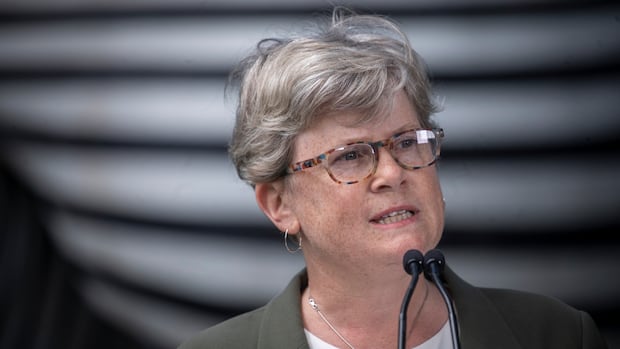
British ColumbiaBritish Columbia’s overdose-prevention safer supply program will require a witness when a user takes their drugs. Government says moving to witnessed model of safer supply drug consumption will prevent diversionAkshay Kulkarni · CBC News · Posted: Dec 02, 2025 10:51 PM EST | Last Updated: 6 hours agoListen to this articleEstimated 4 minutesThe audio version of this article is generated by text-to-speech, a technology based on artificial intelligence.B.C. Health Minister Josie Osborne says patients that are part of the prescribed alternatives program must now take their medication under the supervision of health professionals, such as pharmacists or nurses, effective Dec. 30. (Ben Nelms/CBC)British Columbia’s overdose-prevention safer supply program will require a user to have a witness present when using drugs in an effort to stop the pills from being sold on the streets. The province first signalled changes to the program in February, which at the time included new patients. As of Dec. 30, everyone in the province receiving a prescribed safer supply will be asked to have their consumption witnessed by a medical professional or pharmacist.The move to end take-home safer supply came after leaked internal RCMP slides revealed a “significant proportion” of prescribed opioids were being diverted and trafficked in B.C.WATCH | Take-home safer supply program ended:B.C. ends practice of take-home safer supply drugsB.C. Health Minister Josie Osborne announced that people who rely on prescription opioids must now take those safer supply drugs under the supervision of a pharmacist. It comes after revelations the drugs were being diverted into the hands of organized criminals. As Katie DeRosa reports, critics say the move is long overdue.Health Minister Josie Osborne says the new guidelines would help ensure the prescribed alternatives wind up in the hands of those who need them.”We know that prescribed alternatives are a really important way of separating people from the illicit drug supply,” she told a Tuesday news conference.”This is about ensuring that people stay alive so that they can be connected to care and treatment.”Hydromorphone, a type of opioid, is among the drugs prescribed as part of the program in B.C. (Ashley Burke/CBC)The government said changes include “limited exemptions to witnessed dosing” for patients in “exceptional circumstances” such as living in communities with limited resources.Osborne said one such situation might involve those living in rural communities, where pharmacies might be not open seven days a week. Other situations might involve people who work unusual hours, she said. “But we can’t let those pharmaceutical alternatives get into the wrong hands. And that’s why we’re taking this action, moving into a witnessed consumption model,” she said.WATCH | Safe supply program moves to witnessed-only model:B.C. to require witnesses when people access safe supply drugsThe province is adding further restrictions to a program providing a safe supply of illicit drugs, requiring all patients to take prescription opioids under the supervision of a health professional. As Katie DeRosa reports, one addictions doctor worries politics are getting in the way of medical decisions.Number of patients decreasesThe Health Ministry said in a statement that the prescribed safer supply program saw a peak of 4,500 patients in March 2023, and that number had now dropped to 2,200 clients as of July this year.It was launched in March 2020, at the height of the COVID-19 pandemic, and the ministry did an about-face on the program earlier this year.That was when take-home safer supply was ended following the leaked police presentation, which revealed some pharmacies were alleged to be “offering incentives to clients” to receive prescriptions, with more than 60 pharmacies identified.WATCH | Leaked police presentation reveals drug diversion:Leaked document shows B.C. investigating trafficking of prescription opioidsLeaked Ministry of Health documents released by the B.C. Conservatives show that government and law enforcement officials are aware that prescription opioids are being trafficked provincially, nationally and internationally. Katie DeRosa reports. Osborne said a police investigation into safer supply diversion remains underway, though she declined to share further details.Claire Rattée, the Conservative MLA for Skeena and Official Opposition critic for mental health and addictions, reiterated the Tories’ stance that taxpayer money shouldn’t be used for safer supply programs.Rattée, who herself sought drug treatment as a youth, said that if the government was going to provide her drugs for free, she wouldn’t be an MLA right now.Claire Rattée, the Conservative MLA for Skeena and Official Opposition critic for mental health and addictions, said taxpayers shouldn’t be funding the safer supply program. (Mike McArthur/CBC)”I think I had to hit my rock bottom to make the decision and the determination that I needed to go to treatment, that I needed to turn my life around,” she said.”And if the government was consistently assisting me to continue down that destructive road, I can’t possibly imagine where I would be right now.”Osborne has maintained that the prescribed safer supply program saves lives, pointing to a peer-reviewed study that showed prescribed medical-grade opioids dramatically reduced the rates of deaths and overdoses for drug users living in B.C.Still, the move to a witnessed-only consumption model has led to concerns among doctors who work with drug users.Dr. Ryan Herriot, co-founder of Doctors for Safer Drug Policy and a family and addictions physician in Victoria, said the move constituted “egregious political interference in medical decision-making.””It doesn’t really support people getting on with their lives, you know, being basically chained to a pharmacy all day long,” he said.”If we want to help people basically break up with their drug dealer, avoid the unregulated supply, not overdose overnight, then this is … not helpful.”ABOUT THE AUTHORAkshay Kulkarni is an award-winning journalist who has worked at CBC British Columbia since 2021. Based in Vancouver, he is most interested in data-driven stories. You can email him at akshay.kulkarni@cbc.ca.With files from Katie DeRosa and The Canadian Press
B.C. to require witnesses for those who are prescribed safer supply of drugs