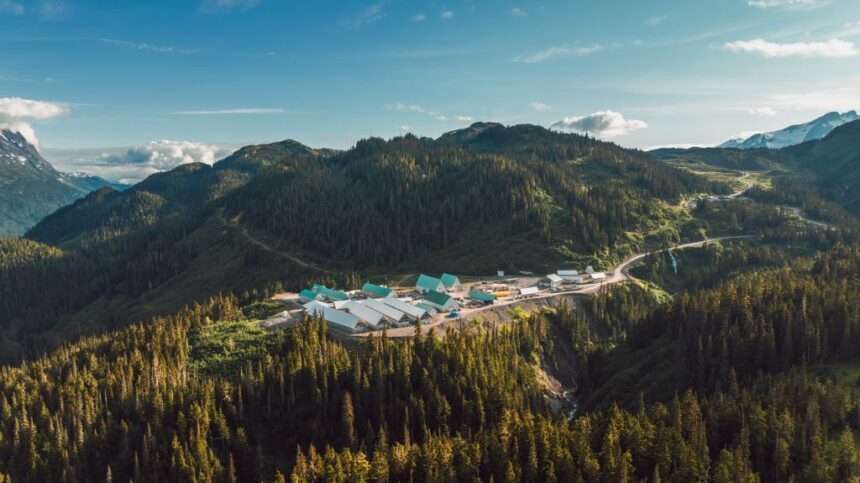
Skeena Resources is seeking to develop an old underground mine into an open-pit gold and silver mine in northern British Columbia and the plans have some Tahltan community members and experts concerned about water contamination. The revitalized Eskay Creek mine in Tahltan territory is expected to increase metals concentrations in some nearby streams above provincial guidelines. In addition to worries raised by scientists and the community, Alaskan Tribes launched a court challenge against B.C. in November, demanding to be consulted since they could potentially be impacted downstream. The mine, just under 300 kilometres northwest of Smithers as the crow flies, would generate $14 billion over the mine’s lifetime if gold and silver prices remain stable, according to Skeena Resources. It plans to provide 949 direct jobs during peak construction and 771 direct jobs during peak operations while it operates for about 12 years. Skeena Resources — a Vancouver-based mining company which does business as Skeena Gold + Silver — acknowledges the mine is expected to impact stream flows and water quality, but believes those specific streams aren’t fish-bearing, emphasizing it doesn’t expect to cause harm to key aquatic species. Concerned observers say data gaps leave uncertainty about the full extent of impacts on water and fish, and whether fish use the area to spawn. Eskay Creek would be the first mine operated by Skeena Resources. A group of Tahltan women have also formed the K’adesibe Collective to share concerns about the environmental risks. They are keeping their identities confidential due to fear of backlash within their community. At community engagement events, members raised concerns about environmental risks and Skeena Resources itself. Some members sent a letter to the company naming their concerns, and say they received no response. For a long time, mining in Tahltan territory has not directly financially benefited the nation. Eskay Creek is the first consent-based agreement under the B.C. Declaration on the Rights of Indigenous Peoples Act to explicitly require the nation’s free, prior and informed consent. But some members say they have felt left out of the process. Photo: Jeremy Koreski / The Narwhal Skeena Resources hoped to receive its environmental assessment certificate from B.C. this year, but that hinges on the Tahltan Central Government’s votes to assent to the certificate’s conditions. Tahltan requested the final assessment be delayed until January to allow more time to engage with members. The mine will be green-lit through a consent-based approval process, meaning Tahltan must independently approve the certificate, in addition to the province. Dozens of community engagement sessions were held over the past three months for members to discuss the possible impacts and benefits of the mine, but the decision to approve or deny the certificate will be made by the board alone, which is composed of one representative from each of the 10 Tahltan families. The Narwhal requested an interview with Tahltan Central Government President Kerry Carlick, but he provided a written statement instead. “The reopening of the Eskay Creek mine is a generational opportunity for the Tahltan Nation,” Carlick said in the statement. “This is a significant step toward economic reconciliation, resulting in $1.2 billion in cash for the Tahltan Nation, in addition to $570 million of Tahltan contracts and $184 million in wages to Tahltans.” “The Tahltan Central Government, Iskut Band and Tahltan Band are committed to protecting the environment and ensuring open, honest conversations with our community about the proposed Eskay Creek revitalization project.” Skeena Resources also provided a statement instead of an interview, and told The Narwhal it “is working collaboratively with the Tahltan Central Government to construct and operate [Eskay Creek] with environmental protection measures that consider broader principles of land stewardship, Tahltan sustainability principles and values of [Tahltan Central Government],” and those measures will inform the permit that is co-developed by Tahltan and the province. Tahltan Central Government defends process, shares some details of impact benefit agreement In a document prepared for its members, Tahltan Central Government said it has contributed to the mine reclamation plan, which outlines how the mine will be safely closed. The nation led its own risk assessment which “brings the opportunity for the nation to set specific Tahltan conditions to offset environmental risks,” the document says, adding that the process ensures “Tahltan decisions are grounded in Nation laws and stewardship principles.” The draft conditions include having a Tahltan monitor during construction and including the nation in environmental monitoring. Separately, Tahltan community members are expected to vote on Dec. 13 whether to approve an impact benefit agreement or send it back to the drawing table. The vote was delayed from October, when a number of community members raised environmental concerns, and questions of how much the terms would economically benefit all Tahltan people. These types of agreements are generally not made public, but on Nov. 19 Tahltan Central Government publicly posted some of the terms, including approximately $10,000 for every Tahltan member. Imperial Metals’ Red Chris mine also sits on Tahltan territory in northwest B.C. It is another one of the 18 projects the B.C. government plans to expedite. It experienced unexpected issues with waste rock seepage into groundwater. Photo: Garth Lenz / The Narwhal Mining has been an economic cornerstone in the region for decades, but as more mines are developed — and critical minerals are positioned as an essential part of B.C.’s future — critics have been calling for improvements to mining practices. A massive tailings dam failure in 2014 at the Mount Polley mine near Quesnel was a clarion call for communities across the north, withs some fearing potential impacts from poor practices could outweigh any economic benefits. Walter Coles, executive chairman of Skeena Resources, tried to build a uranium mine in Virginia with a company he co-founded with his father, on their land passed down from plantation wealth. The proposed mine was rejected due to the state’s moratorium on uranium mining. In the name of critical minerals, B.C. is fast-tracking mines — except gold and silver are not critical minerals Eksay is on Premier David Eby’s list of major projects to fast-track, and the province has been framing this push as a step to strengthen economic sovereignty and build up energy and critical minerals needed for clean energy. Eskay is a gold and silver mine, neither of which are considered critical minerals, but Skeena Resources says it also has critical minerals potential. There’s no way to enforce or even keep track of whether critical minerals do, in fact, get sold for clean energy or other purposes, ecologist Adrienne Berchtold pointed out to The Narwhal. Berchtold, a mining impacts researcher with the non-profit SkeenaWild, argued the government is touting the financial payoff of continual extraction, but the cumulative effects also have a cost — and right now, the costs of Eskay Mine aren’t clear. Clean water and healthy salmon are also incredibly valuable resources for British Columbians, Berchtold said, and this mine could place more pressure on the already-stressed resources. The northwest region is being “rapidly deglaciated,” waters are warming while the province experiences drought and many salmon are in decline, she said. “The cost-benefit analysis of these projects is broken,” she said. “In my mind, it is all cost.” Free, prior and informed consent should look different than old approval processes: Tahltan lawyer Cynthia Callison, a Tahltan lawyer, says it can be hard to discuss the contentious project in the community. She’d like to see more room for respectful disagreement and debate on the future of mining for Tahltan. “To have a democracy you need to have differing points of view. If we want to become a true government we will have differing points of view,” she said. “This is the first time we are implementing free, prior and informed consent, and it’s a lot different than the old model of consultation and accommodation — or, it should be,” she said. In this “old model” it’s long been the norm for First Nations to feel pressured to say yes to industrial projects, she said, because otherwise a project may still be approved even if they say no, and they will get no economic benefit from it if they don’t engage. In a consent-based agreement, there should be room to get every question answered before saying yes, she added. Across Canada, governments are racing to expand production of critical minerals. Here, lithium core samples extracted in Manitoba are stacked on pallets. Photo: Shannon VanRaes / The Narwhal Beverly Slater served as Tahltan interim president for one year after then-incumbent Chad Day was suspended and resigned, partly due to the Tahltan board’s concerns Day had a potential conflict of interest due to his father’s business involvement with Skeena Resources and other mining companies. (A year later, the B.C. Supreme Court concluded the board had not met its procedural requirements in suspending Day. The judge did not conclude the board acted in bad faith.) Slater wants full clarity on the science around Eskay’s potential impacts before it goes ahead. She’s heard some experts cite concerns about risk to fish and water, and concerns about earthquakes and the mine’s design, while Skeena Resources assures the community they’ve fully addressed these issues. The conflicting information leaves her “feeling confused by the science around all of this, and what’s right,” she said. Slater is concerned about cumulative effects and the health of the ecosystem as a whole, and its ability to sustain people and animals in coming decades. “We can’t eat money,” she said. “I take a step back and I go, what’s our responsibility to future generations, and, really, who’s benefiting in all of this?” she said. Many Tahltans simply want to put food on the table and look out for their families, but Slater worries the push for jobs may be put before protecting the environment for future generations. “I do respect the fact that people are talking about their livelihoods, but at what cost?” she asked. She said she feels like Eskay is being framed as a foregone conclusion, even though it hasn’t been approved yet. She feels concerned that some mitigation measures won’t be clarified until after the Tahltan vote on it. “How is that free, prior and informed consent?” she asked. Carlick told The Narwhal there have been 85 community consultations to date “to make sure that every member can be heard.” He said the government’s goal is to ensure “every member can access the information they need to make an informed choice.” Slater said at some information sessions she saw “people were asking questions and not getting the answer.” Online and in conversation with The Narwhal, some Tahltan members shared concerns about these meetings of members being muted or censored, not getting adequate information and feeling unsafe to voice concerns. Eskay Creek mine poised to be approved with uncertainties for water quality and fish left unanswered Nikki Skuce, director at the non-profit Northern Confluence, said it’s generally good to keep mining at areas that have already been disturbed — called brownfield sites — versus disturbing new areas. But given the scale, she wants to see all data gaps filled before the project can go ahead. Reviving the mine would require managing about 40 million tonnes of tailings and 160 million tonnes of potentially acid-generating rock. Tom McKay Lake, just south of the mine, will continue to be used for tailings deposits, as was allowed with the first iteration of the mine. If approved, this potentially acid-generating rock from the Eskay mine could affect groundwater quality, if it seeped into creeks from the tailings pond. Some metals already exceed aquatic life water guidelines downstream of the existing mine, including copper, iron, lead and selenium. Skeena Resources said this is not uncommon in areas that are mineral rich. Effluent is discharged in Tom MacKay Lake, and Skeena Resources expects construction of the mine rock-storage area will lead to effluent exceeding drinking water quality guidelines. The company also expects mining activities will affect the flow of nearby streams, even after the mine closes. Water treatment will likely need to continue “in perpetuity” — a timeline that could mean hundreds of years, or forever. Skeena Resources said treatment will be required for at least 100 years. It said it is exploring “innovative” treatment solutions for sustainable water treatment in collaboration with Tahltan. Canada’s federal fisheries department recommended Skeena Resources collect more baseline information to determine whether salmon are spawning in the affected Ketchum Creek. In response, Skeena said it agreed to use the precautionary principle and treat the creek fish-bearing in absence of data, meaning doing some habitat off-setting. Ecologist Berchtold wants answers to these questions, but argued that B.C.’s environmental assessment office’s draft conditions propose approving the project first and figuring out uncertainties later. Specifically, the assessment concludes Skeena Resources would face measures to “minimize adverse effects” after it’s approved and going through the permitting process.) “The province tends to adopt this ‘wait-and-see’ approach,” she said. “We want to see more detailed planning before projects get approved.” “We just shouldn’t be approving projects to move forward with that level of uncertainty.” Nikki Skuce, director of the non-profit Northern Confluence, said data gaps and uncertainties should be addressed before a mine’s environmental assessment can be approved. Photo: Marty Clemens / The Narwhal Berchtold pointed to Red Chris mine, also in Tahltan territory, as an example. She said the mine proceeded with uncertainty and wound up experiencing unexpected issues managing water and seeing unexpected waste rock seepage spreading into groundwater. Skeena Resources outlines mitigation measures like diverting contaminated water, mitigating seepage and proposing building two water treatment plants. Still, Tahltan Central Government and Environment and Climate Change Canada both raised concerns during the provincial assessment process around uncertainty of how long the treatment plants would be required, how effective and sustainable they would be and what water quality would be like if there were no active water treatment plants, with no contingency plan in place. The provincial environmental assessment acknowledged the company is still developing its proposals to mitigate groundwater quality and “there is still uncertainty about their effectiveness.” In addition to effects on water pollution and streamflow, the draft provincial assessment report found air contaminants may expose off-duty workers at work camps to toxins and particulates which are expected to exceed air quality guidelines. The report said those particulates may be breathed in by humans and wildlife while the mine is in operation and noted First Nations people may be disproportionately affected since they spend more time on the land. Accurately assessing the risk remains “highly uncertain,” the report concluded. “If you’re sort of saying, ‘Yeah, there’s some stuff we still don’t know but we’re going to go ahead anyway and figure it out later,’ that doesn’t align with the intention of environmental assessments,” Berchtold said. In its statement, Skeena Resources said future monitoring will provide more understanding of effects on water quality and build on existing data. Predictions around groundwater “always have a degree of uncertainty,” it said, but it has a “robust” mitigation plan. It said it will codevelop a human health plan with Tahltan to monitor potential impacts to human health from mine activities, including air quality. Mines don’t always deliver on economic promises: report After hearing concerns from Tahltan members, the central government said it went back to the negotiation table, leading to the new terms. One such term was Skeena Resources opening an office on-reserve so Tahltan employees may be eligible for tax-exempt wages. “I commend Skeena Gold + Silver for listening to us and undertaking this important initiative. It will attract Tahltans to return home, spur housing and infrastructure investment in Iskut, Dease Lake and Telegraph Creek, and propel our nation further on our journey toward economic independence,” Carlick said in a statement. A 2024 report said 32 Tahltans were employed across 20 full-time roles out of 316 direct employees. The same report said it has made agreements with 41 Tahltan companies, including multiple owned by the current Tahltan Central Government vice-president Kimberley Marion. Skeena told The Narwhal it will report on employment annually and will prioritize hiring Tahltans, along with training, mentorship and career planning programs “aimed at having as many Tahltans as possible working at the site and creating the future leaders for the Nation and the industry.” It said environment and cultural protections will be required to take place “whether the mine makes a profit or not.” Skuce and Berchtold are skeptical of these economic promises. Projects are often approved based on promises, but the province doesn’t track how much they are fulfilled, Skuce said. A 2024 report in the journal Facets looked at 27 B.C. mines and found on average, only 12 jobs materialized for every 100 promised, and only 23 tonnes of ore were produced for every 100 tonnes promised. She argued there is no urgent need to mine gold and silver, as those resources are available to be recycled, and what remains in the ground could be left for future generations. Skuce said B.C. has improved at getting financial security from mining companies upfront to cover the cost of remediating mine sites. Companies are required to pay these reclamation bonds in full upfront to cover the first five years, and B.C. is incentivizing those companies to begin reclaiming while still operating. Skuce would like to see even higher bonds upfront to cover longer-term costs, and be prepared for environmental risks occurring more often like landslides and wildfires. “There’s just an inherent risk for having a site that already shows there are a bunch of contaminants … that there will be water treatment needed forever.” Recent Posts Thinking critically about Carney’s proposed conservation corridor in northwest B.C. By Matt Simmons (Local Journalism Initiative Reporter) Dec. 3, 2025 9 min. read The federal government says both extraction and conservation are key to the B.C. “corridor” it’s… Controversial B.C. gold and silver mine in Tahltan territory faces make-or-break vote Dec. 3, 2025 13 min. read B.C. is fast-tracking Eskay Creek mine, though it won’t provide critical minerals — and some… Watch: Fast track? Unpacking Carney’s major projects push Reporters for The Narwhal discuss the process, politics and potential impacts of Canada’s push to…
Controversial B.C. gold and silver mine in Tahltan territory faces make-or-break vote