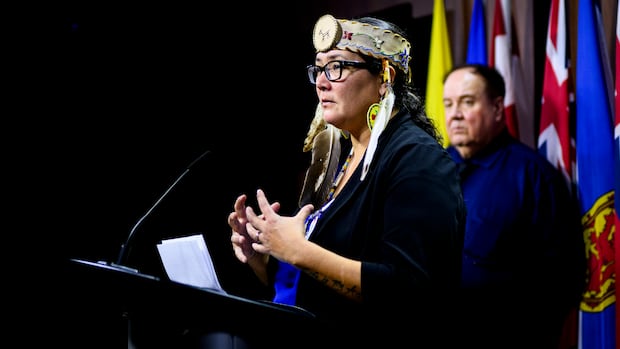
Indigenous·NewChiefs in Ontario are denouncing the federal government’s delayed introduction of a bill to ensure First Nations have safe drinking water. They’re also concerned that Canada intends to weaken proposed legislation before tabling it.Some First Nations leaders concerned Liberals intend to weaken proposed legislation in key areasBrett Forester · CBC News · Posted: Dec 03, 2025 2:23 PM EST | Last Updated: 6 minutes agoListen to this articleEstimated 5 minutesThe audio version of this article is generated by text-to-speech, a technology based on artificial intelligence.Anishinabek Nation Grand Council Chief Linda Debassige speaks during a news conference on Parliament Hill in Ottawa on Wednesday. (Spencer Colby/The Canadian Press)Chiefs in Ontario are denouncing the federal government’s delayed introduction of a bill to ensure First Nations have safe drinking water, amid concerns Canada intends to weaken the proposed legislation before tabling it.First Nations leaders outlined their fears at a news conference on Parliament Hill on Wednesday morning, less than 24 hours after Prime Minister Mark Carney announced his minority Liberal government plans to table a successor to Bill C-61, the First Nations Clean Water Act, in the spring.Bill C-61 died when the previous Liberal government suspended Parliament earlier this year, and Anishinabek Nation Grand Council Chief Linda Debassige says it’s unacceptable it still hasn’t been revived. The Anishinabek Nation advocates for 39 First Nations across Ontario. “First Nations have waited too long. Municipalities, towns and cities when under a water advisory do not have to wait that long,” she said during a news conference.”We have also heard that Canada intends to make amendments to the legislation, potentially weakening it. This is completely unacceptable.”The original bill affirmed First Nations’ human right to safe water and enshrined their self-government right over water in their territories. Debassige said the Liberals are rumoured to be considering removing protection for fresh water sources, for example, among other things.First Nations leaders have received no confirmation the new bill would also recognize clean water as a human right, she added.”We have no assurances. We’ve had no conversations. This issue around amendments, it’s being heard throughout this entire country as far as British Columbia,” she said.”The concerns are all shared, recognizing that this piece of legislation is not perfect. But it’s a step in the right direction.”The Alberta and Ontario governments previously urged Ottawa to abandon the bill, arguing it would undermine competitiveness and delay project developmentIndigenous Services Minister Mandy Gull-Masty wasn’t made available for an interview but said in a statement that ensuring communities have clean water “is a top priority for me and for our government.””We’re working carefully to make sure the legislation is strong, effective, and reflects the needs of communities. I am honoured to continue advancing this important work together,” she said.Carney’s comments ‘disappointing’Debassige was joined at the news conference by three chiefs from Ontario, where Indigenous Services Canada says 38 communities are currently under drinking water advisories of some kind. That means nearly a third of all First Nations in the province fear to drink what comes from their taps.A new law is a legal requirement under a 2021 class-action settlement, and the lack of answers about that settlement creates uncertainty, frustration and deep concern among families, said Shelly Moore-Frappier, chief of Teme-Augama Anishnabai or Temagami First Nation.During the news conference, Moore-Frappier joined a growing chorus of leaders expressing frustration as the Carney government fast-tracks major projects and resource extraction but urges First Nations to wait patiently for action on their concerns.Chief Shelly Moore-Frappier of Teme-Augama Anishnabai (Temagami First Nation) speaks as Chief Gary Quisess of Neskantaga First Nation listens behind her. (Spencer Colby/The Canadian Press)”They are rushing all of this legislation when it comes to trampling on our rights in the name of the national interest. Yet we are still living without basic human rights, like clean water,” she told reporters.”It’s unfathomable, and it’s quite baffling, actually. It’s really more of the same when you look at it.”Carney made the announcement about clean water legislation at the Assembly of First Nations’ annual December meeting in Ottawa, where hundreds of delegates are gathered this week to set policy priorities.The prime minister also told the chiefs he plans to host a joint first ministers’ meeting with First Nations early in the new year, where “you will set the agenda” and where water will be a likely topic for discussion.WATCH | PM says First Nations will be included in first ministers meeting:Carney says he’ll host joint first ministers’ meeting with First Nations in early 2026Prime Minister Mark Carney announced Tuesday he would host a joint federal-provincial-territorial first ministers’ meeting early in the new year. Carney told the AFN’s First Nations Special Chiefs Assembly that ‘you will set the agenda.’Chief Gary Quisess of Neskantaga First Nation in northern Ontario joined the other chiefs at the news conference, where he expressed disappointment with Carney’s words. Neskantaga in northern Ontario has been grappling with a boil water advisory for 30 years. Quisess provided CBC Indigenous with pictures of discoloured water and skin lesions on children, as examples of hardships community members have endured over that period. Quisess was first to the microphone to ask Carney a question Tuesday afternoon but was cut off by the meeting chair as his allotted two minutes expired.”I kind of felt I didn’t get anywhere with my voice. From the prime minister, I didn’t get a clear answer … Am I gonna live at a boil advisory for another decade?” Quisess reflected on Wednesday.In response, the prime minister acknowledged Canada’s “failure” to lift all long-term boil water advisories but Quisess was left unconvinced.”It was disappointing. I came a long way here to speak about and to address the issues. I was given two minutes; two minutes for me to speak,” he said. “And here the prime minister [spoke] about half an hour, not listening to First Nations people address the concerns.”
Delayed introduction of First Nations clean water bill ‘unacceptable,’ say chiefs