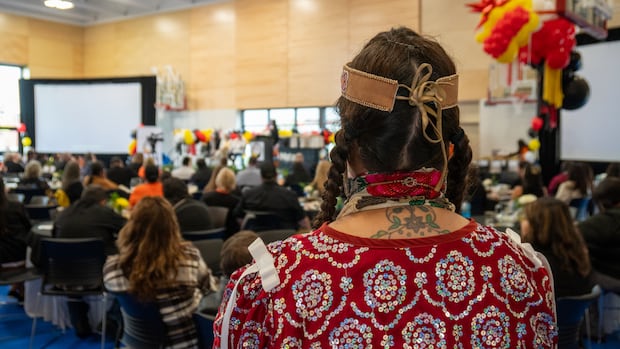
Thunder Bay·NewAs First Nation organizations across the country grapple with federal funding cuts in the latest budget , Matawa First Nations Management (MFNM) says years-long financial pressures have created a crisis for the children and families it serves in northwestern Ontario. Here’s what MFNM is seeking from the federal government, as it considers how to keep its social services up and running.Organization says inconsistent funding has put children and families at riskSarah Law · CBC News · Posted: Dec 03, 2025 1:15 PM EST | Last Updated: 1 hour agoListen to this articleEstimated 5 minutesThe audio version of this article is generated by text-to-speech, a technology based on artificial intelligence.A young dancer is seen from behind at a celebration at the Matawa Education and Care Centre in Thunder Bay, Ont., in this October 2023 file photo. Matawa First Nations Management (MFNM) has declared a state of emergency over years of financial pressures affecting its ability to deliver child and family services. (Sarah Law/CBC)As First Nation organizations across the country grapple with federal funding cuts in the latest budget, Matawa First Nations Management (MFNM) says years-long financial pressures have created a crisis for the children and families it serves in northwestern Ontario.The organization, which represents eight First Nations in Treaty 9 and one in the Robinson-Superior area, declared a state of emergency on Nov. 21 over “critical and ongoing funding failures and policy changes by Indigenous Services Canada (ISC) under Jordan’s Principle and First Nation Representative Services (FNRS) claim processes.”It says the government has breached its obligations to First Nations children under the Canadian Human Rights Tribunal (CHRT) rulings, the Truth and Reconciliation Commission (TRC) Calls to Action, and the principles of the Crown-Treaty relationship.“These funding disruptions, they’ve resulted in immediate and escalating risks [to] essential prevention and protection and advocacy for our family support services that are delivered by our programs,” said Sharon Nate, chief executive officer of MFNM, in an interview with CBC News.Jordan’s Principle, named after the late Jordan Anderson, was established by the Canadian Human Rights Tribunal to make sure First Nations children don’t face gaps, delays or denials in accessing government services because of their identity.Jordan Anderson is seen in this 2003 video provided by the Assembly of Manitoba Chiefs. Anderson, who was from the Norway House Cree Nation in Manitoba, was born in 1999 with a complex genetic disorder that needed specialized care. He died in 2005 at the age of four. (Submitted by the Assembly of Manitoba Chiefs)The principle is based on the legal concept of substantive equality, meaning First Nations children may require additional support to receive the same level of services as other children in the country. Meanwhile, the First Nation Representative Services, also known as band rep, refers to support provided to First Nations children and families who are either involved, or at risk of becoming involved, in the child welfare system.The new federal budget, passed last month, includes two per cent cuts at both Indigenous Services Canada (ISC) and Crown-Indigenous Relations and Northern Affairs Canada — almost $2.3 billion by spring 2030.Sharon Nate, chief executive officer of Matawa First Nations Management, says the new federal budget ‘is concerning to many First Nations and organizations about the future of the services that are provided.’ (Sarah Law/CBC)In a news release issued earlier in November, MFNM said “recent shifts in federal budget priorities have removed key funding avenues, including those supporting Jordan’s Principle and COVID-era wellness programs.”While MFNM initially said its social services framework — Matawa Awashishewiigiihiwaywiin — would be suspended as a result, the organization has since secured enough funding to keep it going until March 31, 2026.“We did give layoff notices to staff because at the time, we had no funds to carry the program forward,” Nate said. “Beyond [March 31, 2026], there’s still uncertainty.“We need to push forward and hold all of our partners accountable in ensuring that there’s no stoppage of services within the Awashishewiigiihiwaywiin program,” she said.Though the federal budget has added extra pressures, Nate said the emergency declaration stems from years of inconsistent federal funding. MFNM is calling on the federal government to stabilize funding for Matawa Awashishewiigiihiwaywiin — specifically its family support and post-majority care claims — and resolve all outstanding Jordan’s Principle funding applications.“Our leadership is looking to establish an urgent action table to prevent further harm and to address these funding gaps that extend beyond March 31, 2026,” Nate said, “and to ensure long-term sustainable funding that meets Canada’s obligations to our First Nations children under the Truth and Reconciliation [Commission of Canada] and the CHRT.”ISC ‘committed to supporting First Nations’A spokesperson for ISC provided an emailed statement to CBC News on Monday in response to questions about how it would support Matawa through its state of emergency. “We are in regular contact with Matawa First Nations Management to support their delivery of social programs, health services, and housing for the nine member First Nations they represent. We continue to work with them on Indigenous Services Canada funding applications,” said spokesperson Pascal Laplante.Laplante said all Jordan’s Principle requests are reviewed on a case-by-case basis, and that the department is “working with Matawa to identify funding options for children and youth, including Jordan’s Principle and other programs.”While he did not mention Matawa Awashishewiigiihiwaywiin specifically, Laplante said ISC provides “annual and targeted funding to Matawa for housing needs,” as well as $500,000 annually — plus surge funding — for its mental wellness team.“The department also provides additional funding supports to Matawa’s Health Co-operative, with over $1 million provided this year.”Nate acknowledged the organization is in talks with ISC and is “looking at steps moving forward.”That being said, Nate said MFNM is tired of having to continue to advocate for renewed funding, and she hears other First Nations organizations are experiencing similar challenges. That is why she wants the government “to establish a long-term sustainable funding path as opposed to these situations we find ourselves in,” she said. ABOUT THE AUTHORSarah Law is a CBC News reporter based in Thunder Bay, Ont., and has also worked for newspapers and online publications elsewhere in the province. Have a story tip? You can reach her at sarah.law@cbc.ca
Matawa First Nations Management seeks long-term federal funding amid state of emergency