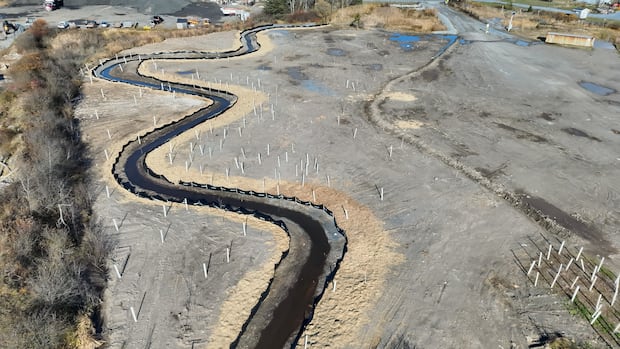
New BrunswickA Saint John creek in an industrial park had become unnaturally straight from sediment and contaminants. But after recent work from environmental group ACAP Saint John, the waterway is now more habitable to wildlife.Environmental group says other projects are ongoing to buffer waterways from human activitySavannah Awde · CBC News · Posted: Dec 03, 2025 2:09 PM EST | Last Updated: 1 hour agoListen to this articleEstimated 3 minutesThe audio version of this article is generated by text-to-speech, a technology based on artificial intelligence.Hazen Creek is pictured after the restoration project. (Submitted by ACAP Saint John)Views from above Hazen Creek show a thin watercourse, its path curvy and winding across land adjacent to an industrial park — a transformation from its earlier state. The Saint John creek had become unnaturally straight, but after recent work from an environmental group, the waterway is now more habitable to wildlife.According to Roxanne McKinnon, executive director of ACAP Saint John, a creek can become too straight when sediment and contaminants from roads flow into waterways.She said shape matters because it can be an indicator of how well a creek will support aquatic life.Hazen Creek is pictured before ACAP Saint John’s project began. (Submitted by ACAP Saint John)”If you look at a map, … most natural streams don’t run too straight,” said McKinnon.”They like to zigzag back and forth.”That gives them natural areas to deposit sediment and improve fish habitat by having pools and riffles.”McKinnon said ACAP Saint John had suspected the creek on the east side, home to a variety of aquatic life, needed attention.So, with a two-year federal grant from the Department of Fisheries and Oceans, the group got started with on-foot assessments of the creek. ACAP Saint John began assessments of the creek with funding from Canada’s Department of Fisheries and Oceans. (Submitted by ACAP Saint John)”It actually has a very healthy population of brook trout and American eel,” she said.”We also see white sucker and kind of our smaller dace, stickleback, chubs … what people all kind of classify together as their bait fish.”But McKinnon said the group knew that the creek had some historic issues with it being part of an industrial park — facing issues such as contamination.She said sediment can make a waterway more wide and shallow, which ultimately creates issues for fish. “If the water’s not deep enough for a fish to swim through, that creates a barrier for them, and they can’t migrate upstream anymore,” she said. Trees planted around the creek will act to filter out the sediment in the run-off that flows in. (Submitted by ACAP Saint John)She also said increased turbidity and suspended solids can lead to reduced oxygen in the water and increased temperatures, “which [are] not things that fish tend to like.”The Hazen Creek restoration is one of several ongoing projects for ACAP Saint John aimed at buffering watercourses from human activity by planting vegetation around waterways to act as a filter for run-off that flows in.McKinnon said the group will continue to keep an eye on the Hazen Creek site and look for ways to protect other urban waterways throughout the city.ABOUT THE AUTHORSavannah Awde is a reporter with CBC New Brunswick. You can contact her with story ideas at savannah.awde@cbc.ca.With files from Information Morning Saint John
Fish habitat restored at unnaturally straight Saint John creek