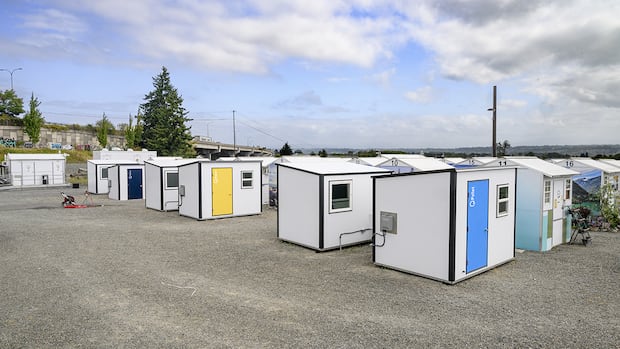
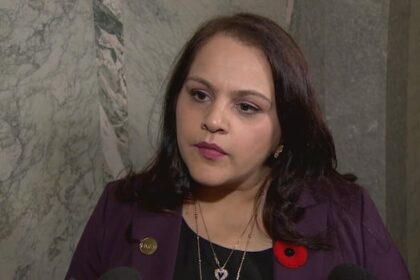
British ColumbiaKelowna has opened three transitional housing sites built around clusters of tiny homes, with each project having a capacity of 60 residents. New figures obtained by CBC News reveal the projects are achieving far lower success rates, in terms of people finding permanent homes, than Mayor Tom Dyas recently suggested.B.C. Housing data shows that around half of transitional housing participants had moved on to other housingChris Walker · CBC News · Posted: Dec 03, 2025 7:43 PM EST | Last Updated: 4 hours agoListen to this articleEstimated 3 minutesThe audio version of this article is generated by text-to-speech, a technology based on artificial intelligence.A tiny home village is seen in Kelowna, B.C., in 2023. The city’s mayor has said there is a high rate of people finding permanent housing through the transitional projects — but figures from the province’s housing agency reveals the projects are achieving lower success rates than the mayor recently suggested. (Submitted by B.C. Housing)New figures obtained by CBC News reveal transitional housing projects in Kelowna, B.C., are achieving far lower success rates than Mayor Tom Dyas recently suggested.In the past two years, the Okanagan city has opened three tiny home villages, catering to the homeless population with the intention that residents would eventually find more stable housing. The tiny homes are funded by B.C. Housing and managed by third-party operators.In an interview with Kelowna Now on Nov. 20, Dyas said “almost 100 of that first 120 [individuals] have moved on. They’ve either moved on to supportive housing… they’ve gone back to family, they’re getting better care. Very, very positive results.”That translates to 83 per cent of people finding more stable accommodation.WATCH | Tiny home project in Kelowna opens:Kelowna, B.C.’s tiny home transitional housing project to start welcoming residentsThe B.C. government and City of Kelowna unveiled a “tiny homes” project with 60 units for the homeless this morning. As Tom Popyk reports, it took a little more than four months for it all to come together – from the pitch to the opening.When asked to confirm the mayor’s numbers, B.C. Housing said that only 42 per cent of participants have moved on to other housing — about half the rate claimed by the mayor. The organization could not explain the discrepancy. Dyas was not made available for an interview for this story. Kelowna Mayor Tom Dyas was not made available for an interview regarding this story. He told Kelowna Now that 83 per cent of tiny home residents found more stable accommodation. (Tom Popyk/CBC)City of Kelowna spokesperson Tom Wilson said at the time of the mayor’s comments, he was only aware of the program’s successful participants, and did not know how many were unsuccessful.The mayor’s office did not dispute the accuracy of the data supplied by B.C. Housing to CBC News. WATCH | Hundreds attend information session about Penticton project:Hundreds in Penticton, B.C., attend information session for tiny homes projectHundreds of people gathered in Penticton to attend an information session on a proposed tiny homes project, meant to address homelessness in the city. B.C. Housing has proposed 50 tiny homes that would serve as transitional housing. CBC’s Tiffany Goodwein reports.The timing is significant as Penticton city council voted on a similar B.C. Housing tiny homes project on Tuesday, ultimately rejecting the proposal. In recommending approval for a similar project in Penticton, however, city staff cited Kelowna’s apparent success, writing in a Nov. 12 report that “sites in communities like … Kelowna have demonstrated good outcomes using this model.”On Dec. 2, Penticton city council voted 4-2 against the proposed tiny home village in that community, largely on the basis that it would include overdose prevention services. Minister of Housing and Municipal Affairs Christine Boyle now says that funding will be reallocated to another city in B.C. that needs transitional housing. Clusters of tiny homesKelowna has opened three transitional housing sites built around clusters of tiny homes, with each project having a capacity of 60 residents.Data provided by B.C. Housing, which they said was current to Nov. 25, shows 297 people have been admitted to Kelowna’s first two projects. Of those, 125 people — representing 42 per cent — moved on to other housing. Another 79 people, or 26 per cent, left for other reasons — including expulsion or returning to the streets.B.C. Housing did not say if there was a uniform way it calculates how transitional housing clients find other forms of housing. (Ben Nelms/CBC)Like many B.C. communities, Kelowna and Penticton have struggled with rising homelessness.B.C. Housing has opened similar tiny home projects in Duncan and Victoria. The Victoria project is slated to close in the spring after its temporary use permit expired in September.ABOUT THE AUTHORChris Walker is a journalist based in Kelowna, B.C. He is the host of the morning radio show Daybreak South.
Kelowna tiny home success rate lower than mayor claims, B.C. Housing report reveals