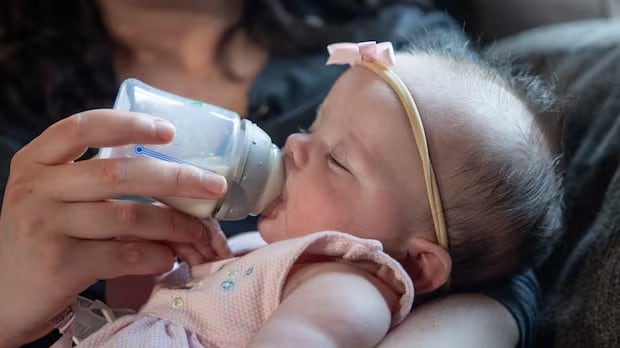
ManitobaA residence for pregnant women and new mothers in Winnipeg is desperate for infant formula, and the city’s housing shortage is being cited as one of the reasons.Lack of affordable housing means new mothers stay 4-5 times longer at Villa RosaDarren Bernhardt · CBC News · Posted: Dec 04, 2025 11:40 AM EST | Last Updated: 2 hours agoListen to this articleEstimated 5 minutesThe audio version of this article is generated by text-to-speech, a technology based on artificial intelligence.Villa Rosa currently has 14 babies in residence, mostly under two or three months. Typically, it has one or two at a time, according to executive director Carolyn Eva. (CBC)A residence for pregnant women and new mothers in Winnipeg is desperate for infant formula, and the city’s affordable housing shortage is being blamed as a major reason.“Prior to the pandemic, we only had moms stay here for a month postpartum but, with the housing shortage, it’s very difficult for young moms on social assistance to find appropriate housing,” said Carolyn Eva, executive director at Villa Rosa.The facility in the Wolseley neighbourhood provides prenatal and postnatal shelter, support and programming. The women are often young, single mothers.Villa Rosa offers a full high school program, run by the Winnipeg School Division, so women can continue their schooling. It then works with Manitoba Housing to find suitable long-term housing.However, the lack of affordable housing options means the women are staying four or five months postpartum instead, Eva says. That means more babies in the facility at the same time.”Right now we have a record number,” Eva said. “We have 14 babies, mostly under two or three months. We usually have one or two.”While there is a lactation consultant on staff — Villa Rosa encourages breastfeeding — it doesn’t work for all mothers, she says, so for the first time, the organization is struggling to find enough formula.”Right now we’re going week to week,” Eva said.The other contributing factor is an overall drop in formula donations.For years, Villa Rosa’s stockpile has been fully supplied by donations from church groups, other organizations and people in the community who would just drop some off, she said.Now they’re dipping into their food budget to buy it themselves, spending about $200 a week that Eva believes is due to the skyrocketing cost. The price of formula has jumped 30 per cent since 2022 and nearly doubled since 2017.Some stores, such as Walmart, now keep it locked up to thwart shoplifters, she says.Kate Kehler, executive director of the Social Planning Council of Winnipeg, blames all three levels of government for pushing Villa Rosa into its current situation.”Absolutely, it’s a domino effect,” she said. “The federal government for decades has stepped away from housing — it has been more active, most certainly — but we’re running into problems as far as that housing supply.”Kate Kehler, executive director of the Social Planning Council of Winnipeg, says the housing shortage won’t improve if the city keeps backing down when someone opposes a location. (Radio-Canada)As for the province and city, Kehler said they’re creating problems through poorly conceived policies.”I liken it to to the encampment enforcement bylaw that they’re putting in place. They are quite literally going into into encampments and saying, ‘yeah, we know we don’t have any place for you, but you still have to leave,'” she said. “That makes absolutely no sense.”Instead of boosting affordable housing spaces, the city is caving to other interests, Kehler says, citing a recent decision to remove vacant property on Sherburn Street from the list for future development.”The whole point of putting a supportive housing unit on Sherburn is because it was a very healthy block to be on,” she said.”[Supportive housing] is not about concentrating people who need more support in one area. That is ghettoizing, and we know it doesn’t work.”Concerns over the loss of parking spaces has resulted in pushback over proposed supportive housing projects near the Pan Am Clinic and Granite Curling Club, Kehler says.“We need a city who is actually going to stick to the plan and to the evidence of that plan,” she said.”They have to be very careful about the precedents they are setting by allowing people to come up with different arguments about why they don’t want this near them.”Until those spaces open up and housing demand can be eased, Villa Rosa will do what it can to accommodate mothers who need somewhere to go, Eva says, and it will keep doing what it can to find formula to support those needs.”We have put a call out to some different groups that have helped us in the past, so we are hoping,” Eva said.The organization accepts food or financial donations at 784 Wolsley Ave. from Monday to Friday, 8 a.m. to 4:30 p.m. Both powdered and ready-to-feed formulas are needed. If it’s a bigger donation, staff are ready to go pick it up.“We’re pretty flexible and somewhat desperate. We’ll make it work,” Eva said.WATCH | Winnipeg organization helps record number of babies during affordability crisis:Winnipeg organization helping record number of mothers, babies during affordability crisisOne Winnipeg organization is having a hard time helping more single mothers and their newborns. Villa Rosa is a safe haven for pregnant and postpartum women, but between the high costs of baby formula and housing, they say they’re housing more people on a dwindling number of supplies.ABOUT THE AUTHORDarren Bernhardt has been with CBC Manitoba since 2009 and specializes in offbeat and local history stories. He is the author of two bestselling books: The Lesser Known: A History of Oddities from the Heart of the Continent, and Prairie Oddities: Punkinhead, Peculiar Gravity and More Lesser Known Histories.With files from Cory Funk and Marcy Markusa
Housing shortage blamed for infant formula shortage at Winnipeg non-profit