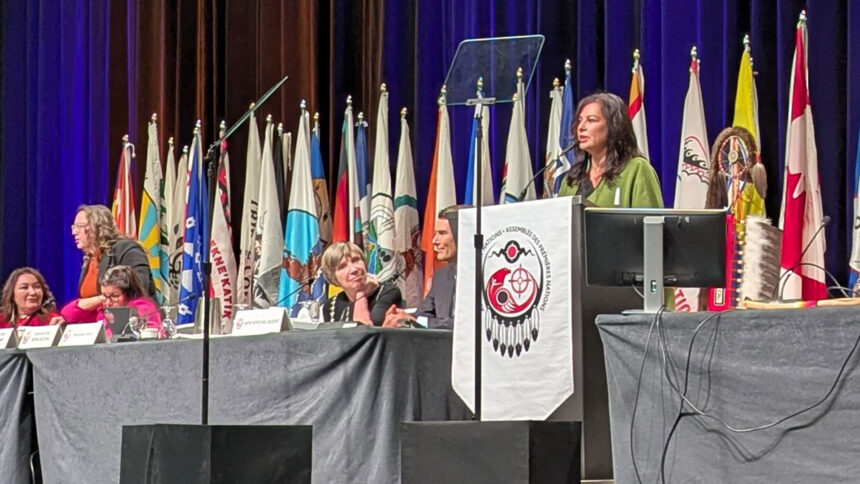
On the final morning of the Assembly of First Nation’s 2025 special chiefs assembly, two back-to-back panels of federal ministers addressed the room and took questions from chiefs for a total of over three hours. For the second panel of the morning, the AFN welcomed Rebecca Chartrand, minister of Northern and Arctic Affairs, Gary Anandasangaree, minister of Public Safety, Gregor Robertson, minister of Housing and Infrastructure, and Eleanor Olszewski, minister of Emergency Management. Each minister spoke briefly about their portfolios and the successes and potential successes they see growing from the current Liberal government. The four ministers are responsible for a series of issues critical to First Nations communities from coast to coast, which was reflected in the broad variety of questions they took. Drinking water Don Maracle, chief of the Mohawks of the Bay of Quinte, began his question by noting that the ministers at the table had inherited a slate of challenges they had not created—much like the members of his community. He quickly moved to the difficult subject of water. “We should not have to take Canada to court through class-action water settlements to get drinking water,” he told the ministers. “Canada should not be our adversary in court over something that’s so essential to the health and well-being of everybody in this country, including our people. That seems to be the only recourse we have.” Maracle’s concerns were echoed by Chief Gary Quisess, from Neskantaga First Nation, A community under the longest boil-water advisory in Canada, as well as Chief Lee Spahan from Coldwater Indian Band. “First Nations right across Canada need clean water,” Spahan said. “Canada has a fiduciary obligation and should be committed to fixing that. The previous Prime Minister said he would, and he never did. Will this government commit to that? If so, when?” Read more: Chiefs grill ministers on major projects and child welfare failures at AFN assembly Carney meets with Prairie chiefs outside Assembly of First Nations gathering Maracle was referring to a settlement agreement to end a 2019 class action lawsuit launched by First Nations to force Canada to pay to fix water systems in communities and introduce legislation so that that right is enshrined in law. That was done in 2024 when C-61 was tabled in the House of Commons. But its progress ended when former prime minister Justin Trudeau prorogued Parliament on Jan. 6. In response, Chartrand—the first Indigenous Minister of Arctic and Northern Affairs—called upon her background as an Anishinaabe woman from Treaty 4 territory in Manitoba. “I live these experiences in my community as well,” she said, “so I just want to say that I agree. No community should have to go to court for clean drinking water, and that is one of the reasons why I’m here.. We know that there was $2.3 billion that is being put towards clean water, and we’re also looking at legislation to enshrine a right to clean drinking water in 2026. “And I know that’s not happening soon enough, but I’m asking you to continue to put your faith in us, that we are working hard, and the more of us that we get at the table, the stronger we’re going to become at that table. So I encourage you once again to continue to participate in federal politics, provincial politics, and continue doing the work that you’re doing.” Prime Minister Mark Carney told the assembly on Tuesday that the government is going to table new water legislation in the spring despite a promise to do it in this fall. According to lawyers representing the First Nations in the class action, they’re considering a “motion to compel” to force the government to action. Housing Multiple chiefs raised the issue of housing, from a variety of perspectives. One chief said that since the 2021 wildfires and Atmospheric River event, his community still has families whose lost homes have not been replaced. He said that while the government of Canada committed to help rebuilding those homes, his Nation has not yet received money. The chief of Neskantaga raised another issue. “Housing issues are rising [in Neskantaga] because our population is rising. The housing issue will never get filled up because we all grow,” he said. Chief Mike Christian of Splatsin First Nation said his community was in the business of building homes. He explained that Splatsin homes were capacity-building, both for his Nation and for the communities they worked with to build homes in. “So one of the questions that we’re having from not only a corporate but a First Nation perspective is, how do we fit into that procurement strategy?” The Assembly of First Nations’ 2025 Special Chiefs Assembly. Photo: Jesse Staniforth/APTN Chartrand acknowledged that procurement “isn’t working as well as it can be,” but said she has been speaking with Joël Lightbound, minister of Government Transformation, Public Works and Procurement, about how to improve procurement from Indigenous businesses. “There is some work being done right now between Indigenous Services Canada and Public Services and Procurement Canada,” Chartrand said, “There is work that’s being done in the background to help support our procurement processes for Indigenous people. We’re testing bonding guarantees. And keep in mind that the $10 billion that has been set aside [for housing] is also that guarantee for economic development opportunities.” Robinson added that the government supported building houses in large cities and small towns. “We need everything in between,” he said, “and the way we’re designing Build Canada Homes is to be responsive to all of that. It works from a proposal approach. It’s not an application into a program that drags on for years and years. It’s more, make your best proposal with partners to build in your community, and we will work as fast as we can to figure out if that is ready for support.” The drug crisis Christian also raised the issue of the opioid crisis, saying in his community, organized crime is responsible for drug trafficking, and criminals have become more aggressive about extorting members, even to the point of kidnapping them and demanding they withdraw money. “We do have a fairly decent relationship with the local RCMP, but they can’t deal with this stuff,” Christian said. “So I think as soon as it’s identified in the community, it should be escalated up to those that can deal with it. “Then we’re not wasting time, and we’re not losing family members to fentanyl and whatever else. I’ve lost a couple of really close family members to that shit. Sorry for my language. But that’s what it is. And it has to get out of the community.” Anandasangaree, who is the former minister of Crown–Indigenous relations, responded by linking addictions to opioids and meth with mental health challenges. “[The situation] is one that requires a broader response from health and public safety,” he said. “We can’t arrest or charge our way out of this crisis.” He noted that across Canada, the opioid emergency has so far killed 50,000 people, and said 20 families lose a loved one every day. “It is something that we need to do better at as a country, as a people,” he said. “The work that the federal government will do is in terms of supporting mental health supports. But also, looking at all options with the provinces. Because a lot of this falls on the province to support them in their efforts.” Policing Isaiah Robinson, deputy chief councillor of Kitasoo Xaixais Nation, raised the issue of the RCMP’s slow responses to emergencies in his community. Over the past year, he said, his community had two suspicious deaths, and in each case it took the RCMP more than 24 hours to arrive. “Our members do not feel safe,” he said. “Our children do not feel safe. Where is the accountability to the RCMP when it comes to our tripartite agreement in which there is negligence against them?” He noted that in the RCMP’s absence, it has fallen to his own leadership to act as a proxy for police in the community, pulling over drunk drivers—who may even be family members—stopping fights, and dealing with child and family issues. “We have a solution,” he said. “We ask that you assign senior-level staff to assist us in developing a regional by-law authority which our neighbouring nations are interested in supporting and are being a part of too.” Maracle, meanwhile, noted that in Tyendinaga, there are police personnel shortages. “The elephant in the room is that there’s not enough officers,” he said. “There has been not enough investment to ensure that there’s enough officers to ensure the safety of our people and our communities.” Chartrand suggested building upon structures that are already proving functional, such as the First Nations and Inuit Safety Officer Program, which she said she’s recommending become an essential service. “We just need to keep empowering the work that our communities are doing,” she argued. “And I think we also need to consider how we align with the mandate of this government. We know that there’s a commitment to hiring a thousand more RCMP, we’ve been hearing your recommendations, we want to keep building on what’s working. “You know, the First Nations Safety Officer program is supporting 400 communities across the country, it makes sense to keep building on that.” Anandasangaree acknowledged that First Nations’ relationships with the RCMP, Canadian Border Services Agency and Correctional Services of Canada are shaky. “It is essential that our law enforcement agencies have the trust of people that they serve,” he said. “We know that over the decades, especially with the RCMP, that the level of trust has not been there. It is one that requires greater attention. “I spoke to the commissioner earlier today to make sure that we have greater communication and greater accountability. In short, in a few weeks, we will be appointing the first Commissioner to oversee the RCMP and CBSA. It is probably the most important accountability tool that we have.” A critical issue for Anandasangaree was representation. He said he aimed to see more First Nations hired to the RCMP, CBSA, and Correctional Services. “That is probably the most effective way to ensure that the voices are heard within the structures of responsibility,” he said. “I know there is oftentimes a complicated relationship with law enforcement, and I urge leaders to work towards bridging that gap. “Officers who understand the community, the Nation, who you represent, are critically important. They can play a bridging role. They also will be able to build greater trust.” However, he drew the line at empowering the RCMP to enforce First Nations’ by-laws. “There is a bit of a conflict with respect to [the RCMP’s] enforcement abilities,” he said. “I know Saskatchewan, a fair amount of work went into amending the Provincial Offences Act. I know that other provinces are looking at this, including Ontario. So we do need to make sure the enforceability can be done by the RCMP or local police. It’s an area that we need to continue to work on.” Incarceration Several Chiefs raised the issue of Joey Toutsaint. During the previous panel with a different set of ministers, Vice Chief Calehan Head of Red Earth Cree Nation was the first to mention him. “I ask the ministers to write his name down,” Head said. “Joey Toutsaint, a Black Lake Denesuline First Nation member that has been held in solitary confinement for over eight years. That is considered torture. Canada and the federal system is torturing one of our members and probably many others in the federal institution.” In the second ministers’ panel, Spahan raised Toutsaint’s name as well, also asking ministers to write it down. “It’s just the crime doesn’t match the punishment that he’s getting,” Spahan said. “And we want you to do something to get him out as soon as possible. We don’t want you guys to continue to damage him. I just ask for your support and kindness and the urgency to do something. The Prime Minister knows about it. Work with him and get him out in the next couple of days.” Anandasangaree said he couldn’t address Toutsaint’s situation, but overall, he acknowledged that Canada has a problem with over-incarceration. “It is a fact,” he said. “The numbers speak for themselves. We have reports from the Office of the Correctional Investigator. We have reports from the Auditor General. And it is an area where I think collectively we need to do better. We have an Indigenous Justice Strategy with corrections as a central part of that. But it’s not enough. And what I will suggest is that we need to work. I met with the BC Justice Council folks yesterday. And my commitment to you is to work towards reducing the over-incarceration of Indigenous people overall.” Several chiefs complained about the lack of time and opportunity to speak directly with the ministers. Chartrand noted the number of invitations she has received to visit chiefs in their own territories. “I hear you,” she said, “this isn’t enough time. But when I look at my ministry alone, which represents 40 per cent of Canada’s landmass, it is impossible. There’s no way I’m going to get to every single community by the end of my term.” For that reason, she encouraged chiefs to consider alternate means of identifying their concerns. “We have to utilize all of the resources that are available to us so that we can keep this communication going. We’re trying to find creative ways to meet with people. And I hope you continue to be open to that. Meeting online, utilizing these resources.” Continue Reading
We should not have to take Canada to court: Tyendinaga chief chastises ministers over water legislation


Leave a Comment