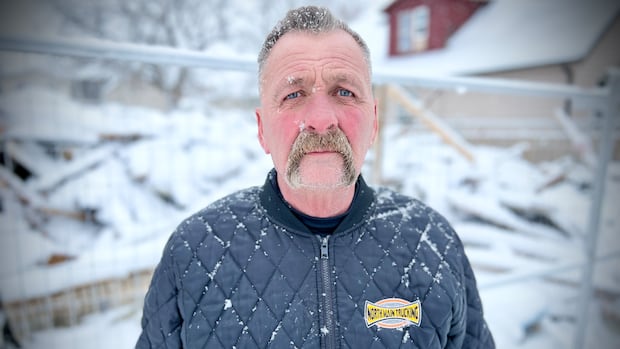
ManitobaThe head of the William Whyte Neighbourhood Association hopes a City of Winnipeg plan to crack down on vacant properties leads to a transformation in his community. Winnipeg’s planning, property and development committee voted to move the plan forward on ThursdayCameron MacLean · CBC News · Posted: Dec 04, 2025 10:13 PM EST | Last Updated: 3 hours agoListen to this articleEstimated 4 minutesThe audio version of this article is generated by text-to-speech, a technology based on artificial intelligence.Darrell Warren, president of the William Whyte Neighbourhood Association, says too many owners sit on properties without any intention of redeveloping them. (Travis Golby/CBC)The head of the William Whyte Neighbourhood Association hopes a city plan to crack down on vacant properties leads to a transformation in his community. Darrell Warren estimates there are about 200 empty, demolished or vacant properties in his north Winnipeg neighbourhood — about 10 per cent of the roughly 2,500 homes in the area. “We need to make William Whyte a neighbourhood again,” Warren said.On Thursday, city council’s property and development committee voted in support of a strategy that aims to put pressure on owners to make their properties fit for habitation again, or risk losing them to the city.The city report outlining the strategy calls for more aggressive use of taking title without compensation, a legal tool allowing the city to seize derelict properties tax arrears. It also proposes shortening the timeline before seizure can begin from three years to two.The plan would also change the city’s empty building fee, turning an existing flat charge of two per cent of assessed value into a sliding scale, rising by one percentage point per year up to a maximum of five per cent.Revenues would go into a new reserve dedicated to vacancy enforcement and redevelopment.Warren supports the changes, which he thinks could put pressure on owners.”I love it, because there’s some properties being held onto by owners and they’re not doing anything with them,” he said. “If you don’t have some sort of plan for that property, we need to go ahead and take the property away and make it a viable … property again.”A growing problemThe City of Winnipeg has struggled for years to come up with a way to deal with the problem of vacant and derelict properties, which frequently become targets for break-ins and pose fire risks to surrounding buildings. The number of properties registered under the city’s vacant building’s bylaw grew from 543 in 2021, to 788 as of October 2025 — a 45 per cent increase.Winnipeg Fire Paramedic Service data shows 232 fire incidents in William Whyte from Jan. 1 to Dec. 31, 2024, according to the city report.Jonathan Hildebrand, the city’s manager of strategic planning and the author of the report, serves as chair of the city’s problem property task force.”We kept very front and centre the reality that behind property are people,” Hildebrand said. “Many of the people that are behind a lot of the property we discuss here find themselves in very desperate situations … but at the same time we recognize the status quo isn’t acceptable.”The city’s strategy proposes a partnership with the Manitoba Housing and Renewal Corporation, along with the non-profits Purpose Construction and Build Inc., to redevelop properties, with the goal of increasing affordable homeownership.That would begin with a pilot on a city-owned lot at 400 Pritchard Ave., in William Whyte. The non-profits, along with the renewal corporation, would develop a process for selecting future property owners. The plan also proposes:Delegating authority to the city’s chief administrative officer to ramp up use of taking title without compensation.Reducing the amount of time before the city can begin the process of seizing a home for unpaid taxes from three years of arrears to two, effective 2027, pending budget review.Creating a new acquisition program for distressed houses whose owners want to walk away.Coun. Evan Duncan, who chairs the property and development committee, said the issue is no longer confined to Winnipeg’s core.”This is not just affecting one councillor, or two councillors anymore,” he said. “It’s now spreading citywide, and you have to stop that threat.”In some cases, owners consider it cheaper to abandon their properties rather than fix them, Hildebrand wrote in the report. Duncan says the plan changes that calculus by sending a message to “bad actors” through aggressive enforcement.”It’s not going to be tolerated anymore and we’re moving in to make some noise,” he said.Owners will still be given ample notice and opportunity to fix their properties before the city takes title, said Duncan.The plan would still need approval from council before moving ahead.ABOUT THE AUTHORCameron MacLean is a journalist for CBC Manitoba living in Winnipeg, where he was born and raised. He has more than a decade of experience reporting in the city and across Manitoba, covering a wide range of topics, including courts, politics, housing, arts, health and breaking news. Email story tips to cameron.maclean@cbc.ca.
William Whyte resident welcomes city plan to crack down on derelict property owners