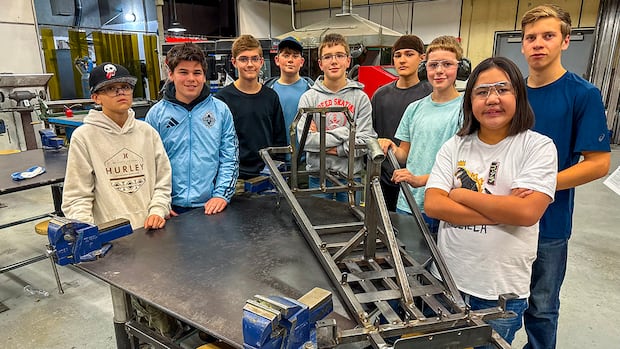
British ColumbiaStudents at Dr. Kearney Middle School are learning to weld, machine, and even program their own self-driving EVs as part of a hands-on after-school program preparing them for the future of trades, where fabrication meets robotics and automation.Students at Fort St. John’s Dr. Kearney Middle School weld and even program their own self-driving EVsMatt Preprost · CBC News · Posted: Dec 08, 2025 8:00 AM EST | Last Updated: 3 hours agoListen to this articleEstimated 4 minutesThe audio version of this article is generated by text-to-speech, a technology based on artificial intelligence.The Dr. Kearney Middle School go-kart club meets every Tuesday and Thursday afternoon. As the students learn to program their own self-driving EVs, their shop teacher hopes the program helps build a new generation of trades workers. (Matt Preprost/CBC)While most students head home after school in Fort St. John, B.C., brothers Arjen and Henry Pos lean over a workbench sealing welds on a half-finished go-kart frame.“We are some of the few kids in our neighbourhood who don’t own a dirt bike or a quad,” says Arjen. “We haven’t really had the farm kid experience that a lot of our classmates have had, from having either parents in the oil patch or living on a farm.”Around them, the sounds of metalwork — clinks and clanks — ring around the shop at Dr. Kearney Middle School. Teacher William McColm walks the room playing foreman, giving each of the 14 students a tailored task for the hour and checking in on their work. Brothers Arjen and Henry Pos weld seams along a half-finished go-kart frame. (Matt Preprost/CBC)McColm started the after-school club last year to give students a hands-on introduction to fabrication, welding and digital design before they reach his Grade 9 class.He says the club has helped students find their identity as much as it has engaged them with their academic classes, applying math and science in a way relevant to their interests.”They’re trying to understand where they fit in the world,” says McColm. “This program gives them an opportunity to realize that they can work with their hands, that they can make things, that they can contribute to a team, that they can be successful in building something they find meaningful.”Training for a changing trades landscape B.C’s latest labour market outlook predicts more than 168,000 job openings in trades and related fields by 2035, mostly as workers retire.This year, Dr. Kearney students are learning to build three go-karts, starting with a simple-gas powered kart. Next they’ll build a full-suspension model, and then a self-driving EV.“We’re going to take everything that I do in robotics, and we’re going to add sensors to one of the frames and we’ll add computers,” says McColm. As artificial intelligence continues to evolve, and the economy continues to progress, McColm sees a future where trades workers will need to understand fabrication as much as they do automation.“If kids can leave my program with this understanding — that the future is going to be a blend of both the robotics concepts and their hands-on fabrication — then I think they’re going to be better prepared for what the future may bring,” he said.For the Pos brothers, the future is already on their minds. Arjen wants to be a 3D video game designer, while Henry wants to build rockets. Both say the club is teaching them the attention to detail and safety those jobs will demand of them.”The number one thing about this club is that we have to be really safe,” says Henry. “When you lose your fear of a tool, that’s when the tool hurts you.”Brothers Arjen and Henry Pos show the metal sculpture and infinity cube they learned to fabricate in William McColm’s workshop at Dr. Kearney Middle School in Fort St. John. (Matt Preprost/CBC)Spring ‘go-kart rodeo’ plannedThe Dr. Kearney shop students fabricate almost everything in-house, from the chassis to the steering column. What they can’t make, they source from local suppliers, online retailers, and community donations.The school district has a new milling machine on order for the shop, while McColm says another machining tool called a lathe is on his wish list. Both will expand what he can teach and what students can build.“What we’re doing here is helping to create the next generation of trades workers here in Peace River,” says McColm. “Any businesses that can help support this are benefiting the community greatly.”WATCH | B.C. teams make history at world’s largest robotics competition:Young B.C. engineers win triple crown at world’s largest robotics competitionA team of young engineers from B.C. has made history at the world’s largest robotics competition. For the first time ever, a single team won the top three awards in the university division at VEX Robotics. Amelia John met with the team known as “TNTN” (ten ton) at their headquarters in West Vancouver. The club will roll their karts onto the school track in May for Dr. Kearney’s first go-kart rodeo. McColm hopes teams from across the school district, and elsewhere in B.C., will show up to race and compete in building challenges.”The idea is to make this an annual thing.”ABOUT THE AUTHORMatt Preprost is a reporter with CBC British Columbia based in Fort St. John, covering stories focused on the Peace Region and Northern Rockies. Email him at mathew.preprost@cbc.ca
After-school go-kart club aims to create next generation of trades workers in northeast B.C.