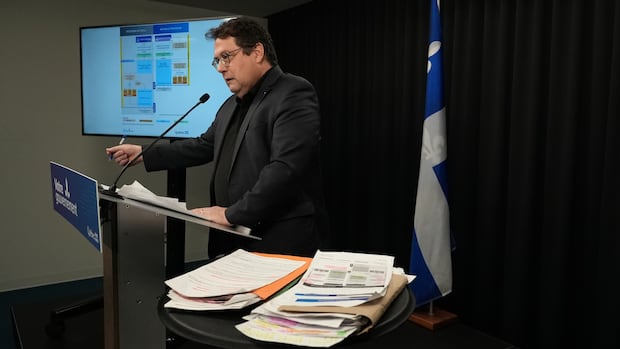
MontrealThe goal is to get energy, mining, industrial and transportation projects off the ground more quickly, Environment Minister Bernard Drainville said Monday. Critics fear it will come at a cost.Critics fear speeding up process will come at cost of environmental oversightBenjamin Shingler · CBC News · Posted: Dec 08, 2025 8:45 AM EST | Last Updated: 1 hour agoListen to this articleEstimated 3 minutesThe audio version of this article is generated by text-to-speech, a technology based on artificial intelligence.Quebec Environment Minister Bernard Drainville announced plans to speed up approvals on Monday in Quebec City. (Sylvain Roy Roussel/Radio-Canada)The Quebec government is aiming to cut by half the time it takes to conduct an environmental assessment of a proposed project, in a move critics say could weaken government oversight. The goal is to get energy, mining, industrial and transportation projects off the ground more quickly, Environment Minister Bernard Drainville said Monday.Under the new proposed measures, the Environment Ministry would aim to complete a review nine months after receiving an impact study. Currently, that process can take up to 18 months.Speaking at a news conference in Quebec City, Drainville insisted the changes would not reduce the level of environmental oversight. He said the current system takes too long and is too bureaucratic. “We think that the product of this improved process, more modern process, will benefit both the economy and the environment,” he said.The Coalition Avenir Québec government is also expected to table a bill Tuesday aimed at fast-tracking major projects, inspired by the federal government’s legislation geared toward “nation-building” projects.Drainville took over as Quebec’s environment minister in a cabinet shuffle in September. At the time, Premier François Legault said overhauling the Environment Ministry’s rules and timelines would be a priority.To achieve the new timeline, Drainville said the government would switch to a paperless system, more quickly consult with the public and Indigenous communities and grant a larger role to the Bureau d’audiences publiques sur l’environnement (BAPE). Drainville said the process will be “more transparent” and more focused on the specifics of a proposal. The draft regulation outlining the changes will be open for public consultation from Dec. 10 through Jan. 24.Alice-Anne Simard, executive director of Nature Québec, said Monday she is concerned the reforms will come at a cost despite assurances to the contrary.“Once you remove regulations, you always find yourself less protecting the environment,” Simard told CBC Montreal’s Daybreak.“It would be great to have a project approved twice as fast … but what we see is that we are weakening our different legislation and regulations to protect the environment.”A union representing provincial government workers issued a statement condemning the move, saying the ministry cannot realistically accelerate assessments while cutting back on staff. More than 100 positions were cut at the Environment Ministry in September.”We cannot afford to reduce environmental requirements and the fight against climate change while we are in the midst of a climate crisis,” said Guillaume Bouvrette, head of the Syndicat de professionnelles et professionnels du gouvernement du Québec. WATCH | Is Quebec’s Green Fund still green?:Quebec wants millions meant for climate action to be used for other government programsThe province recently introduced a bill that would give the government the power to use Quebec’s Green Fund surplus for whatever it sees fit. The fund is meant to help the government combat climate change and currently has a surplus of about $1.8 billion. ABOUT THE AUTHORBenjamin Shingler is a reporter based in Montreal covering social issues and Quebec politics. He previously worked at The Canadian Press and the New Brunswick Telegraph-Journal, and is an alumnus of the Oxford Climate Journalism Network. He can be reached at benjamin.shingler@cbc.ca.
Quebec looks to slash environmental assessment times for industrial projects