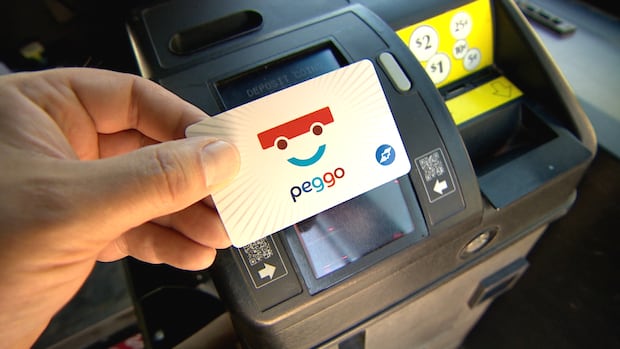
ManitobaWinnipeg Transit has taken its next step toward replacing the city’s Peggo card fare payment system, issuing a call for bids to design and install a modern fare collection platform that would allow riders to pay with credit cards, debit cards or mobile apps.New system to replace Peggo cards could be in place by late 2027Cameron MacLean · CBC News · Posted: Dec 08, 2025 6:31 PM EST | Last Updated: 3 hours agoListen to this articleEstimated 4 minutesThe audio version of this article is generated by text-to-speech, a technology based on artificial intelligence.The new system would replace Winnipeg Transit’s Peggo cards, which launched in 2016. (Trevor Brine/CBC)Winnipeg Transit has taken its next step toward replacing the city’s Peggo card fare payment system.In a request for proposals posted on Friday, it issued a call for bids to design and install a modern fare collection platform that would allow riders to pay with credit cards, debit cards or mobile apps.The request for proposals comes after years of complaints about Peggo, which launched in 2016, including long wait times for online payments to show up on card balances, and a lack of alternative ways to pay for fares.With the new system, riders would be able to tap a bank card or smartphone instead of relying on reloadable cards. It would also allow account-based payments, which opens the possibility to offer fare-capping, which sets a maximum amount users are charged within a certain period.“We’re putting out an RFP that is very open-ended,” Kirk Cumming, Transit’s manager of information technology, told CBC in an interview.“It really gives the city’s broad goals in terms of fare collection technology and is sort of looking to get the responses from the different vendors to see what the newest technology has to offer.”The move could help address fare evasion, which Transit estimates costs between $7 million and $10 million per year, Transit officials told the public works committee at a budget meeting on Monday. “We haven’t done a full analysis to determine the different breakdown of different reasons why people might not pay their fares. But … one of those reasons is when people’s preferred option for payment is not possible,” Cumming said.Having more options to pay could also help boost ridership. Laurie Fisher, Transit’s manager of finance, told the committee declining ridership this year has led to a revenue shortfall of $8 million this year.Ridership remains below pre-pandemic levels, sitting at about 89 per cent of 2019 demand, down from roughly 95 per cent last year. Fisher told the committee the downturn began late in 2024 and is not necessarily linked to the city’s network redesign launched this summer.The move toward procuring the new payment system follows a consultant’s review of Winnipeg’s fare structure and technology in 2024. Cumming expects Transit to recommend a vendor later in the latter half of 2026, with a target of implementation in late 2027. Transit faces possible bus shortage by 2028Winnipeg Transit also warned councillors Monday the city’s aging bus fleet and the high costs of buying replacements could leave the services without enough vehicles on the road to meet demand.Last year, Transit announced it would resume buying diesel buses once a federal funding program to purchase zero-emission buses was completed in 2026. A 40-foot diesel bus now costs about $912,000, while a battery-electric version is roughly $1.8 million, and fuel-cell units cost around $2.3 million. Even with the switch to buying cheaper buses, Fisher told the committee Transit might not be able to replace buses fast enough.With the end of the federal Investing in Canada Infrastructure Fund agreement, Winnipeg’s annual capital funding for buses drops from about $101 million in 2026 to between $23 million and $33 million from 2027 to 2031. Projections assuming an 18-year service life show Winnipeg’s funded fleet falling from 642 buses in 2026 to 479 by 2031. Winter service requires about 564 buses to operate reliably.“By 2028, based on what is needed for the winter service, there is a risk that we will not have enough buses to consistently provide scheduled service on a daily basis,” Fisher told councillors.ABOUT THE AUTHORCameron MacLean is a journalist for CBC Manitoba living in Winnipeg, where he was born and raised. He has more than a decade of experience reporting in the city and across Manitoba, covering a wide range of topics, including courts, politics, housing, arts, health and breaking news. Email story tips to cameron.maclean@cbc.ca.
Winnipeg Transit begins search for new tap-to-pay fare system