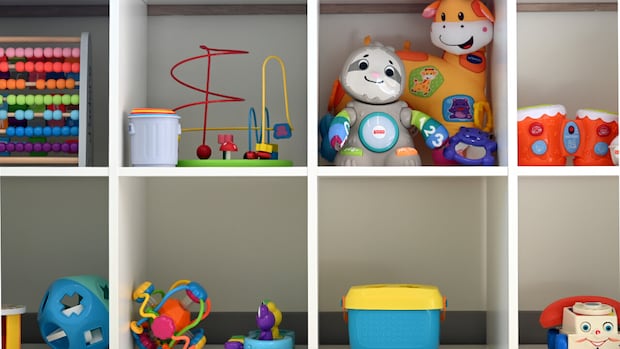
Nova ScotiaFamilies are still “desperate” for child-care spaces and some are still paying much more than the target of $10 a day laid out in the 2021 agreement with Ottawa.Families still ‘desperate’ for spaces, paying high fees despite targets in 2021 planFrances Willick · CBC News · Posted: Dec 09, 2025 5:00 AM EST | Last Updated: 4 hours agoListen to this articleEstimated 5 minutesThe audio version of this article is generated by text-to-speech, a technology based on artificial intelligence.Nova Scotia’s child-care agreement with Ottawa set targets for reduced fees and new child-care spaces. A new report says there’s still progress to be made. (Pascal Raiche-Nogue/CBC Radio-Canada)Nova Scotia has made progress on meeting the goals of the federal-provincial agreement on child care, but still has room for improvement, a new report says.The report from the Canadian Centre for Policy Alternatives Nova Scotia, released today, says the province has fallen short on fee reductions, the creation of new spaces and working conditions for early childhood educators.”While many of those targets have been met, child care remains unaffordable and inaccessible for many families, and ECEs are still undervalued and underpaid,” the report says.The agreement, signed in July 2021, was supposed to bring child-care fees down to an average of $10 a day by March 31, 2026, create 9,500 new early learning and child-care spaces by the same date, and improve ECE training, pay and benefits.Many families still paying higher feesReport co-author Kenya Thompson says for those lucky families who have been able to access regulated, non-profit daycare supported by the agreement, it has made a huge difference for affordability.”We’ve talked to families who have, you know, instead of putting down like basically a second mortgage every month on child-care fees, they’re paying an affordable amount,” she said.Child-care fees at licensed non-profit centres were reduced by 25 per cent of the average 2019 fees in April 2022, and another 25 per cent in December 2022.As of April, the median child-care fee in Halifax was $24 a day for infants and $22.25 per day for preschoolers, according to the report.But Thompson said spaces are still not readily available in much of the province, so too many families are turning to for-profit centres, which often charge more.The report points out that six other provinces that signed bilateral child-care agreements with Ottawa have already reached the $10-a-day threshold.Families still ‘desperate’ for spacesThompson said although many new spaces have been created, it’s difficult to track exactly how many are for full-time daycare, as the province’s numbers combine those spots with before-and-after-school spots as well as pre-primary spaces.And, she pointed out, those types of care are anything but interchangeable.”A parent can tell you if they have an infant that needs a space, they can’t make do with the before-and-after-school space,” Thompson said.She said Nova Scotia still has too many child-care deserts, especially in rural or remote areas.One daycare operator in Halifax says she gets five to eight calls per day from families seeking a child-care spot. (Katerina Georgieva/CBC)But Karen Wright, the executive director of the North End Community Day Care, says demand still far outstrips space availability at her centre in north-end Halifax.Wright said demand has tripled since the agreement came into effect, and her centre had to cut its waitlist off at 500 names.”The truth of the matter is in a year … you’d only have like 15 or 20 spaces opening. So we’ll never meet the demand for the waitlist that we carry.”Wright said she gets five to eight people calling every day looking for a child-care space.”Families are desperate,” she said. “Like, they’ll be crying on the phone. There is no space for their children.”Thompson said only 30 per cent of communities in the province are reaching the target of providing enough spaces for 59 per cent of children under six.Improvements for educatorsThompson said while Nova Scotia made the “awesome” decision to introduce a defined benefits and pension program for ECEs, becoming the first province to do so, working conditions could still improve in the sector.”The wages ultimately need to be stronger so that we can see the recruitment and retention of educators that we need to really create a strong program,” she said.The report notes that some ECEs who were at the upper end of their wage grid had their wages frozen, and some still earn less than a living wage.The sector should also have access to more paid professional development opportunities and more affordable educational opportunities in post-secondary programs, the report says.Political reactionIn response to the report, the NDP’s critic for education and early childhood development, Paul Wozney, said it’s clear the child-care system is not working for many families.”Despite the Houston government’s big promises to reach $10-a-day child care by March, some families in Nova Scotia are still paying more than $35 a day — that’s over $8,000 a year,” Wozney said in a statement. “This is money parents could be using for groceries, rent, and keeping the lights on, instead of paying significantly more for child care than families in other Canadian provinces.”Wozney added that the government is “blurring the lines” on how many spaces it has created, “ignoring the fact that more than 1,650 spaces have been lost in the last two years alone.”In a statement, interim Liberal Leader Iain Rankin said progress on child care has stalled.”The federal funding is there, but what’s missing is a clear plan,” he said. “The province should re-engage with Ottawa and recommit to the next phase of fee reductions so families aren’t left without access to the affordable, accessible childcare spaces they deserve.”The CBC asked the Education and Early Childhood Development Department questions about its progress on the targets but has yet to receive a response. MORE TOP STORIESABOUT THE AUTHORFrances Willick is a journalist with CBC Nova Scotia. Please contact her with feedback, story ideas or tips at frances.willick@cbc.ca
N.S. child-care system still struggling to meet targets in federal agreement, new report says