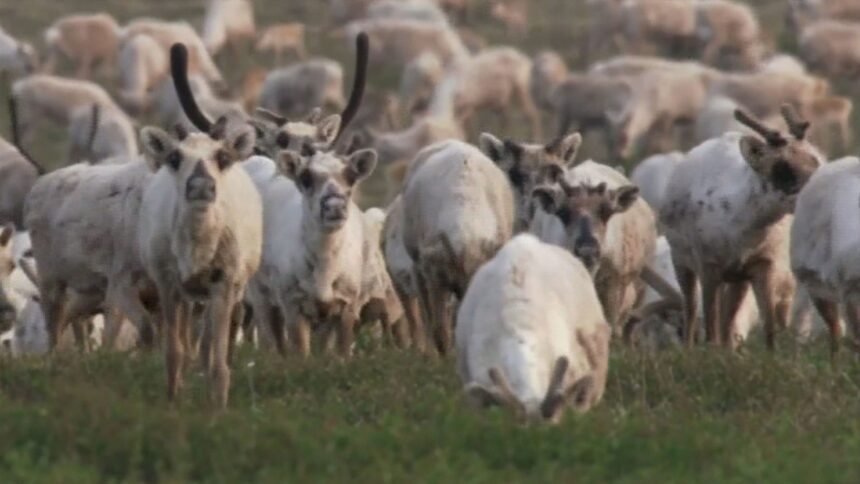
The Innu Nation in Quebec is slamming the provincial government for failing to properly protect caribou herds from climate change, resource development and consequent habitat loss. “Quebec is doing nothing, absolutely nothing,” said Guy Bellefleur, the Innu Nation’s lead on the caribou issue. Bellefleur said it has fallen to his people to manage a resource the province has abandoned. “The communities with knowledge of the caribou are realizing that they have to take responsibility for the species that has always been their symbol,” he told APTN News. Bellefleur said the Innu Nation’s goal is to ensure the sustainability of caribou into the future and to leave a legacy for Innu children. He added they are willing to work with governments on the plan. “That’s how we’ll create real partnerships. That’s how we’ll develop our work together with respect. Because if we don’t start now, when will we ever start again?” Bellefleur, a councillor in the Innu Community of Pakua-Shipi, said the Innu Nation held a two-day gathering on Dec. 4 and 5, in the Tshissenitamun Mitshuap Centre at Mani-Utenam, to discuss what to do about the caribou herd. The discussion began with a presentation by Bellefleur and his colleagues offering an overview of the situation for both migratory and woodland caribou. In Quebec, “migratory caribou” refers to members of the George River and Leaf River caribou herds in the north of the province. Both herds have been in serious decline since their peaks in the early 1990s. According to Polar Knowledge Canada, the George River caribou has collapsed in numbers from some 800,000 in the early 1990s to only 8,100 in 2020. The Leaf River herd has also lost population, but not as dramatically. The Cree Nation Government released research in 2024 finding 155,000 Leaf River caribou remained, down from 430,000 counted by Quebec government aerial surveys in 2011. Woodland caribou, by contrast, live farther south, and have even fewer numbers: a 2023 Quebec government report estimated the remaining population at between 6,162 and 7,554. In some areas, they are considered nearly extinct: according to Environment Canada, there are only nine boreal caribou in the Val d’Or area, and only 30 in the Charlevoix area. Both of those populations live in enclosures. After discussing the caribou numbers and their circumstances, Bellefleur said, forum organizers invited attendees to come up with a plan to help save the caribou – an animal, he noted, “which has always helped us in the past.” “It was enjoyable to listen to them and share their knowledge about caribou,” he said. “It really informed all the communities about the true situation of the woodland caribou and the migratory caribou, and we achieved our goal of making people aware that caribou are not an inexhaustible resource.” Read more: Innu Nations in northern Quebec want better protection of the woodland caribou Ottawa dragging its feet on protecting endangered caribou: B.C. conservation groups Debate over caribou policy has raged for nine years in Quebec, dating back to the previous Liberal government. In 2016, the government created an action-plan for woodland caribou management that was supposed to lead to a published strategy. However, that strategy has never been released. Days prior to the gathering, La Presse published reporting revealing that by 2023, the Coalition Avenir Québec (CAQ) government had developed plans for 15 protected areas for woodland caribou. However, following concerns about the effects of the plan on the forestry industry, the CAQ government reduced the number of planned protected areas to two. Pilot projects in those two regions were to begin sometime in 2024, but never did. La Presse also reported the government acknowledged having ignored a 2021 request by the Innu Council of Pessamit for a caribou moratorium. Federal government intervention The issue has created friction between Quebec and Ottawa, where the federal government has placed pressure on the province to protect the woodland caribou. In June of 2024, then–Environment Minister Stephen Guilbeault placed an emergency order under the Species at Risk Act to protect Quebec’s boreal caribou habitat. Quebec rejected that federal intervention intended to force the province to act on the issue. Then–Environment minister Benoit Charette described the 2024 emergency order as “arrogant” and a threat to the economic survival of Quebec regions dependent on forestry. At the time, Charette complained the CAQ government had been blamed for a problem that had been getting worse for some time. “This species has been in decline not for four years, not for six years, but for decades,” he said. “It is documented and well known that this decline began several years ago. And we are the first government to try to reverse this trend.” After Premier François Legault shuffled his cabinet in September, Charette became minister responsible for infrastructure, and Bernard Drainville took his role as minister of environment. Caribou photographed in near Abitibiwinni First Nation (Pikogan) in the west of Quebec. Photo: APTN News Bellefleur said he has little patience for the government of Quebec’s caribou position, which he sees as a non-position. “When the federal government puts pressure on Quebec,” he said, “Quebec creates various committees, meetings, and commissions. There is a commission that makes very strong recommendations in favor of the caribou. Quebec does not follow the recommendations. Nothing happens. “They just talk about good intentions to appease the federal government. After that, nothing.” For Bellefleur, the task of protecting caribou requires protection to the environment and habitat in which caribou live. “There are too many predators. It’s not just animals like bears and wolves,” he said. “It’s human beings who are doing a lot of damage to the caribou. The roads that penetrate the interior of the terrain make it easier for bears and wolves to attack the caribou. Because that’s where the caribou walk.” Bellefleur said he understands how difficult it is to ask Innu not to hunt caribou, the animal that has sustained his people for thousands of years. The relationship between Innu and caribou is foundational to the history and culture of the entire Innu Nation. “The Innus from Uashat to Shefferville [500 km north of Uashat] and migrating forest caribou have always coexisted,” he said. “It was the animal that made us travel across the territory. It’s not for nothing that we were nomadic peoples. We followed where the caribou were. And when it was time to settle down, people would return to the riverbank to make canoes, make snowshoes, find a wife or a husband. After that, we would return inland.” Yet he said that currently, overhunting by both non-Indigenous and First Nations hunters concerns him. “We’re invading the caribou’s bedroom,” he said. “We’re disturbing them. We have to take steps to help them. Women and young people are saying, ‘When we’re older, we want to see caribou.’ So we’re asking hunters to reduce the pressure of hunting.” The response Bellefleur said he has received is simply that hunters are unlikely to stop hunting, and he understands that. “There has been no conclusion,” he said, “because it’s a very sensitive subject, because it directly attacks the food supply or pantry of the Innu Nation. So it’s causing a lot of debate.” Consequently, Bellefleur said the Innu Nation wishes to hold a follow-up meeting on caribou at the end of January, in order to try to reach some conclusions. “The caribou needs to be monitored,” he said. “We need to do inventories on the caribou. We need to protect the caribou’s habitat. And we need to limit access to the caribou’s habitat. So we want to be involved in these matters, not just as a small interest group. We are the holders of thousands of years of Indigenous knowledge, and we know very well how important the caribou is. We know the hunters, and we know what’s happening inland.” Bellefleur said that in meetings between Innu leadership and Quebec officials previously, Innu leaders felt as though Quebec treated them as a minor interest group. “That’s not how we’re going to work with Quebec,” he told APTN. “Because Quebec [and] all the governments talk about partnership with Indigenous communities. They talk about reconciliation. These are great principles, but when it comes time to implement them, it seems like it’s just unidirectional. We can’t agree on a real partnership. They have their own definition. What they’re telling us is to fit into the mold that’s already been made.” For several years, some Innu hunters have voluntarily stopped hunting caribou, despite the impacts to communities of going without one of their most central traditional foods. Yet Bellefleur noted Innu communities can only do so much without support from Quebec. “There are communities that have imposed moratoriums on themselves,” he said, “But the forestry companies continue to carry on. They don’t have a moratorium. That’s how it is. If we sit down as partners, we have to decide. If there is an imposed moratorium, then it has to be a moratorium that goes both ways. We have to react as a true government. We really want to save the species.” Continue Reading
Innu Nation forum slams Quebec government for inaction to protect caribou



Leave a Comment