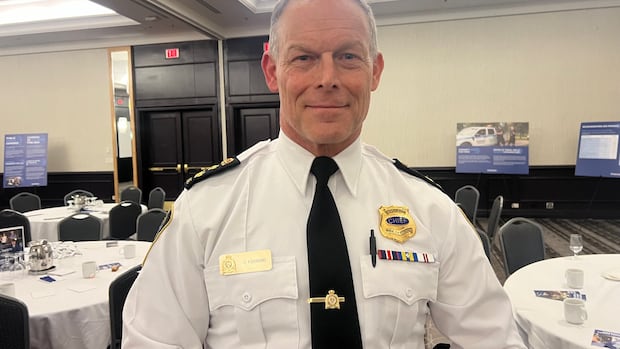
New BrunswickAt an open house event Wednesday night, Fredericton city and police officials spoke about the challenge of addressing rising rates of mental health needs and homelessness, stressing a need for help from other levels of government. Police, city highlight challenges of mental health, addictions and homelessnessSam Farley · CBC News · Posted: Dec 11, 2025 5:00 AM EST | Last Updated: 3 hours agoListen to this articleEstimated 4 minutesThe audio version of this article is generated by text-to-speech, a technology based on artificial intelligence.Fredericton Police Chief Gary Forward said it’s a challenge for officers to address systemic issues of addiction and mental health during a brief interaction with someone in crisis. (Sam Farley/CBC)Fredericton city and police officials say they need help from other levels of government to face down the challenge of rising rates of mental health needs and homelessness.“We only own part of this. As a municipal government, we have police. We are responsible for policing, they can’t get to root causes,” Mayor Kate Rogers said during a speech at a public safety open house on Wednesday night.Since she was first elected to council in 2012, Rogers said socioeconomic issues have become more prevalent in the city as the broader society fails to address them.The audience of about 75 people included about 15 officers, most city councillors, and some members of the public.Rogers, chief administrative officer Steve Hart and police Chief Gary Forward each spoke, highlighting several public safety initiatives recently launched by the city.The main focus was the previously announced 47 recommendations made by a community safety task force, which allow progress to be tracked online. Only a handful are under the city’s jurisdiction, while most are responsibilities of the provincial and federal governments.“As a community, you shouldn’t care whose jurisdiction is what. As citizens, you should just care that you’re getting good services and that you feel safe and you feel secure,” Hart said. Brochures at the event highlighted increased trail lighting and the community safety services unit, a squad of security officers with the city that patrol trails and downtown areas. Another brochure detailed a new security camera registration program, which the department said has had 194 people register their cameras so far. Hart said the reality is that the city “can’t police our way out of this issue.”Fredericton CAO Steve Hart said the city can’t police its way out of larger issues that need to be addressed by higher levels of government. (Sam Farley/CBC)While the city can boost police staffing or add more trail lighting, “none of that is going to substantially make improvements until such time as we have mental health supports and supportive housing supports and access to addictions treatments regularly and frequently across the province,” he said. While Hart highlighted the community safety services unit, he admitted that beefing up security in key areas can simply push crime to farther outlying areas or different neighbourhoods. “And we can’t blanket the city with security forces. I don’t think any of us would want to live in a community that felt like that,” Hart said. Forward spoke to challenges the police face when called to a scene with a person who has severe mental illness built up over “decades of trauma.”“And there is relatively little that we can do as a law enforcement presence. We cannot solve somebody’s addiction in a five-minute conversation,” Forward said.He said most of the force’s calls for service used to involve less urgent matters such as petty crime. A unit of retired officers was created in February specifically to tackle those issues and Forward said they’ve received just over 1,400 files so far.Forward said a new unit dedicated to less urgent police matters has received 1,400 files since February. (Sam Farley/CBC)“That’s a step in the right direction,” Forward said, adding that it allows frontline officers to spend more time on serious or urgent calls. During a brief question and answer session, one resident asked officials how they reconcile a “disjointed” feeling between their argument that policing can’t solve everything without help from other levels of government while simulatenously increasing spending for public safety initiatives.Rogers said she felt it was important for council to be “doing all that we should within our authority to solve” some of the societal issues, while at the same time clearly carving out which levels of government are responsible for what. Forward echoed Roger’s comments, acknowledging the taskforce’s recommendations are not a “fantasy” that will solve every problem.“But for the first time in a while, I feel that at least now we’re making steps and gains in the right direction, Forward said. “It’s going to continue to be disjointed, but with each recommendation that’s resolved, I think it becomes a little bit more fluid.”ABOUT THE AUTHORSam Farley is a Fredericton-based reporter at CBC New Brunswick. Originally from Boston, he is a journalism graduate of the University of King’s College in Halifax. He can be reached at sam.farley@cbc.ca
Cant police our way out of this, Fredericton official tells meeting on public safety