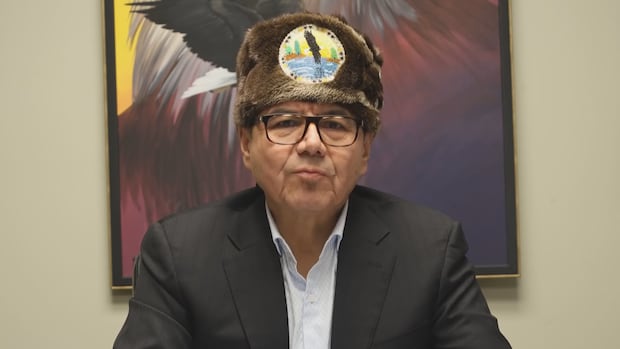
The chief of Manitoba’s most populous First Nation says his band is exploring legal options after its real estate trust sold most of a former golf course near Winnipeg to a property developer who used to advise the band and the trust.Peguis First Nation Chief Stan Bird said he’s seeking accountability after the 2021 purchase of the former Meadows golf course in East St. Paul and the 2024 sale of most of that land to a numbered company controlled by developer Andrew Marquess.”We are currently reviewing our legal options around this sale,” Bird said in a Nov. 22 video address on Facebook.Marquess received at least $4.4 million between 2021 and 2023 for consulting work he conducted for Peguis and its real estate trust, according to documents obtained by CBC News and a list of payments provided by the band’s chief and council.That work included the 2021 purchase of the Meadows land, utilizing $10 million worth of money Peguis received to settle broken treaty promises along with a $5.5-million loan from a numbered company controlled by Marquess’s wife, Maureen Diamond, according to court records.Marquess’s numbered company received 90 per cent of the Meadows land in 2024 in exchange for a promise to pay Peguis First Nation Real Estate Trust $10 million within seven years, according to a purchase and development agreement obtained by CBC News.In his Facebook address, Bird raised several concerns about the sale and said some of the former trustees of the Peguis First Nation Real Estate Trust “must be held accountable” for a lack of transparency.Bird said band members should have had a chance to vote on the transfer of $10 million from the Peguis Treaty Land Entitlement Trust — which governs funds the band received to settle the federal government’s historic land debt to the First Nation — to the real estate trust, which bought the Meadows land.An aerial view of the former Meadows Golf Course, most of which is now controlled by former Peguis adviser Andrew Marquess. (Rural Municipality of East St. Paul Secondary Plan)According to the Peguis Treaty Land Entitlement Trust agreement, transferring funds from one trust to another trust requires band member approval.”This did not happen, and it is in breach of the treaty land entitlement trust,” Bird said in the video, referring to a provision that requires a vote involving 90 per cent of eligible band members, and a 75 per cent supermajority, to approve transfers of funds from the band’s Treaty Land Entitlement Trust.Bird also said trustees did not deliver audited financial statements or report to the band, as required by their trust agreement. An August 2024 letter to the real estate trustees — provided to CBC News by lawyer John Gailus, who represents Peguis First Nation — stated the trustees “must comply with the terms of the trust agreement” and provide council with 2023 audited financials, plus written annual and activity reports for 2021 through 2023. Gailus said Peguis’s chief and council never received those documents. The real estate trust eventually posted audited financial statements for 2021 and 2022 to its website. The documents are dated 2024, and it’s unclear when they were added to the site.Neither the trustees with the Treaty Land Entitlement Trust nor the current Peguis First Nation Real Estate trustees responded to requests for comment.Bird declined further comment, stating his Facebook added was “as thorough as I could be.”Developing land ‘a fight’ from the start: former trusteeGreg Stevenson, the former chair of the Peguis First Nation Real Estate Trust, said he was not aware a vote was required to transfer funds between two trusts.”I don’t know the fine print for that,” he said.Stevenson said it took a while to complete audits for 2021 and 2022 because “we were doing so much,” and the 2023 audit is not public because the trust owes money to its auditing firm.”They’re not going to release those audits until we pay them,” he said. “They’re done. They’re just not paid for.”Stevenson, who described Marquess as a friend, blamed Bird for the trust’s inability to develop the Meadows land.”It was a fight right from the very beginning when he got in, and it’s still a fight today,” he said, referring to a cease-and-desist order issued by Chief Bird and Council and lawsuits initiated by the band after Bird became chief.On March 1, 2024, Peguis chief and council ordered the real estate trust to cease all operations until audited financial statements were provided, according to a band council resolution. At that point, no audited statements were produced for the real estate trust, which had been operating since 2021.”When [those] type of actions are taken publicly, it pretty much stops us from developing because nobody wants to work with us.”Stevenson and the real estate trust’s other former trustees were replaced in January 2025 after Peguis held an overdue vote to elect new trustees. The former trustees were appointed by chief and council in the summer of 2021 when the band was led by Glenn Hudson, who served as Peguis’s chief from 2009 to 2015, and then again from 2017 to 2023. He was defeated by Bird in a 2023 election Hudson is still contesting in court.Bird blamed the Meadows saga on Hudson.”This unusual transaction is only the latest in a series of bad deals that were spearheaded by former chief Glenn Hudson,” Bird said in the Facebook video. He also cited MJardin, a failed cannabis grow business, and a stalled Peguis development at Assiniboia Downs. According to land titles, the racetrack land currently has a $7-million mortgage owing to the Manitoba Jockey Club Inc and a $127-million mortgage owing to now-insolvent lender Bridging Finance, which issued a series of high-interest loans to the First Nation.”As a chief and council, we continue to do our best to clean up the mess that [Hudson] has left behind,” Bird said.Lack of vision in current leadership: former chiefMarquess’s lawyer Kevin Toyne said in a statement in November the Meadows deal is a normal business transaction.Toyne noted in a statement this week that the current Peguis lawsuit against Marquess contains allegations regarding the Meadows transaction. Toyne said Marquess “will continue to vigorously defend himself against all of Chief Bird’s unfounded allegations.” CBC News asked former chief Hudson to respond to Bird’s contention that the Meadows is the latest in a series of bad projects Hudson initiated. Hudson turned the tables on his successor and his council.”If they don’t have that vision and they don’t have that foresight and the knowledge to be able to move a deal forward, then it will be a bad deal,” Hudson said. “Unfortunately, that’s the road it went down with the change of leadership,” he said in a Nov. 25 telephone interview.”It’s sad to see the way things are proceeding in terms of all these lawsuits and defamation of some individuals, including myself.”Peguis First Nation sued Marquess in 2024 over allegations the developer failed to act in the best interests of the band while he consulted for the band and its trust.”I’m one that looks forward and looks at the positive outcomes of things,” Hudson said. “We have too much work to do to address the issues of our people than fighting with our people.”According to a sworn affidavit in Manitoba’s Court of King’s Bench, filed by a lawyer for Marquess after the developer was sued by Peguis First Nation in 2024, Hudson said he was introduced to Marquess in 2019.The former chief said in the affidavit he had his first meeting with Marquess in early 2020 at Winnipeg’s Rae & Jerry’s Steakhouse.Former Peguis First Nation chief Glenn Hudson, centre, and former Peguis consultant Andrew Marquess, right, pose with Prime Minister Mark Carney at a Liberal fundraiser at a Clay Oven restaurant in Winnipeg on Nov. 15, 2025. (Submitted)Marquess began working for Peguis as a consultant in 2020. According to a report he delivered to the band’s chief and council, his work included overseeing a task force to deal with Bridging Finance, the now-insolvent lender that provided Peguis a series of high-interest loans when Hudson served as chief.In that report, Marquess said he was part of the Meadows deal from the beginning.”In the spring of 2021, an opportunity became available to purchase the former Meadows golf course,” Marquess said in the report.Marquess said in the report that in order to make the purchase, the real estate trust used $10 million in treaty land entitlement funds, as well as a $5.5-million loan from his wife’s company, which Marquess called “a related company of mine.”Hudson said in the affidavit that Marquess and a former trustee with the Peguis First Nation Real Estate Trust “had some preliminary discussions” about the purchase of the Meadows land with the managers of a separate Peguis trust —the Surrender Claim Trust, which oversees a $126-million settlement the band received as compensation for being forcibly removed from its lands near East Selkirk in 1907.Those discussions “did not go well,” Hudson said in the affidavit. “The Surrender Claim Trust administrator suggested to Marquess that if he thought Meadows was such a good investment, he should buy it himself.”Hudson’s affidavit said it was his idea to create the Peguis First Nation Real Estate Trust.”I wanted an entity that could pursue initiatives and investments over the long term, without them being dissolved or reversed after each change in PFN [Peguis First Nation] leadership,” the affidavit said.”Andrew’s involvement in the establishment of the trust was to provide advice and guidance on the structure (as did other PFN advisors) and to connect us with financial and legal professionals to implement the trust’s creation,” Hudson said in the affidavit.None of the allegations in the Peguis lawsuit against Marquess have been proven in court.Trustee quit over Meadows concerns: court doc At least one Peguis real estate trustee raised early concerns about the Meadows file. Candace McCorrister, a former treasurer for real estate trust, wrote Hudson in July 2022 to flag a contract with Marquess that granted the developer “full control of this project without our involvement and clauses of legal action if we interfere.”McCorrister’s email, filed in court, said although she was the trust’s treasurer, she was not asked to review the $5.5-million loan from Marquess’s wife. She voiced concern that “we will not be able to repay this amount back” by the time it was initially slated to mature, in 2023.McCorrister resigned from the trust in January 2023, telling Hudson via email her departure was due to “detrimental risks and concerns” she brought forward but were not resolved.Hudson said in his Nov. 25 interview he could not comment on McCorrister’s initial letter, describing it as an internal conversation among trustees.The transfer of most of the Meadows land to Marquess in 2024 resulted in a good outcome for Peguis First Nation, he said.”If it wasn’t transferred, it would have fell in the hands of the lending agency,” Hudson said, referring to a threatened foreclosure by Canadian Western Bank, which lent money to Diamond to lend to the Peguis real estate trust.”They would have claimed that back and then ended up selling it at a lower cost and a lower price, and we would have lost our investment.”So it was a good outcome on what the real estate trust put together.”In an email sent to CBC News in November, Marquess’s lawyer disputed that Canadian Western Bank was going to foreclose on the land.Chief Bird questioned how any Peguis member could praise the Meadows transaction.”How can this type of deal be structured and supported by some of our own people? We are now told that $10 million will be reimbursed to us after seven years, without any security and at a ridiculously low interest rate,” Bird said in his Facebook address.”Yet some, and I emphasize some, of our former trustees believe this was a good deal for Peguis.”A mortgage payable to Peguis “will be registered on title once the applicable provisions of the sale and development agreement have been satisfied,” Toyne wrote in November.As of publication, the mortgage has not been added to the land title.WATCH | Peguis reviewing legal options after land sale to former adviser:Peguis reviewing legal options after land sale to former adviserThe chief of Manitoba’s most populous First Nation says his band is exploring legal options after its real estate trust sold most of a former golf course near Winnipeg to a property developer who used to advise the band and the trust.
Peguis reviewing legal options after sale of former golf course to past adviser