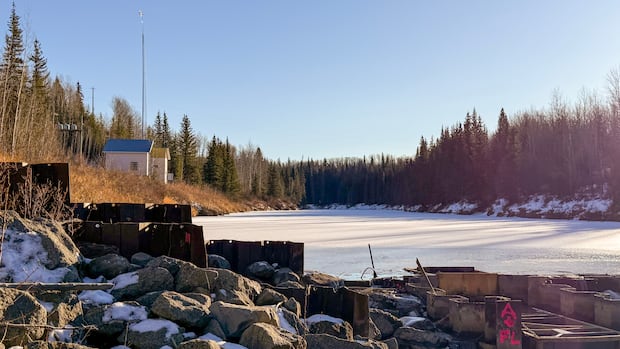
British ColumbiaTo help pay for a new $100-million water pipeline from the Peace River, Dawson Creek wants to sell some of the water it plans to draw to industrial users. But, many stakeholders oppose that plan.Regulator questions city’s industrial water sale plan to offset cost of estimated $100-million projectMatt Preprost · CBC News · Posted: Dec 11, 2025 10:00 AM EST | Last Updated: 1 hour agoListen to this articleEstimated 5 minutesThe audio version of this article is generated by AI-based technology. Mispronunciations can occur. We are working with our partners to continually review and improve the results.View of the Kiskatinaw River where the City of Dawson Creek currently sources its drinking water. (Matt Preprost/CBC)The City of Dawson Creek’s push to fast-track a $100-million water supply pipeline to the Peace River is drawing both support and criticism from regulators and First Nations in northeastern B.C.To help pay for the project, the city plans to sell surplus water from the new pipeline to industry. However, many stakeholders oppose that plan.The city says it urgently needs the pipeline to secure a new source of drinking water for about 15,000 residents due to ongoing drought in the Kiskatinaw River, from which it currently draws water. To speed up construction, Dawson Creek has asked B.C.’s Environmental Assessment Office (EAO) to exempt the project from a full environmental review.But the B.C. Energy Regulator is pushing back. In a submission to the EAO, it has accused the city of “using water scarcity as leverage to expedite the process for financial gain.”“[The project] downplays what appears to be the primary goal of becoming the largest industry water user and seller in the region, which is problematic,” the regulator wrote.Kevin Henderson, Dawson Creek’s chief administrative officer, rejects those assertions. He says city taxpayers can’t afford to build the pipeline on their own, and that industrial water sales are one way to offset the massive cost.”We have water scarcity without a doubt, we’re not leveraging that,” Henderson said. “The reality for us is funding the project is going to be problematic.”In its own submission, B.C’s ministry responsible for water said the city has provided “no rationale” or information on the “potential market” for the more than 10 million cubic metres of water a year that would be available to for sale.“It is not advisable to permit such a significant volume for water sales by one entity,” reads the statement from Ministry of Water, Land and Resource Stewardship.The Kiskatinaw River near the community of Farmington, B.C., on Nov. 22, 2025. The Kiskatinaw River is at record lows due to ongoing drought conditions in the northeast B.C. (Matt Preprost/CBC)Industry unlikely to buy in, regulator suggestsThe energy regulator says it “fully” supports Dawson Creek’s effort to secure water from the Peace River, but thinks it’s asking to draw too much.It said any potential industrial users would be “unlikely to commit” to the costs needed to haul water from the pipeline as such users like to source water as close to the point of use as possible. It says relying on industry to buy water is “a large financial risk.””With increasing frequency and severity of drought conditions, the focus should not be on increasing availability of freshwater to industry, but instead making reclaimed and recycled water more available,” the regulator said.“This entire process of Environmental Assessment could be avoided and expedited if the City decreased their applied for withdrawal rate and annual volume.”Henderson says Dawson Creek could sell water to be used for more than just oil and gas, including agriculture, food production and wildfire mitigation. “A greater regional benefit that serves not just the city of Dawson Creek, but can serve many uses,” he said. “That only makes sense if you’re going to undertake a project of this scale.”LISTEN | Extreme drought in Dawson Creek forces officials to call a state of local emergency:Radio West12:01Extreme drought in Dawson Creek forces officials to call a state of local emergencyDarcy Dober, the mayor of Dawson Creek, explains the city’s plans to keep water flowing during a state of extreme drought, as well as long term plans to draw water from the Peace RiverFirst Nations raise consultation concernsFirst Nations in the region also oppose the plan for industrial water sales, and say they have not been adequately consulted.The Doig River First Nation wrote the EAO that it “does not support the commoditizing of water especially in the face of cumulative effects, climate change and severe regional water security issues.”First Nations also say the city must fully restore any areas disturbed during the pipeline’s construction, and it must address the ways it has impacted the Kiskatinaw River, where the city has been drawing water since 1942.“Water is a primary focus of the Nation and the Kiskatinaw River is of high cultural importance” Saulteau First Nations wrote.View of the Kiskatinaw River weir at Arras on Nov. 22, 2025. This is where the City of Dawson Creek impounds and intakes its domestic drinking water supply. (Matt Preprost/CBC)City has one year to revise planThe province says Dawson Creek has one year to respond to the concerns and submit a detailed plan, before its makes a decision whether to exempt the project from environmental review. Henderson says the city is willing to work with stakeholders to find creative ideas to make the project work. That could include scaling down the project to address concerns. Northern B.C. city plans highway hose line to avoid winter water shortageThe City of Dawson Creek in northeast B.C. is about to lay more than 50 kilometres of water hoses along the Alaska Highway. As the CBC’s Matt Preprost reports, it’s being done to prevent a local water shortage.But, the city will still be looking at regional needs far into the future, he said.”We don’t need all of that water today. We took the approach of, ‘If we’re going to go through the process, let’s plan for the next 50 to 100 years,'” he said.Subscribe to CBC’s Fort St. John Weekly for a round-up of the best news and stories from B.C.’s Peace and Northern Rockies. ABOUT THE AUTHORMatt Preprost is a reporter with CBC British Columbia based in Fort St. John, covering stories focused on the Peace Region and Northern Rockies. Email him at mathew.preprost@cbc.ca
Province, First Nations push back as Dawson Creek seeks to fast track Peace River water pipeline