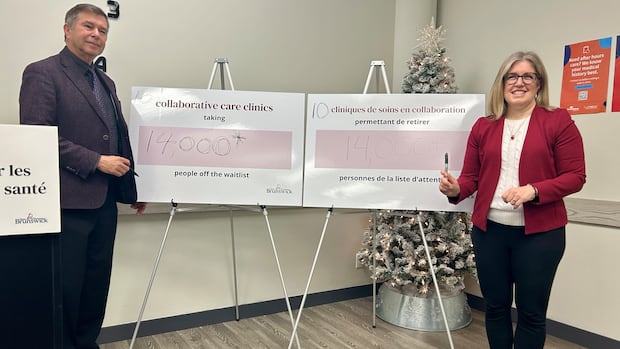
New BrunswickA promise to “establish” 30 collaborative care clinics was the Liberals’ key campaign promise during last year’s election and in their first throne speech in November 2024 they promised there would be 10 by the end of 2025. The 11th was announced in Saint John on Tuesday. The first 11 collaborative care clinics could take 14,000 people off the wait list, province saysSilas Brown · CBC News · Posted: Dec 12, 2025 5:00 AM EST | Last Updated: 2 hours agoListen to this articleEstimated 6 minutesThe audio version of this article is generated by AI-based technology. Mispronunciations can occur. We are working with our partners to continually review and improve the results.Health Minister John Dornan and Premier Susan Holt announced the 10th collaborative care clinic this year on Monday in Bathurst. (Charles-Étienne Drouin / Radio-Canada)As Health Minister John Dornan announced the 10th collaborative care clinic of the year Monday morning in Bathurst, he scrawled 14,000 on a Bristol board at the front of the room. That’s the number of people the government is hoping to match with permanent primary care providers through the clinics.Then he marked an asterisk. It was “a bit of fun because there’s 125,000 [who don’t have a family doctor or nurse practitioner] by our last estimate with N.B. Health Link,” Dornan said. “And so my hope was that we would be not doing 14,000, but 140,000. So it was a bit of a play.”We are determined to have all New Brunswickers attached,” he said.But the province’s target of taking 14,000 from the temporary N.B. Health Link system with these first clinics shows how challenging it will be to make meaningful progress on the 125,000 people without a permanent primary care provider. Dornan said he wrote the asterisk because ultimately he wants to see many more than 14,000 people come off of the wait list. (Victoria Walton/CBC)A promise to “establish” 30 collaborative care clinics was the Liberals key campaign promise during last year’s election, and in their first throne speech in November 2024 they promised there would be 10 by the end of 2025. The 11th was announced in Saint John on Tuesday.Officially, the government’s goal is not to completely clear that list by the end of its mandate. During January’s State of the Province address, Premier Susan Holt and Dornan said they would try to raise the percentage of people attached to a doctor or nurse practitioner from 79 per cent in 2024 to 85 per cent in 2028. Dornan hopes to exceed that number. WATCH | ‘My target is to get rid of the list completely’:Minister ‘determined’ to match N.B. patients with primary care providerThe government hopes the first 10 collaborative care clinics will take 14,000 people off the 125,000-person wait list. “My target is to get rid of the list completely,” he said. “Our current mandate says 85 per cent of New Brunswick should be attached. I think that’s certainly plausible.” “I am aiming for more than that. I think there will be a little bit of momentum as we get more on board, as physicians get comfortable with the new service agreement and realize that collaborative care is very, very positive.”The total number of people without primary care is likely higher than 125,000, since N.B. Health Link captures only people who have signed up to receive temporary care while they wait for a permanent option.Opposition skepticalThe Official Opposition is skeptical of Dornan’s ambitions to address the entire list. “Well, in my heart, we would all want to see 100 per cent of New Brunswickers have access to a doctor, that would be great,” said interim Progressive Conservative Leader Glen Savoie.But he said with the amount of doctors retiring, making real progress on attaching New Brunswickers to primary care providers will require faster action than the government has achieved so far.Interim Progressive Conservative Leader Glen Savoie is skeptical Dornan will be able to accomplish his ambitious goals. (Silas Brown/CBC)“So to be able to say unequivocally that that’s going to happen, well, good luck to him, but I don’t think it’s possible,” Savoie said.If the next 20 clinics were to take a similar number of patients from the list, about 42,000 people would be attached by 2028. And it’s not clear how quickly the first 14,000 people will be matched. In the news release about the Miramichi clinic, the province said 1,000 people will be rostered “within two years.”Dornan admitted that even with the flurry of announcements, it does take time for them to start having an impact on the list of those without primary care. “There’s some that are being attached today and others will be attached to the next weeks, months, within the year, at least. So the 14,000 that we are anticipating don’t all come off the day that we announce a clinic,” he said.“They come off in succeeding days, weeks, months.”Dornan is hoping that as more doctors move away from solo practice to the collaborative team-based model, working with nurses and other health-care providers such as pharmacists and physiotherapists, the patient loads of the clinics will increase.Expanding existing clinics ‘low hanging fruit’How the government tallies clinics is under scrutiny as well. Holt has been clear that not all of the clinics will be brand-new clinics. Of the 11 announced, nearly all of them are expansions of existing clinics with the government chipping in for additional staff, or a larger space. Green Party Leader David Coon said the government is focusing on “low hanging fruit” in order to meet its promised influx of clinics.They “picked community health centres and practices that were already in one way or another collaborating and have invested some money to add staff or create additional space,” he said.“But we’re not really seeing the creation of anything new.”Both regional health authorities have lofty primary care goals themselves, targeting full attachment with primary care practitioners by 2029.Horizon and Vitalité run collaborative clinics, also known as family health teams, that do not count towards the government’s goal of 30 clinics. Those 30 will be clinics receiving some sort of direct support from the Department of Health. But Coon said Dornan’s goals will depend on how the government supports the next 20 clinics: if they continue to expand existing clinics or if they try to establish new ones. “What they did was pick what was already happening. ‘If we put a little more money in there, then that will augment what they can do,’” Coon said.New clinics “cost a lot more money. So this upcoming budget should reflect the true cost of creating new collaborative care clinics as opposed to building on the shoulders of existing ones. And the budget will tell the story whether that’s going to happen or not.”ABOUT THE AUTHORSilas Brown is a Fredericton-based video journalist. You can reach him at silas.brown@cbc.ca.
Health minister wants to see full primary care access by end of mandate, despite 125,000-person backlog