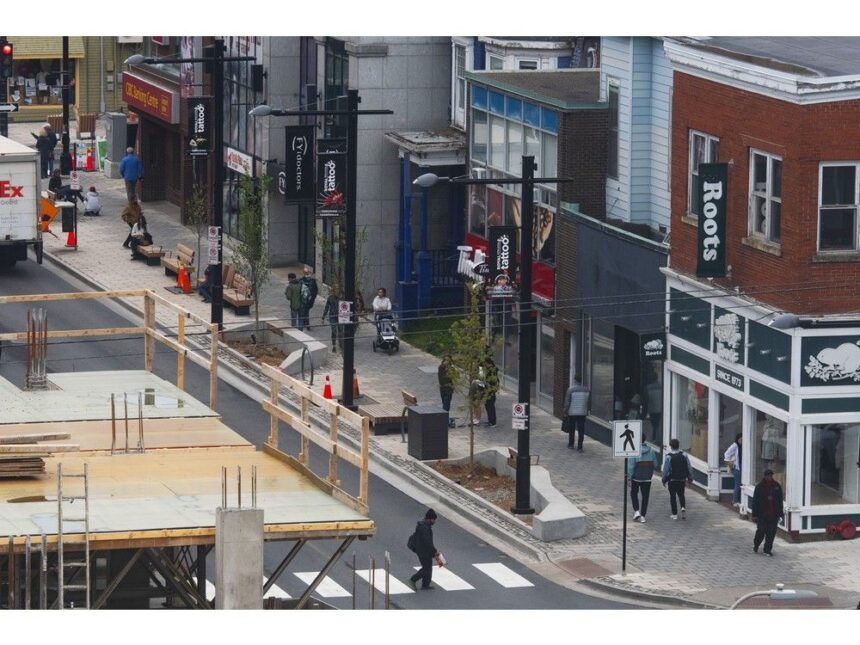
Article contentCoun. Sam Austin (Dartmouth Centre) said he was tempted to vote against it just on principle but agrees with most of the changes and by voting no, “then the province will be in our business more than they already are.”Article content“I think there is a time to fight on this and I think the time to fight on this is going to be when we next take the regional plan forward,” Austin said.Article contentBye-bye ground-floor commercialArticle contentOne of the amendments allows developers to skip a ground-floor commercial space rule for multi-unit buildings starting construction after April 1, 2028. They no longer have to include at least 20 per cent commercial space on the ground floor.Article contentSue Uteck, with the Spring Garden Area Business Association, said she wants HRM to stand up to the province on this.Article content Pedestrians walk along Spring Garden Road in May 2022. Photo by Ryan Taplin /The Chronicle HeraldArticle contentWalkable amenities need to be provided, she said, and this will force people to travel for goods and services.Article contentArticle content“Ground-floor commercial space is vital in sustaining small businesses that drive neighbourhood growth,” Uteck said.Article contentCoun. Laura White (Halifax South Downtown) said it’s issues like these that make it hard to vote in favour of this plan, “when I know it needs to pass anyway.”Article contentBuffersArticle contentHall said that the province is moving HRM backwards in many ways, particularly for the environment with the removal of a 30-metre buffer for watercourses, wetlands and coasts.Article contentWinters said that industry and resident feedback showed concerns about ditching the buffer rule that was approved by council in June and not included in the amendments presented Thursday. She said it would be considered in the review of the regional plan.Article contentHall, who is active with the Williams Lake Conservation Company and one of several residents who spoke on this issue, said that when buffers are reduced, it damages wetlands and adds to wildfire risk.Article contentArticle content“Our city is being robbed of its soul,” she summed up.Article content Williams Lake in September 2020. Photo by Eric Wynne /The Chronicle HeraldArticle contentStephen Adams, a former councillor and now executive director of the Urban Development Institute of Nova Scotia, spoke about his opposition to a 30-metre buffer and that two developments wouldn’t be able to proceed because of it.Article contentBut those could be really small projects, argued Coun. Kathryn Morse (Halifax – Bedford Basin West). She said the buffer was taken out of the plan because of Adams’ concerns.Article content“I find that so unacceptable and poor policy making,” she said.Article contentTony Mancini (Dartmouth East – Burnside) said there’s plenty of scientific evidence to prove that the farther back the better, and he said he hopes the province is listening.Article content“If a developer cannot adjust the design to make it fit, then there’s something wrong with the design.”Article contentRural short-term rentalsArticle contentMost of the speakers spoke out in favour of the amendment supporting rural short-term rentals on the eastern side of HRM. The change allows one unit per lot for residential zones, with no change in other zones.Article contentTerry Black, with the Short-Term Rental Association of Nova Scotia, said it’s great “but it doesn’t go the distance.”Article contentHe said it should extend to the other zones beyond residential.Article contentKim Sorensen is a short-term rental owner and said she’s lost $52,000 because she can’t rent her second property that’s in an industrial zone.Article contentIn the end, only two councillors, Morse and Coun. Virginia Hinch (Halifax Peninsula North), voted against it.Article content
Hands tied, Halifax council approves minimum planning requirements to boost housing supply