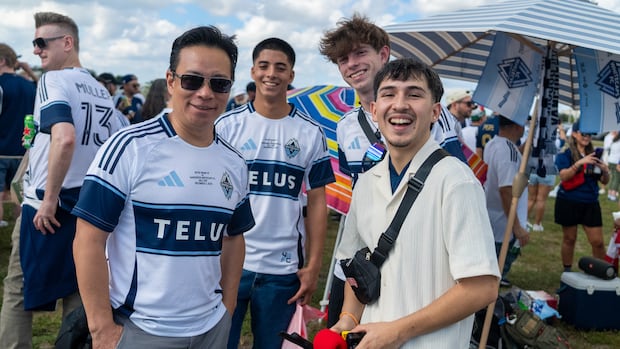
British Columbia·AnalysisThe City of Vancouver’s history began with a land deal between a government desperate for a product and a private corporation with plenty of perceived leverage. Proposed ‘entertainment district’ could involve hotels and condos, and put pressure on rapid transitJustin McElroy · CBC News · Posted: Dec 12, 2025 10:00 AM EST | Last Updated: 3 hours agoListen to this articleEstimated 5 minutesThe audio version of this article is generated by AI-based technology. Mispronunciations can occur. We are working with our partners to continually review and improve the results.Vancouver Mayor Ken Sim takes in the Vancouver Whitecaps tailgate party in Fort Lauderdale, Florida, before the MLS Final, a week before his news conference with the team announcing a memorandum of understanding for a new stadium. (Andrew Lee/CBC)The City of Vancouver’s history began with a land deal between a government desperate for a product and a private corporation with plenty of perceived leverage. In the 1880s, CP Rail agreed to switch their terminus from Port Moody to a smaller settlement further west known as Granville in exchange for 6,000 acres of land in the surrounding unincorporated area. Since then, different areas of Vancouver have been transformed by real estate plays — and the most recent chapter began in earnest on Friday with the memorandum of understanding (MOU) between the city and the Vancouver Whitecaps.“It cannot only be the stadium,” said Whitecaps CEO Axel Schuster, speaking at a press conference where he and Vancouver Mayor Ken Sim announced a plan to develop a new stadium at Hastings Park that, if successful, would replace the current city-owned horse race track.Under the terms of the MOU, the Whitecaps would be financially responsible for building the stadium, while receiving the land at a below-market rate on a long-term lease. However, the real change to the face of Vancouver wouldn’t come from the stadium — but a new “entertainment district” that the Whitecaps would receive continual profits from. Vancouver Whitecaps CEO Axel Schuster says that building a stadium alone would leave the team in a bad financial situation. (Ethan Cairns/The Canadian Press)“If you have to build a stadium in Vancouver and it’s only the stadium, then the cost … will not put you in a financially better situation than we are now,” said Schuster, who has said a better long-term business model for the Whitecaps outside of B.C. Place was necessary to attract new investors.“If we want to build a successful future for this club here, we have to get to a better and financial sustainable situation as a club … so we have to develop a whole plan around this.”The potential lease area for the Vancouver Whitecaps includes both the land at the Hastings Park racecourse for a potential field, but also the adjacent stables and storage that could be used for an entertainment district. (City of Vancouver)A Hilton and a Tap and Barrel? Under the MOU, the lands leased to the Whitecaps would include both the track, and a plot of land of approximately the same size just to east of it, which currently holds the horse stables and other storage area. The idea of a corporately-owned or leased “entertainment district” on public land to subsidize a professional sports team with a privately built stadium would be new to Vancouver.But it’s increasingly common in other North American cities, from the Battery in Atlanta to Hollywood Park in Los Angeles. In this 2017 file photo, a concert venue nears completion in the mixed-use area, featuring restaurants and retail stores at SunTrust Park, at the Atlanta Braves’ Major League Baseball stadium in Atlanta, Georgia. A large complex called The Battery Atlanta now surrounds the stadium. Similar plans are proposed in Vancouver to develop a new stadium and entertainment district at Hastings Park. (David Goldman/The Associated Press)Typically, they have a mix of hotels, restaurants and condos on the site, with varying degrees of direct integration into the stadium.In the case of Vancouver, nothing has been sketched out just yet — but the city understands that an ambitious proposal will likely come to their doorstep and eventually face a number of potentially development and rezoning hurdles. It would also put further pressure on TransLink to develop its long-term rapid transit project that would link the site to the North Shore, Expo Line and Millennium Line. But those details are for another day. “There will be a lot of opportunity to go through a public hearing and make sure it works in the context of our city in the region,” said Vancouver Mayor Ken Sim. “It’s really up to the Whitecaps and their partners to come up with a plan and finance that plan.”WATCH | Vancouver Whitecaps one step closer to getting their own stadium:Vancouver Whitecaps one step closer to getting their own stadiumThe Vancouver Whitecaps are one step closer to getting their own stadium. The team and the city have agreed to negotiate terms for a new stadium and entertainment district at Hastings Park. But as Jon Hernandez reports, there’s no guarantee the project will ever get built. Municipal affairs reporter Justin McElroy follows with analysis. Risk to taxpayers?According to sources with direct knowledge of negotiations in the municipal and provincial government, a core motivation is to keep the Whitecaps in Vancouver without committing taxpayer dollars to their survival. For the moment, this MOU appears to meet that objective. It allows the Whitecaps to focus on the details of a stadium and entertainment district, the city on creating a lease and neighbourhood plan to facilitate it, and the province to negotiate a new lease with the team at B.C. Place in the interim.The province is set to negotiate a new lease with the Whitecaps at B.C. Place. (Ben Nelms/CBC)“We intend to secure a fair market value lease while ensuring no undue financial risk to taxpayers,” said Sim. However, a few minutes later he said “we’ll do whatever is possible to make sure that the Whitecaps have a future in the City of Vancouver.”WATCH | Schuster says there’s ‘no plan B’ other than Whitecaps staying:Vancouver Whitecaps CEO says intention is to keep team in city with ‘no plan B’Axel Schuster, the Whitecaps’ CEO and sporting director, says a proposed new stadium comes at a time when the team’s owners are preparing to sell the city’s Major League Soccer franchise. He acknowledged political turbulence is affecting the team off the field, but he hopes the club’s good start to the season continues.What happens if the Whitecaps say direct financial assistance or additional future tax breaks are required to secure the future of the team? It’s a hypothetical neither the city or the province wants to get into at this point. B.C. Minister of Jobs Ravi Kahlon says no requests have been made regarding provincial assistance in the Whitecaps’ stadium plans. (Ben Nelms/CBC)“We have not had any of those conversations. No requests have been made,” said Jobs Minister Ravi Kahlon, when directly asked if the province would rule it out. “Obviously, when the discussions go forward, we’ll continue to monitor what it is that the city and the Whitecaps finally decide on.” Sim and the Whitecaps repeatedly referred to Thursday’s announcement as a “first step.” Left unsaid was how complicated the many remaining steps are. ABOUT THE AUTHORJustin is the Municipal Affairs Reporter for CBC Vancouver, covering local political stories throughout British Columbia.
How the City of Vancouver’s deal with the Whitecaps could transform the Hastings Park area