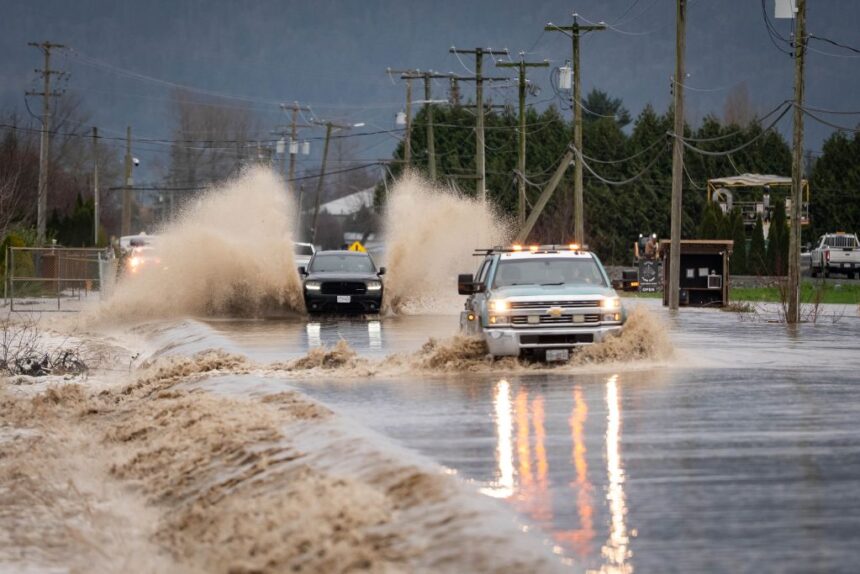
Heavy rainstorms are once again causing flooding in the Fraser Valley region east of Vancouver this week, prompting evacuation orders, highway closures and renewed criticism that the provincial government has failed to adequately prepare. As of the morning of Dec. 11, about 400 properties were under evacuation order, with another 1,800 under evacuation alert. The flooding was triggered by a series of atmospheric rivers that pummelled Washington state and southwestern B.C. with heavy rains. While the rain has temporarily slowed, more is expected to hit the region in the days to come. Atmospheric rivers — the same weather phenomenon that drove catastrophic flooding in B.C. in 2021 — are expected to become bigger and more frequent due to climate change, increasing the risks of major floods. In the wake of the 2021 disaster — which left five people and hundreds of thousands of livestock dead — the provincial government developed a new flood strategy. It committed to improve flood risk mapping, invest in new infrastructure, restore wetlands and other ecosystems to reduce flood risks and invest in community-led initiatives to relocate people from particularly risky areas. Central Fraser Valley Search and Rescue responded as flood waters inundated areas of Abbotsford, B.C., on Dec. 11. While Emergency Management and Climate Readiness Minister Kelly Greene said lessons learned in 2021 were being implemented during this flood event, some warn the province still hasn’t made enough investments in flood mitigation. Photo: Ethan Cairns / The Canadian Press But with Fraser Valley communities once again inundated with water, some question the government’s commitment to address flood risks. Tyrone McNeil, president and Tribal Chief of the Stó:lō Tribal Council and chair of the Emergency Planning Secretariat, said B.C. has been too slow to act. “They’re just not doing enough on resilience,” he said in an interview Thursday, noting the province has yet to invest in the new flood strategy. “It’s a great policy, but it’s troublesome that there’s no resources to actually implement it,” he said. In September, B.C. municipalities were told there was no new funding available for the flood strategy due to a growing provincial deficit. Though many municipalities have proposed projects to mitigate flood risks, representatives say they require funding from higher levels of government to implement them. “I get that the province is crying poor right now,” McNeil added. “But there’s got to be a way they can find funds for these proactive activities that keep people dry.” Dozens of farms with livestock faced evacuation orders As of Thursday morning, 66 farms with livestock were under evacuation order, with another 99 under evacuation alert, Agriculture and Food Minister Lana Popham said during a flood briefing. While the water levels are not as high as they were during the 2021 floods, Casey Pruim, board chair of the BC Dairy association said, “It’s still drastic and has a huge impact on the families.” Pruim, who is also a dairy farmer, is not directly impacted by the current floods. But he is concerned about a lack of investment in flood protection. He said communication with the Ministry of Agriculture and emergency operations has improved relative to the 2021 floods. “What, more importantly, has absolutely not improved is the level of investment in flood mitigation,” he said. “It’s definitely concerning and for our friends who are living in the Sumas Prairie, it’s devastating,” he said. “I don’t think you can put into words the impact it has on these families.” During the flood briefing Thursday, Popham said she had been in direct contact with farmers. Buildings on Jem Farms flooded near the Sumas border crossing in Abbotsford, B.C., on Dec. 11, in the wake of another severe atmospheric river. As of Dec. 11, 66 farms with livestock were under evacuation order in B.C. Photo: Ethan Cairns / The Canadian Press “I can tell you that the theme of a lot of those calls has been that, yeah, they’re pretty worried but they feel more prepared and so I think that’s going to be really helpful as we watch the next 12 hours play out,” she said. Emergency Management and Climate Readiness Minister Kelly Greene warned Thursday that “we are not yet through this emergency.” She said the ministry was holding regular coordination calls with at-risk communities and was continuing to deploy sandbags, tiger dams (large tubes that can be filled with water to form a flood barrier) and other flood defence assets to protect properties and livestock. At the same time, geotechnical experts were on the ground to assess risks across the region. Aaron Sutherland, vice-president of the Insurance Bureau of Canada, called these latest floods a “wake up call.” The bureau estimates insured damages from the 2021 floods reached $675 million, making it, at the time, “the most costly severe weather event in the province’s history.” Non-insured losses from 2021 flooding were estimated to range from $1.5 to $4.7 billion, according to research from Vancity and the Canadian Centre for Policy Alternatives. Sutherland noted there hasn’t been a major flood event in the Fraser Valley since 2021 and he worries that may have lulled folks into a “false sense of security.” “What we’re seeing in Abbotsford here, once again, is a reminder that we need to be increasing our investment to better protect our communities and particularly in those high-risk areas,” he said. While the insurance industry in Canada does offer home insurance with flood protection, it’s only available to 90 to 95 per cent of British Columbians, Sutherland said. And, the five to 10 per cent of people who can’t access it are those living at highest risk of floods, he explained. What that means is the people directly affected by the current flood situation likely don’t have insurance for it, he said. Instead, they’ll be reliant on government disaster assistance. “Government is going to be paying for it one way or the other,” he said. It’s “much better to pay for it on the front end by building that resilience than pay for it year after year after year through disaster assistance and other government programs to pay for the recovery.” As severe storms grow more frequent, some call for managed retreat in flood-prone areas While climate change is driving more intense rainstorms, flooding has also become a significant risk in the Fraser Valley due to colonization and ongoing development. In 1924, Semá:th Xhotsa, or Sumas Lake, was drained and converted to agricultural land, which is now known as Sumas Prairie and is among the most fertile farmland in B.C. The lake, which supported salmon and sturgeon, as well as food and medicinal plants, had served as a natural flood mitigator, absorbing freshet, or heavy rains and snow-melt, from the Fraser River. A shadow of the lake returned in the 2021 floods, reopening the sensitive question of managed retreat and the possibility of allowing a portion of the lake to return to both reduce the risks of flooding and support wildlife. Since the disaster four years ago, Semá:th First Nation, Leq’a-mel First Nation, Máthxwi First Nation, the cities of Abbotsford and Chilliwack and the province signed a collaborative framework for flood mitigation in the Sumas River watershed. In an interview with The Narwhal last year, Murray Ned, executive director of the Lower Fraser Fisheries Alliance and an advisor to Semá:th First Nation, warned that with communities grappling with so many other urgent issues, preparations for the next flood too often fall by the wayside. Tyrone McNeil, president and Tribal Chief of the Stó:lō Tribal Council and chair of the Emergency Planning Secretariat, warned B.C. hasn’t done enough to build flood resilience. Photo: Jesse Winter / The Narwhal McNeil said there are key steps the province should be taking to build flood resilience. Developing better modelling to understand the risks of heavy rainstorms, for instance, would help identify the most at-risk flood areas. There are also hundreds of kilometres of historically fish-bearing streams through the Fraser Valley and the Lower Mainland that have been cut off from the Fraser River by railways, roads and dikes, McNeil said. “Those are the same waterways that are going to be trying to carry this rainwater off the mountain sides, off the valley floor into the river, but they can’t make it,” he said. “My concern there is that farmers’ fields remain flooded a lot longer than they need to, lower-lying roadways are covered because the surface water can’t shed into the Fraser.” Some of those waterways should be reopened and reconnected to the Fraser River, he said, not only to help clear out flood waters, but also to restore ecosystems. — With files from Steph Kwetásel’wet Wood and Michelle Cyca Recent Posts B.C.’s failure to fund flood response ‘troublesome’ as atmospheric river strikes again Dec. 12, 2025 7 min. read Rising waters closed highways and forced evacuations, prompting fresh criticism that the province has been… A decade of fighting over a controversial mining project in Manitoba — and still no decision Dec. 12, 2025 24 min. read The Sio Silica sand mine southeast of Winnipeg was proposed, then rejected, then reviewed, then… In Tlingit territory, the fight to protect herring is complicated Dec. 11, 2025 19 min. read An excerpt from “We Survived The Night” by Julian Brave NoiseCat
B.C.s failure to fund flood response troublesome as atmospheric river strikes again