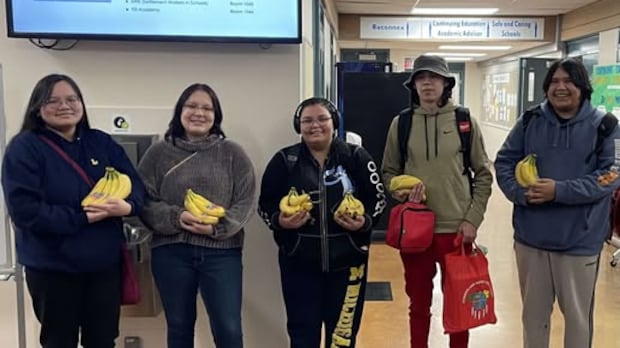
IndigenousA group of young adults from Cumberland House Cree Nation travelled to British Columbia in November to take part in The Ballantyne Project, a program designed help them develop the skills needed to succeed should they decide to move away from their home north of Saskatoon.The Ballantyne Project teaches young adults the basics of living off-reserveLouise BigEagle · CBC News · Posted: Dec 12, 2025 5:18 PM EST | Last Updated: 1 hour agoListen to this articleEstimated 4 minutesThe audio version of this article is generated by AI-based technology. Mispronunciations can occur. We are working with our partners to continually review and improve the results.A group of young adults from Cumblerland House travelled to Maple Ridge, B.C. in November to learn life skills including planting, cooking and financial management. From left: Ethel Cook, Janay Stewart, Shineal Settee, Brant Budd and Maddox Laliberte. (Submitted by Dwayne Ballantyne.)A group of young adults from Cumberland House Cree Nation travelled to British Columbia in November to take part in a program designed help them develop the skills needed to succeed should they decide to move away from their home northeast of Saskatoon.Ranging in age from 18 to 30, the group spent 10 days at the Bridge House in Maple Ridge, B.C., home of The Ballantyne Project.Born in Montreal Lake Cree Nation, about 450 kilometres north of Saskatoon where he lived until he was 21, Dwight Ballantyne grew up wishing more resources were available in the northern community. Dwight Ballantyne left his home in Montreal Lake Cree Nation when he was 21. Nine years later he is working to widen the horizons of young adults who face the same problems he did when it comes time to decide on a path in life. (The Ballantyne Project’s Facebook)“There’s challenges, barriers and opportunities that I’ve never had until I turned 21,” Ballantyne said, “so the whole thing was to give the opportunity to youth who may want the opportunity to see what’s out there.” Maddox Laliberte, who was part of the November group, agrees.Laliberte, 20, says growing up in a remote community such as Cumberland House is isolating, making it difficult to learn about the outside world. He is certain the skills and values he learned during his stay will help him should he choose to leave his community for school or work.“In the beginning [it] was kind of a culture shock, but in a good way,” Laliberte recalled. “It’s showing me what are the possibilities that could be waiting for me in the future.”Laliberte, who graduated from high school two years ago, says he learned about time management, budgeting and even simple tasks such as cooking and cleaning for yourself during his stay at Bridge House.“This program is really inspirational. I feel like I could accomplish things going out in the world,” Laliberte said, adding he has learned the ability to say yes to things he might once have been afraid to try.Lalberte says the experience was terrific, especially since he got to share it with people he grew up with.“This program is beautiful, amazing, and it gave me confidence to go out in the world,” he said.Alex Pennock, far right, an instructor with the Ballantyne Project, instructs the group on planting and determining what will grow best. (Submitted by Dwayne Ballantyne)“It’s way different out here [in B.C.] than in Saskatchewan,” said Janai Stewart, 19, who had never travelled outside of Saskatchewan before her trip to Bridge House. She graduated from high school and left her community to find work in Saskatoon.“I’ve just been learning about new things that I’ve never known before, like a credit score — how to maintain it — and how to pay for your bills on time and budgeting,” Stewart said.Stewart says she learned how to handle food safely and other skills she can show on her resumé when looking for employment.Stewart says the program taught her and he companions how to be independent while also getting to know each other better: “Just connecting with one another, building better, stronger bonds with one another.” With seven bedrooms and six bathrooms, the Bridge House can host up to 10 youths and two chaperones taking part in the Ballantyne Project. (Submitted by Dwayne Ballantyne.)While acknowledging he has no teaching certificate or formal training, Ballantyne says growing up on a reserve means he understands what it’s like to lack the chance to improve skills and education, and what is needed to do so.During their stay the youths learn about different types of opportunities, including exposure to trade schools, colleges and universities.As well, they’re taught basic life skills ranging from financial literacy, including how to get a bank card, to how to book a medical appointment.“We want to get them all the stuff that they may need to succeed, so they can put that stuff on their resumé,” Ballantyne said.Ballantyne says he designed his project to give youth a head start should they decide to leave the reserve, while not ending up meeting the wrong people as he had.“A lot of people on reserve are scared to leave, which is fair, and most times they don’t because they don’t have the support or the guidance to hold their hand,” Ballantyne said. Ballantyne says he wants to inspire the youth to chase their dreams, and while you can make a life out of yourself on reserve it’s OK to pursue things in the wider world.“They deserve a chance too, just like everybody else in this country,” Ballantyne said.The Ballantyne ProjectABOUT THE AUTHORLouise has been a journalist with CBC since September 2022. She is Nakota/Cree from Ocean Man First Nation. She holds a bachelor of fine arts from the University of Regina. Louise can be reached at louise.bigeagle@cbc.ca.
Cree group travels to B.C. to learn life skills needed to succeed in an urban world