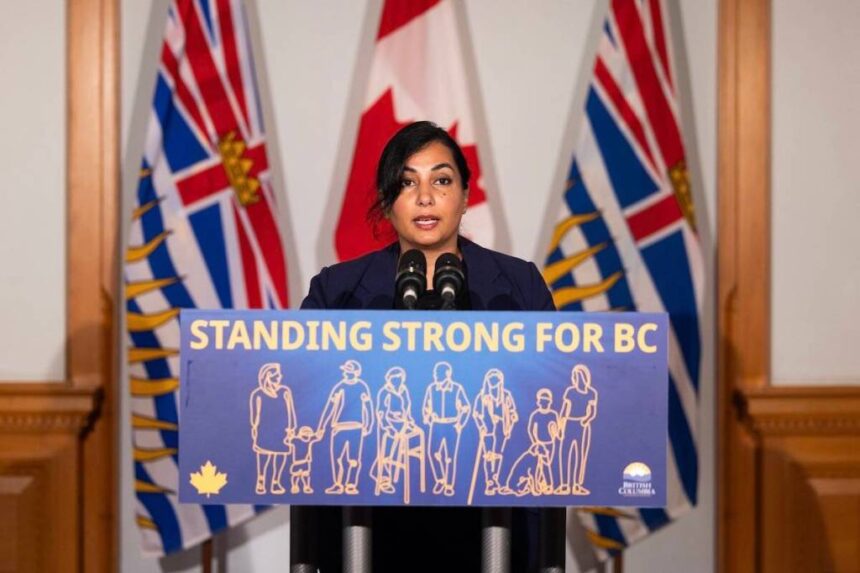
Published 3:02 pm Friday, December 12, 2025 By Lauren Collins and Mark Page The B.C. government has filed a notice of civil claim against vaping giant JUUL, alleging the company deliberately made its products more addictive and designed them to be attractive to young people. Premier David Eby said he wants to “hold the company accountable” in similar ways that opioid and tobacco manufacturers were. “We want to prove in front of the court that we believe that JUUL targeted young people, put in nicotine salt additives in their product to make it more addictive,” he said. “And had negative effects on the health of our young people as a result.” Attorney General Niki Sharma said in a written statement on Friday (Dec. 12) that the claim was filed in B.C. Supreme Court under the new Vaping Product Damages and Health Care Costs Recovery Act, which specifically authorizes the government to recover public health costs from electronic cigarette manufacturers. It’s the first civil claim launched under the act, but Sharma said it will not be the last. She added that other manufacturers and wholesalers are also under consideration for litigation for their role in what she called a “public health crisis.” Sharma’s statement says JUUL was an “early and significant contributor to vaping-related public harms, engaging in deceptive marketing practices aimed at youth to maximize its profits at the expense of people’s health and at significant cost to our public health system.” She also blamed JUUL’s “youth-friendly flavours” for addicting young people to nicotine. Rob Cunningham, a lawyer for the Canadian Cancer Society, said he strongly supports the province’s decision to sue and target the market behaviour of vaping companies. “We’ve had such success in reducing new smoking,” he said. “And we do not need a new generation of kids becoming addicted to nicotine through e-cigarettes.” Cunningham also wants other companies held accountable in addition to JUUL. He pointed to the tobacco lawsuits as an example of a case in which several companies were sued jointly. There could be downsides to this approach, though, because it adds complexity. Earlier in 2025, the province received the first payment of nearly $1 billion from the landmark $3.6-billion tobacco settlement. The provincial government – on behalf of other federal, provincial and territorial governments – also filed a lawsuit to recover the costs from 1996 onward from the consultancy firm McKinsey. The lawsuit alleges McKinsey promoted opioid use. San Francisco, Calif.-based JUUL is also being targeted first because it has already been sued in the United States, with a base of evidence already established, Eby said. Cunningham said this evidence includes internal JUUL documents that have since become publicly available. There is also a yet-to-be-certified class action lawsuit filed against JUUL in the B.C. Supreme Court. Any evidence introduced in that case could be used in the province’s civil suit.
Province of B.C. files claim against vaping giant JUUL