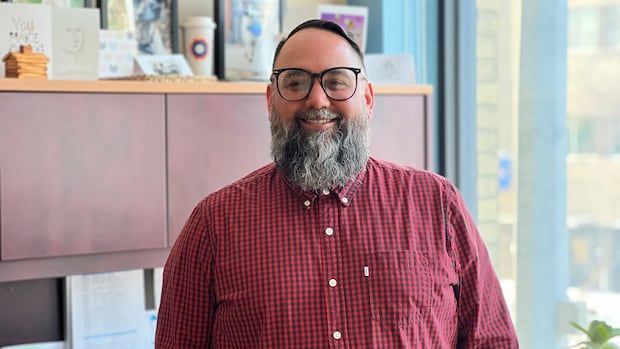
ManitobaCommunity organizations are asking the City of Winnipeg to rethink its new encampment restrictions due to the limited availability of permanent housing.’There’s no available housing for us to access,’ says Jamil MahmoodNathan Liewicki · CBC News · Posted: Dec 12, 2025 10:46 PM EST | Last Updated: 5 hours agoListen to this articleEstimated 4 minutesThe audio version of this article is generated by AI-based technology. Mispronunciations can occur. We are working with our partners to continually review and improve the results.Jamil Mahmood, executive director of the Main Street Project in Winnipeg, says the there’s no access to available housing for people forced out of encampments by the city. (Felisha Adam/CBC)Community organizations are asking the City of Winnipeg to rethink its new encampment restrictions due to the limited availability of permanent housing.The Mostyn Park encampment in West Broadway was cleared out by city crews Wednesday, prompting organizations like Main Street Project and the West Central Women’s Resource Centre to scramble to find housing for a handful of homeless people.Other encampments, including ones at Pacific Avenue and Ellen Street, and on Empress Street near Omand’s Creek, have been cleared away since the rules were put in place by the city last month.People are not permitted to remain in encampments during daylight hours, and they are prohibited within 50 metres of schools, daycares, playgrounds and skating rinks.Encampments are also not allowed within 30 metres of transit shelters, docks, bridges and some public facilities.The Main Street Project, which works with the city to find housing for people in encampments, is still trying to figure out how to best assist people forced to leave behind makeshift tents and belongings.A no trespassing sign is pinned on a fence near Mostyn Park on Friday. (Felisha Adam/CBC)Jamil Mahmood, the project’s executive director, says in the case of Mostyn Park, there was no housing available, and his team was forced to find temporary beds because the city put up no trespassing signs.“Right now, there’s no available housing for us to access. So we’re kind of left trying to figure out a shelter option as a short-term kind of gap filler,” he said Friday.“We’re not getting the housing that we need to be able to offer people good housing so they have a place to move from an encampment.”He estimates seven people were able to get beds at the Salvation Army after Mostyn Park was cleared out, but some individuals have already left the shelter, opting to go to another encampment or seek other arrangements. Mahmood says that’s a major concern.“We don’t know where they are, aren’t able to provide them with resources and services, or support them. So that creates some challenges,” he said.On top of that, winter has arrived, so finding temporary shelters is already difficult.’Violation of people’s human rights’Lorie English, is the executive director at the West Central Women’s Resource Centre.Like Mahmood, she says the city’s new policy on encampments has put her organization in an “awkward” position.“It’s really making our work much more difficult when we’re trying to connect and build relationships with people, build trust so that they trust us to move them into supportive housing,” English said.“Now we’re in a position where every day we don’t know where they might be the next day because encampments are being taken down before we’ve had an opportunity to make an offer of housing.”Lorie English, executive director of the West Central Women’s Resource Centre, believes the encampment ban is a violation of people’s human rights. (Felisha Adam/CBC)English says the women’s centre, which opened in August and is funded by the province, has transitioned just over 60 people into adequate housing through the province’s homelessness strategy.She considers the city’s stance on encampments “quite restrictive,” particularly for females and gender-diverse persons.“We need to respect the fact that people have the human right to exist wherever they can, and quite frankly, we feel like the encampment ban is a violation of people’s human rights,” English said.She would like to see enhanced communication between the city, province and the community to find a way forward where everybody’s needs can be met.“We also need to recognize that if we make the work that’s already complicated even more complicated, it will take us even longer to house the folks that are currently living unsheltered,” English said.She emphasized that housing supports need to be in place before individuals are banned from encampments, otherwise “we’re really just chasing the problem around the city rather than actually solving the problem.”CBC asked the city how many people have been relocated since the new rules were put in place and whether they were put into permanent housing, but the city hasn’t provided any specific information.ABOUT THE AUTHORNathan Liewicki is an online reporter at CBC Manitoba. He was previously nominated for a national RTDNA Award in digital sports reporting. He worked at several newspapers in sports, including the Brandon Sun, the Regina Leader-Post and the Edmonton Journal.With files from Felisha Adam
Winnipeg homeless support groups struggling to find housing as more encampments are cleared out