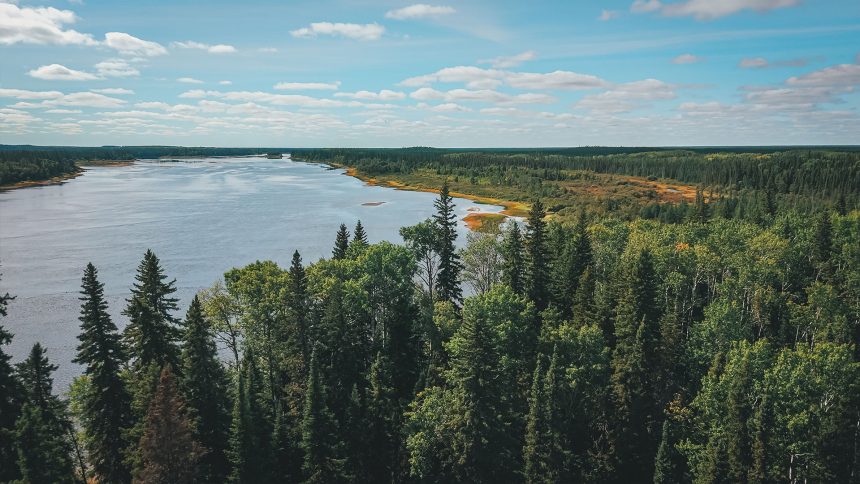
A First Nations organization in northern Ontario is challenging the federal government’s approval of a road to the Ring of Fire, a mineral-rich region in northern Ontario. In its request for a judicial review filed on July 23, Friends of the Attawapiskat River said that Ottawa is ignoring its own federal impact assessment that found construction of the road will cause “significant” damage to the environment and Indigenous rights. Despite this, Environment and Climate Change Minister Julie Dabrusin approved the project, stating that despite the adverse effects that will be caused, the project is “justified in the public interest.” The 107-kilometre all-season, gravel road was proposed by Webequie First Nation, located in Treaty 9 territory. Its main function is to support future mining projects in a 5,000-square-kilometre area of the James Bay Lowlands called the Ring of Fire, located about 500 kilometres northeast of Thunder Bay. It’s one of three roads proposed for the area. The area is known for its abundance of critical minerals needed in the green economy but has sat dormant for decades. According to the request for judicial review, this road is going to destroy a “globally significant carbon storage powerhouse that is the peatlands, the stewardship of lands, waters and recovery of biodiversity…” “The development of this Project would transform the lands and waters in an otherwise pristine region, through the construction of additional roads, mineral exploration including line cutting and borehole drilling, the construction of transmission lines and other linear infrastructure, and mining activities associated with the proposed Black Thor, Black Label, Big Daddy and Eagle’s Nest mines, among others,” said the application for judicial review. “The Project would impact lands and waters of profound importance to the Friends who have relied on the Attawapiskat River since time immemorial.” A judicial review is a request to the Federal Court to have a government’s decision scrutinized to ensure that it followed the Constitution and properly applied its own policies. A court can order the government to review its decision. A map of the Ring of Fire in northern Ontario. This is the first legal challenge to the Webequie road. The government, long criticized for its inability to get major projects underway, is looking at this from an economic perspective. “The Designated Project is proposed by Webequie First Nation and is an opportunity for economic reconciliation and self-determination,” Dabrusin wrote in the impact assessment. “The Designated Project would likely create employment and economic opportunities for Webequie First Nation community members and potentially members of other Indigenous groups…” But according to the minister’s report on the impact assessment, the likely effects of the road construction would “result in net positive GHG emissions.” Dabrusin’s report said that the effects of the project would not result in a “net positive contribution” to Canada’s meeting its environmental obligations or its “ability to meet its commitments in respect of climate change.” According to the judicial review, filed by Legal Advocates for Nature’s Defence, Dabrusin “improperly excluded any consideration of the project’s negative effects on biodiversity and climate change.” She also “selectively placed more weight on potential positive effects of the Project on Indigenous rights and sustainability, while ignoring the negative effects on Indigenous rights and sustainability.” According to its website, Friends of the Attawapiskat River is a “Treaty 9-based Indigenous grassroots group dedicated to protecting the health and integrity of the lands, waters, peoples, and future generations that would be impacted by the proposed Ring of Fire, including downstream communities along the James Bay coast.” “Crucial to protecting our traditional territory, which includes all people, is making sure Canada simultaneously upholds their obligations to the environment, Treaty, and the world,” wrote Michel Koostachin, a member of the group and an applicant in this request for review. “As community members, we have a say – from the day we are born. We have inherent rights, we have sovereignty rights. Future generations will ask us, ‘why didn’t you say something’? This judicial review is for them: it’s us using our rights.” Pushing through projects Both Canada and Ontario are pledging to build big projects faster. On June 24, 2025, the federal government fast-tracked Bill C-5 – the Building Canada Act – to do just that. Passed with almost no debate or consultation, the Act gives the minister overseeing a project the power to bypass a number of federal laws already on the books, mostly having to do with the environment, if it deems the project is in the interest of the Nation. It also opened the Major Projects Office to streamline requests. It currently has nearly two dozen projects on the books that are either under review or approved. A recent approval, also in northern Ontario, was given the green light despite several severe adverse effects to both the environment (fish and migratory birds) and to the rights of a half dozen First Nations in the area. According to Dabrusin’s approval, the Crawford Nickel Mine north of Timmins also fell under the category of a project that is “justified in the public interest.” Ontario has a similar law to Canada. Like the federal government, it pushed through the Protect Ontario by Unleashing our Economy Act with little debate or consultation. It allows the provincial government to suspend laws, even the rights of municipalities, if it wants a project to go ahead. Premier Doug Ford said that the first project to fall under this act would be the Ring of Fire. On June 25, Webequie First Nation Chief Lorraine Whitehead joined Ford at a news conference to kick off construction of the road. The judicial review of the road has not been approved. Continue Reading
Friends of the Attawapiskat River file for judicial review over road to the Ring of Fire



Leave a Comment