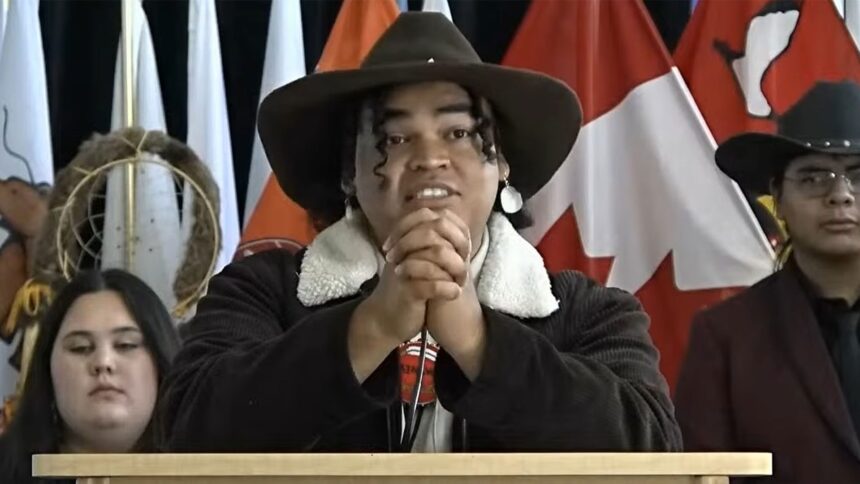
A group of Indigenous youth in Ontario are warning that a bill tabled in Parliament on Monday could have “horrible” implications for the future of the environment and Treaty rights. Speaking at the Nishnawbe Aski Nation (NAN) conference on Wednesday, Ramon Kataquapit, who sits on the Chiefs of Ontario Youth Council, described the proposed law as “the bite that comes and chomps on us. “This isn’t the threat, this is the attack,” he said. Bill C-39, the Building Canada Strong Act, gives ministers the ability to streamline certain major projects by making them exempt from certain laws (mostly environmental) such as the Impact Assessment Act, shortening the time between the project’s approval and the beginning of construction. This law is similar to Bill C-5, the Building Canada Act, which was passed in 2025 and introduced the concept of projects of “national interest.” This essentially means that if a major project is deemed of national interest — generally those involving critical minerals, transit and energy, or those which benefit international trade — there is the possibility that they may be exempt from laws, such as the Species at Risk Act, and all federal approvals are “automatically granted at once,” according to Ottawa. Bill C-5 “shifts the review from ‘whether’ the project should proceed, to ‘how’ the project should proceed,” according to Canada’s website. However, Bill C-39 introduces a new, larger player — regions of natural interest. Instead of just one specific project being exempt from laws, the bill would make it so any projects in a specific region are subject to the same process, as determined by the relevant minister. At the NAN conference, the bill raised concerns about what this would imply for the environment, as well as Treaty Rights, as projects would be “pre-approved without involvement or consent,” according to Grand Chief Alvin Fiddler. Although, according to the Office of the Minister of Energy and Natural Resources, projects can only be “pre-approved” if they meet certain conditions set out during Indigenous consultation through a regional assessment process, which works the same as an project assessment process normally would under the Impact Assessment Act. Kataquapit, who is Cree and Taino, who are Indigenous to Puerto Rico, said “it’s scary to see, as a youth,” and that he believes leadership is “getting stomped on.” The 24-year-old is the co-founder of the Okiniwak Youth Movement, and has recently returned from a three-week-long journey through the James Bay Lowlands with his cousin, Jeronimo, the founder of Here We Stand Youth Movement. James Bay is a large, inland body of water which connects to the southernmost point of the Hudson Bay. The remote peatland (James Bay Lowlands) around it is known as the “breathing grounds,” Kataquapit said, and carries more than 30 tonnes of carbon. According to the World Wildlife Fund, the Hudson and James Bay Lowlands are one of the largest natural carbon storage sites on the planet, housing over five million hectares of untouched habitat to fish, migratory birds, and other wildlife such as polar bears. It is also home to the Ring of Fire, a 5,000 square kilometre section of land teeming with untouched minerals, including copper, nickel, and chromite. In June, Ontario, in partnership with Webequie First Nation, broke ground on a 107-kilometre gravel road to provide easier access to the area, which is currently only accessible through a winter road or by air travel, to allow for more mining opportunities. Construction began five years ahead of schedule, although this was done through an additional partnership with Marten Falls First Nation rather than a law. In July, Friends of the Attawapiskat River, an Indigenous-led advocacy group, requested a judicial review of the project. The group claimed that Ottawa was ignoring its own federal impact assessment, which stated the road would cause “significant” damage to the environment and Indigenous rights, APTN reported in August. In her statement of approval, Environment and Climate Change Minister Julie Dabrusin noted that while the project will have adverse effects, it is “justified in the public interest.” Here We Stand’s journey through James Bay was done in response, in an effort to better educate the public on the land at risk if mining increases. “I’ve seen the pristine life out there. I’ve seen the balance of nature and our animals working with one another, all to make this place that we call the land, the water, the earth. It taught me something, that this place is so important to us, that we should treat it how we treat ourselves,” Kataquapit said. “There were several times where I could’ve died out there,” he continued, “but we went out there to show just how important it is … Because there’s no separation between us and the Earth. We’re all the same in the eyes of Creator. I learned that when a polar bear could’ve mauled me out there just two weeks ago.” Bill C-39, Kataquapit warned, would strip not only the protections in place for the environment, but also the Treaty Rights of First Nations in the area, as pre-approval would require no consultation. “These projects are being fast-tracked for investors who don’t even live in this country,” he said. “We have a bigger duty [as First Nations people] … it’s not between our communities at all, it never was.” Polar bears are pictured in the James Bay Lowlands. Photo: Jeronimo Kataquapit. National interest a ‘politically derived’ term says Elizabeth May Speaking to reporters on Monday, federal Green Party leader Elizabeth May said that, because of Bill C-5, she didn’t believe there was an environmental assessment process anymore, as there is no basis behind which projects are considered to be “in the national interest.” She said that in order for a project to be declared as such, there must be a business case. However, when it comes to projects such as the West Coast Oil Pipeline, there was none. “I see nothing in what the government has planned or announced that suggests they think they need to have one,” she said. “I think at a minimum, Canadians need to know there is no business case for this project. We are about to hear that they’ve brought in vast, sweeping economic legislation of great import. Nonsense. They got rid of any law last year, in Bill C-5, so there is no impact assessment required.” According to the federal government, there are five criteria a project must meet to be considered of national interest under Bill C-5, including the “advancing the interests of Indigenous Peoples” in the area, among others. If passed, Bill C-39 would also have implications for major projects even if they don’t fall under a region of national interest, as it would make several changes to the way an impact assessment is currently done under the Impact Assessment Act. Generally, major projects such as mines or pipelines that could have a negative impact on the environment or First Nations in the area must be assessed by the Impact Assessment Agency of Canada (IAAC). It would also be subject to several laws and undergo Crown consultation. Bill C-39 would allow for ministers to quicken the assessment process through one federal decision rather than several. This would also apply to projects which are not in the national interest. IAAC would still assess projects, but would also be responsible for co-ordination between the different departments, according to Ottawa, to avoid duplication. The organization, along with a “designated” minister and the Environment minister, would then reach the final verdict on whether or not the “adverse effects are justified,” according to legislation. “The federal government’s constitutionally duty to consult is not being shortened or limited in any way shape or form in this bill,” stated the Office of the Minister of Energy and Natural Resources. When it comes to fish and species at risk, the bill would allow ministers to do feasibility studies on permit conditions, including how following laws such as the Fisheries Act would impact the project’s economic value. Ecojustice, a national environmental law organization, warned that the bill would “gut assessments” for major projects such as the Robert Banks Terminal 2, a planned marine container terminal for the Port of Vancouver which could have “potentially irreversible consequences” for the Southern Resident Killer Whales — a critically endangered population of orcas which have been impacted by sound pollution and a depleting population of Coho salmon, their primary source of food. The whales are protected under the Species at Risk Act. “We all want a strong Canada, but truly building Canada strong means respecting nature and staying within ecological limits,” stated Margot Venton, director of nature at Ecojustice, in a release. “Putting nature up for a fire sale to attract foreign investment puts the health, livelihoods, and local economies of communities across the country at risk. Without functioning ecosystems, we cannot maintain a functioning economy. Fast-tracking major projects at the expense of salmon, killer whales, and the ecosystems they depend on is short-sighted. “This political moment will pass. Extinction is forever. When we discard strands of the web of life, the entire system begins to unravel often in ways we do not fully understand. We don’t know how to recreate the complex ecological systems that keep us alive. Once they are gone, there is no easy way back,” she stated. Fighting for the future Kataquapit said that while he cannot speak for communities in support of the bill, he and his colleagues aim to fight so that everyone has consent when it comes to projects which could have negative impacts on the land or cultural sites in the surrounding area. He said he believes the Ring of Fire would likely be the first region of natural interest if the bill is passed. “It’s a literal international issue,” he said. “We shouldn’t treat it like there are only certain stakes involved … not only would this damage the environment, not only would this damage the rights and pre-existing agreements within Treaties, but we’re leaving a horrible, horrible future for our next generation.” On Thursday, Kataquapit confirmed that NAN leadership ruled to oppose the bill. Prior to this, he said his youth group would be protesting as it continued to move along. Tags: Bill C-39, Bill C-5, Elizabeth May, environment, Fisheries Act, Green Party, Here We Stand, James Bay, Nishnawbe Aski Nation, Ontario, Ramon Kataquapit, Ring of Fire, southern resident killer whales, species at risk act, west coast oil pipeline Continue Reading
Proposed federal law attacks environment, stomps on leadership, says youth



Leave a Comment