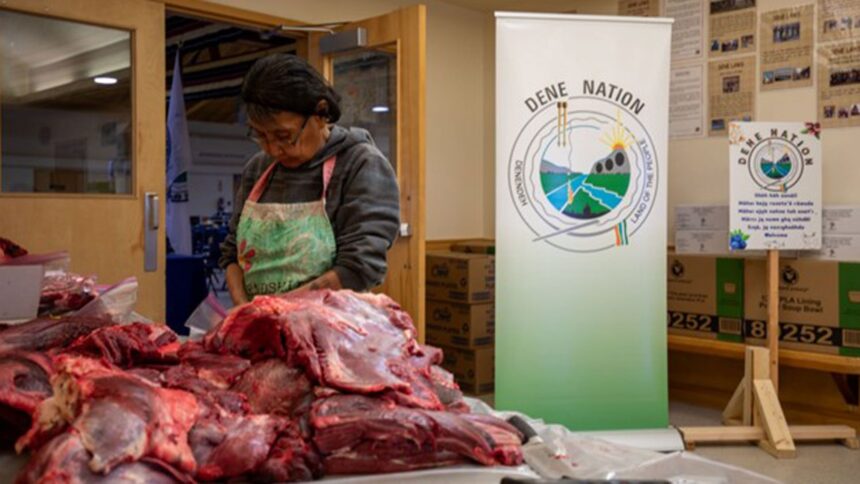
Dene leaders have declared homelessness a crisis affecting every Dene First Nation and also called for stronger wildlife protections and greater control over economic development in Denendeh. These resolutions, among several others, were passed at the 56th Dene National Assembly, held at Kátł’odeeche First Nation earlier this month. Leaders discussed housing, wildlife conservation, major projects and the need for Dene governments to have greater influence over decisions affecting their lands and communities. The assembly opened in a good way with traditional drumming and prayers and traditional foods, including moose meat that was harvested by Irene Graham, a hunter and head of the guardianship program at Kátł’odeeche First Nation. “It’s food sovereignty, it’s cultural resilience, it’s all those and it’s our Dene way of life,” Graham said. Graham also described the protocol of harvesting on the land. “We give an offering of tobacco. It’s a contract that we have with animals that we respect them and it brings you luck, you have a safe journey while you’re out harvesting on the land,” she said. Dene leaders call for caribou conservation Honouring and protecting wildlife was a major theme at the assembly, where delegates discussed how development has already affected traditional harvesting and wildlife habitat. Gwich’in leader Chief Robert Charlie-Tetlichi of the Inuvik Native Band described efforts to balance economic development with environmental protection in the Mackenzie Delta region during the creation of the Dempster Highway. “We put a good corridor in place. We tried to get people to hunt the traditional way, which is walking and hunting on the path of the caribou,” Charlie-Tetlichi said. Fred Sangris, an Elder, hunter and chief with Yellowknives Dene First Nation, warned that the Bathurst caribou herd is facing a serious crisis. “The most important animal that our ancestors defended and kept around was caribou,” Sangris said. “Today, there’s a crisis with caribou, and no one’s protecting them.” Sangris referenced numbers APTN News has reported in the past, whereby the Bathurst herd has declined from about 500,000 animals in 1985 to fewer than 4,000 today. He pointed to several possible contributing factors, including overharvesting, development, climate change and disease. The assembly passed a resolution supporting Yellowknives Dene First Nation’s efforts to establish a conservation area to protect the Bathurst herd while it is in Chief Drygeese Territory. The proposed area would be established under Dene law and knowledge and led by the Yellowknives Dene. Sangris also called for hunter education programs and protected areas to help the herd recover. A resolution passed at the assembly calls for federal projects serving both defence and community needs deliver lasting benefits for Dene communities. Photo: Charlotte Morritt-Jacobs/APTN. Dene leaders seek greater benefits from major projects Delegates also called for major projects, including the proposed Mackenzie Valley Highway and Arctic Economic and Security Corridor, to be designed, built, owned and operated with Dene participation. The assembly’s economic development resolution calls for cooperation among Dene regions, governments, businesses and communities to pursue long-term benefits while protecting Dene rights, lands, waters, wildlife and culture. Jeffrey Rosnawski, a Yellowknives Dene First Nation delegate, raised concerns that First Nations could miss procurement opportunities because of communication and capacity barriers, including in discussions involving the Department of National Defence. “We have expressed the importance of increasing benefits to the Indigenous people in the north,” Rosnawski said. “And we have expressed that we wanted those efforts tracked diligently to ensure these benefits are being thought of and established with Indigenous peoples from the north.” The resolution calls for work with federal departments and infrastructure programs so projects serving both defence and community needs deliver lasting benefits for Dene communities. It identifies opportunities including employment, training, procurement, business partnerships and Indigenous equity ownership. It also says participation must be led by the Dene themselves, with each First Nation retaining authority over its own lands and decisions. Dene National Chief George Mackenzie said the benefits of major projects must reach small, remote communities rather than concentrating in larger centres. “We know across Canada that spin-off will go to major cities,” Mackenzie said. But in the small community, in our very fly-in community, there’s no opportunity like that.” Mackenzie said the Dene Nation must prepare for the economic and social impacts that come with major projects. “Education has to be adjusted and looked at to better serve our people,” Mackenzie said. “It’s a lot of money, billions of dollars and with that social problems always happen.” Another resolution that was passed calls for the Dene Nation to work with individual First Nations and territorial, federal programs to support people who want to return to their home communities. Photo: Charlotte Morritt-Jacobs/APTN. Housing priorities The assembly passed a resolution declaring homelessness a crisis affecting every Dene First Nation. It directs the Dene Nation to advocate for better outcomes for Dene citizens experiencing homelessness in Yellowknife, while recognizing that the delivery of shelters, outreach, housing and health services remains the responsibility of the territorial government, the City of Yellowknife and service organizations. The resolution calls for the Dene Nation to work with individual First Nations and territorial and federal programs to support people who want to return to their home communities, including help with transportation, housing, reconnection and ongoing support. It also calls for better information about homelessness in Yellowknife to be collected and shared by home community and First Nation, in keeping with Dene data sovereignty principles. Katlia Lafferty, a Yellowknives Dene First Nation delegate, helped draft the resolution and called for First Nations to receive direct funding to deliver their own housing. “Give direct funding to the First Nations to deliver their own housing. NWT Housing is a corporation, and at the end of the day, they’re profiting off of poverty,” Lafferty said. Lafferty, who grew up in housing and has advocated on the issue for years, called for changes including an end to rent increases tied to market rates when tenants fail to report information, wage garnishment and housing arrears for people unable to pay. She also called for HAP houses to be returned to tenants. “Corporations capitalize. They are meant to make money. Housing was never put in place to be making money off of people. It was supposed to be helping people,” Lafferty said. She said the long-term goal should be for First Nations to take control of housing. “The goal would be to dissolve it completely and us to take over our own sovereign homes and have our land back. It’s a land back strategy is what we need,” she said. The resolution also directs the Dene National Chief to seek meetings with Yellowknife’s newly elected mayor and council after they take office on Nov. 2, as well as the premier and the minister responsible for Housing NWT. The meetings would address Dene priorities, including culturally safe outreach and shelter services, support for people returning to their home communities and a continuing role for Dene leadership in homelessness planning. All resolutions set out priorities for the Dene Nation’s continued advocacy with territorial and federal governments, with the Dene National Chief expected to report on progress at the 57th Dene National Assembly. Continue Reading
Dene leaders declare homelessness a crisis, call for greater control over housing and major projects


Leave a Comment