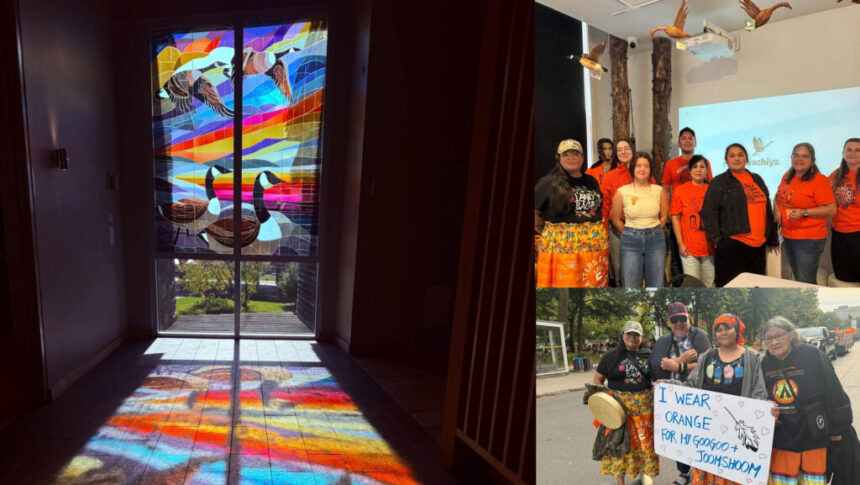
The National Day for Truth and Reconciliation on September 30 was an occasion for remembrance, learning and shared responsibility, honouring survivors of residential school and reflecting on how to support healing and resilience. The Grand Council of the Crees highlighted the legacy of a colonial system that separated Indigenous children from their families, land, language and identity. It suggested the day was an opportunity to educate the next generation through community events. The Cree Health Board shared that “healing happens together, through the relationships, teachings and supports that carry our communities forward.” Cree midwife Elizabeth Bobbish announced that a resolution to implement the United Nations Declaration on the Rights of Indigenous Peoples was unanimously adopted at the midwifery provincial level. In Ouje-Bougoumou, the Aanischaaukamikw Cree Cultural Institute launched Our Children, a temporary exhibit that takes visitors from pre-contact to the residential school era and on to Cree realities today. The exhibit will be displayed until February 5. It features information panels, relevant objects selected from its collection and demonstrations of typical residential school clothing. “It’s pretty powerful,” said Aanischaaukamikw executive director Kathy Shecapio. “I couldn’t help but cry when I looked at it. That’s our story. Tears are healing, acknowledging the story, and recognizing the impacts.” Shecapio said the exhibit acknowledges intergenerational trauma of residential schools while “honouring the strength, resilience and survival of Cree people.” Her team sewed the residential school clothing worn by the mannequins in the exhibit. Aanischaaukamikw is hosting traditional sewing sessions Tuesday afternoons all season to promote storytelling and connection with cultural roots. “We have to think of future generations and what we’re teaching,” said Shecapio. “Experiencing it helps them acknowledge the remaining wounds they have. When they understand both the trauma and resilience of our ancestors, they can better understand themselves and build a healthier future.” Following Our Children, other exhibits will explore Cree legends, including those about bears. “Interpreting those legends help you appreciate the bear a little more as a sentient being,” explained Shecapio. “Aanischaaukamikw is not simply a place where the past is kept. It’s a living space where the past, present and future meet.” Guided by the mission embedded in its name, transferring traditional knowledge “from the dwelling of our ancestors,” Aanischaaukamikw is seeing an increase in school groups and other visitors. “What’s important is giving us the identity back,” Shecapio asserted. “What colonization stopped you from knowing, we give it back to you. It’s an extraordinary evolution from what museums usually do.” The message that Every Child Matters was emphasized at events across the country, including a Montreal march of hundreds of people wearing orange shirts. Cree artist Angela Ottereyes walked with her family and hosted the Cree Outfitting and Tourism Association (COTA) team for a beading workshop at Montreal’s Wachiya Store. Ottereyes said her parents – both residential school survivors – were deeply touched to see many non-Indigenous students standing outside their school to greet marchers. “When people see us walking, wearing orange, speaking our truth and honouring the children who never made it home, they learn,” shared Ottereyes. “And when they see us leading, they have an opportunity to learn how to walk alongside us.” Earlier that day, this year’s Mamu Nikantetau expedition led by Innu surgeon Dr. Stanley Vollant finished its 350-km journey at the Lachine Canal in southwest Montreal. The group of 29 mostly Indigenous participants travelled from Kitigan Zibi to Ottawa and on to the Mohawk communities of Kanesatake and Kahnawake before reaching their destination. “We have to change the paradigm and transform this anger into a positive thing, constructive, and this kind of expedition changed lives,” Vollant told APTN. “I was proud of my grandparents, but I’m prouder now, because I walk on their path and bring people on the land, connecting them to the spirituality of Indigenous people.” Meanwhile, an international tribunal emphasized accountability. Following public hearings held in May, the seven judges of the Permanent Peoples’ Tribunal (PPT) reconvened in Montreal September 30 to conclude that Canada had committed crimes of genocide, apartheid and enforced disappearances. “These crimes continue as long as they remain unaddressed by real, rather than symbolic, change,” the judges stated. “Today, dispossession of Indigenous ancestral lands and resources continues, while children growing up on reserves become sick from lack of clean water and sanitation. There cannot be healing, truth or reconciliation in such circumstances.” Requested by the Native Women’s Shelter of Montreal (NWSM), the legally non-binding forum heard from numerous residential school survivors, including Waskaganish’s George Diamond. Over a decade after Canada’s Truth and Reconciliation Commission, NWSM executive director Na’kuset alleged that its 94 calls to action have been largely ignored. Now that the PPT’s judgment has been delivered in a 78-page document, she said, “What matters is whether that recognition leads to meaningful change.”
Resilience and Accountability Orange Shirt Days message is that truth must underpin reconciliation