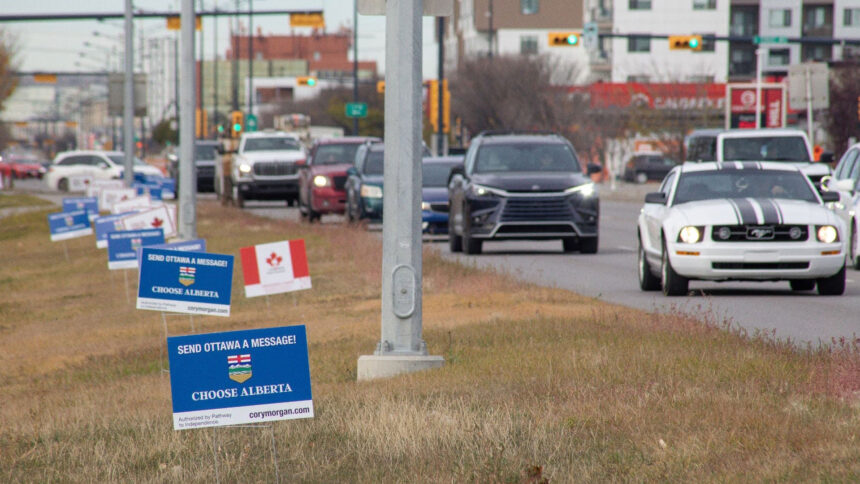
As Albertans prepare to vote on the province’s future in Canada, Siksika Nation Chief Samuel Crowfoot says the separation debate raises questions about who would honour First Nations treaties and protect the rights they guarantee. “There’s too many unanswered questions and there’s been no consultation with First Nations, and that’s a requirement as protected by the Constitution.” Crowfoot said. Crowfoot’s great-great-great-grandfather, chief Crowfoot, was an original signatory of Treaty 7, which established a relationship between the Blackfoot people and the Crown. That treaty predates Alberta’s entry into Confederation in 1905. The Oct. 19 referendum will ask Albertans whether the province should begin the process of separating from Canada. For First Nations, the question extends beyond provincial politics to treaty obligations, sovereignty and the Crown’s responsibility to uphold agreements protected by the Constitution. Chief of Siksika Nation, Samuel Crowfoot poses for a photo in his traditional homelands close to where Treaty 7 was signed. Photo: Charlotte Morritt-Jacobs/APTN. Siksika Nation, Piikani Nation, the Blood Tribe and Athabasca Chipewyan First Nation challenged the decision. On May 13, the Alberta Court of King’s Bench ruled that Alberta breached its duty to consult First Nations in the process leading to the approval of a citizen-led separation petition. Crowfoot says it’s because of First Nation’s taking legal action that the vote is non-binding, meaning it would not itself make Alberta independent, but it could influence the next steps in the separation debate. The province and the petition organizer appealed the ruling. Carly Fox, a lawyer and member of the Kainai Nation, emphasized to APTN News how Alberta had hired outside private practice counsel to handle the appeal rather than relying on Alberta Justice. “That shows that they’re really interested and willing to put a lot of effort and public money into this, which I think is really upsetting,” Fox said. Voter Information sessions raise questions Fox has been holding information sessions for Siksika Nation and other members of the Blackfoot Confederacy to explain the referendum questions and their potential implications. “Even though treaty rights are a collective entitlement, I think as an individual, to me, it was important for me to vote and to defend my treaty rights,” Fox said. She said the referendum questions about immigration could leave voters with a misleading impression of existing rules around access to public services. “There’s rules for eligibility for income support and for education and for health care,” Fox said. “It’s not a free-for-all, but the way that the questions are framed makes it seem like that.” Carly Fox is a lawyer and member of the Blood Tribe who has held information sessions to answer questions and create discussion around the referendum and its potential implications for Indigenous communities. Photo: Charlotte Morritt-Jacobs/APTN. Crowfoot said the referendum’s questions about immigration also raise concerns for the Blackfoot Confederacy, whose members have family and cultural ties on both sides of the Canada-U.S. border. The Confederacy includes Siksika Nation, Piikani Nation and the Kainai Nation, also known as the Blood Tribe, in Alberta, as well as the Blackfeet Tribe in Montana. “Those discussions about immigration don’t take into account First Nations and the unique position that we’re in. And so we have concerns about that,” Crowfoot said. He said many Siksika members are married to members of the Blackfeet Tribe in Montana, raising questions about how potential changes to immigration rules could affect their ability to cross the border. “Is that something that can be seen as another obstacle to keep them from their traditional homelands?” he said. Referendum street signs along the Trans-Canada highway in Calgary. Photo: Charlotte Morritt-Jacobs/APTN. Federal Responsibility Prime Minister Mark Carney attended a Forever Canadian Rally in Calgary on Friday and urged Albertans to vote to keep Canada united, but there was no mention of recognizing treaty rights and the role First Nations played in challenging the separation petition. Fox called the rally a missed opportunity to build a stronger nation-to-nation relationship. “I think it would be really nice for him to fully understand First Nations rights and understand our sovereignty and understand why we’re here and work with us,” Fox said. She said the federal government also has a responsibility to uphold treaties as a treaty partner. “They have a duty to ensure that the provincial governments are upholding their treaty rights and to work alongside First Nations if there are cases like this where the provincial government decides that they don’t want to adhere to the law,” she said. Siksika Nation is located about an hour east of Calgary. Photo: Charlotte Morritt-Jacobs/APTN. Treaty rights and the right to be heard Crowfoot said throughout the referendum debate there has been a lack of meaningful consultation. “It means sitting down with us, asking questions, giving us the opportunity to ask questions,” he said. “We’re not asking for special treatment, we’re asking for our constitutional rights to be respected,” Crowfoot acknowledged that some First Nations people are hesitant to participate in provincial elections because they worry voting could legitimize a political system they believe has not respected their rights. He said some leaders have urged people not to vote in provincial or federal elections for that reason. But Crowfoot said decisions made by governments in Edmonton and Ottawa directly affect First Nations, making participation important. “What happens in Ottawa in terms of laws and policies affect us here on Siksika and what happens in Edmonton affects us here on Siksika,’” Crowfoot said. “We have to have our say. And elections are how we do that,” he said. Crowfoot also said the debate has contributed to anti-Indigenous rhetoric, including calls to do away with treaties and reserves. “People are now saying, ‘Forget the treaties, screw them, do away with them and do away with reserves,’” he said. “They’re doing that under the guise of ‘equality.’” Crowfoot said his nation has received hateful calls and messages, but also support from people across Canada who thanked First Nations leaders for defending treaty rights. The provincial, territorial border dividing Alberta from the Northwest Territories at the 60th parallel. Photo: Charlotte Morritt-Jacobs/APTN. Fort Chipewyan voters turned away While treaty rights are central to the debate, Indigenous leaders in northern Alberta say access to the ballot is another concern. During a press conference on Oct. 16, First Nations and Métis leaders criticized Elections Alberta after advance voting in Fort Chipewyan was rescheduled, amongst other obstacles to voting. Athabasca Chipewyan First Nation Chief Allan said voters arrived at the polling station on Oct. 15 to find the doors locked. The advance poll was rescheduled to Saturday, Oct. 17. “Elections Alberta did not have enough staff and they didn’t recruit enough people,” They didn’t invest in training to the required amount,” Adam said. In a written statement to APTN, Elections Alberta said it had initially agreed to delay voting out of respect for the passing of an Elder. However, it said the community later requested that voting proceed on the previously agreed date of Oct. 15. Elections Alberta said the polling place at the Fort Chipewyan Regional Municipality of Wood Buffalo office was not fully staffed and could not open at 9 a.m. “Without training, the elector experience would have caused confusion and led to many questions on how to receive identification and mark electors from the voting record,” the agency said. Elections Alberta said it sought approval from community leaders to move the advance poll to Oct. 17, giving the returning officer time to train election workers on Oct. 16. It said voting on referendum day, Oct. 19, would continue from 9 a.m. to 8 p.m. Fort Chipewyan Métis President Ruby Ladouceur said members did not receive formal notice of the change until noon on Thursday, after members had already arrived to vote. “Fort Chipewyan is a fly-in community,” Ladouceur said. “Our Métis members and our neighbouring First Nation cannot simply drive to the next polling station.” Watch Charlotte’s story on how the refendum is directly tied to the treaties signed long before Alberta became a province She said the nation expects to be informed directly and in a timely manner when changes affect its members’ right to vote. Lepine said Mikisew Cree First Nation had invested resources in helping members participate, including arranging transportation and assisting with identification. “This is probably one of the most important votes that we’ve been communicating to our nation, to our citizens, to rock the vote, to go out and defend our treaty,” Lepine said. “We’re completely appalled by what happened yesterday, when they are turned away after we’ve been extending so much resources and support for them to go and vote.” Lepine said Mikisew members also encountered problems in Fort McMurray and Edmonton. Mercredi said Treaty 8 Sovereign Nations had written to Elections Alberta about voting concerns. According to Elections Alberta over one-million Albertans have cast a ballot in advanced polls. Photo: Charlotte Morritt-Jacobs/APTN. The agency told APTN its chief electoral officer responded to the letter on Friday afternoon. Mercredi said remote communities face additional barriers, including limited access to conventional address documentation and polling stations. “I myself am travelling seven hours,” Mercredi said. “Seven hours to vote one way, just to make sure that my voice is heard.” Elections Alberta said the criteria for establishing advance voting locations are set out in Section 98 of Alberta’s Election Act and are based on population. The agency said 36 First Nations communities hosted voting locations on reserve during the 2026 referendum, compared with 33 in 2023. The 2026 figure is unofficial and subject to confirmation in the official referendum report. For questions on the ballot, click here: Alberta referendum Continue Reading
Treaty rights and voting access at centre of Alberta referendum


Leave a Comment