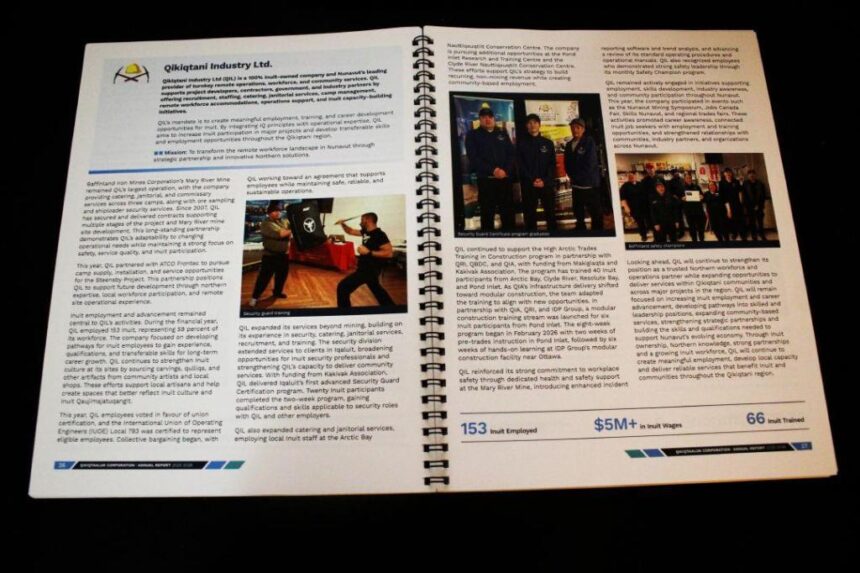
Published 8:42 am Thursday, October 29, 2026 By William Koblensky Varela Local Journalism Initiative Northern News Service Qikiqtani Inuit Association for-profit company Qikiqtaaluk Corporation has maintained a 50 per cent Inuit employment rate over the past two years, despite having a target of 85 per cent, the association’s board of directors was told on Oct. 7. Training Inuit security guards, reopening a hardware store and hiring more Inuit on fishing vessels were all ideas put forward at the Qikiqtani Inuit Association (QIA) annual general meeting in Iqaluit’s Aqsarniit Hotel. Larry Audlaluk, a QIA board of directors member from Grise Fiord, said there have been issues with the security guards at the Aqsarniit Hotel, which is owned by the Qikiqtaaluk Corporation. “I have heard some very awful experiences that people have faced from these security individuals, especially last week, when something happened here. They seem to handle individuals so roughly, which is not necessary,” Audlaluk said. Last year, Qikiqtaaluk Corporation paid for 20 Inuit to complete a two-week advanced security guard training course run by Ottawa-based LTT Tactical, according to the company’s annual report. Hand-to-hand combat, wrestling holds, first aid, de-escalation techniques and crowd control were all part of the exercises shown in LTT Tactical’s Iqaluit training video. Qikiqtaaluk Corporation president Harry Flaherty said he’s aiming to increase the number of Inuit bouncers at the Aqsarniit Hotel. “We have directed individuals as to how we could hire more Inuit security guards here, as well as train them mainly here at the hotel. If we could have Inuit employees, I think it would be more appropriate,” Flaherty said. Aqsarniit Hotel has one of the lowest Inuit employment rates among Qikiqtaaluk Corporation’s companies, hovering between 20 and 30 per cent over the past two years. Reopening the shuttered Iqaluit hardware store Frobuild was another suggestion from Audlaluk on how to increase Inuit employment. The Qikiqtaaluk Corporation-owned store closed down in 2013 because it was losing money, Flaherty explained. “We have not restarted any store, but I would ask if there is direction by QIA to look at this to see whether or not it would be feasible to build another tool store,” Flaherty said. He suggested the Qikiqtaaluk Fisheries Corporation could help increase Inuit employment as well. But he said there’s a high barrier to entry for working on a fishing ship. “I’m sure that we will continue to plan to hire Inuit, whether it’s for fishing vessels or other areas, because it requires a lot of training to work on a vessel,” he said. Fluctuating Inuit employment rates at Baffinland’s Mary River iron mine is part of what’s keeping the Qikiqtaaluk Corporation’s level at 50 per cent, according to Flaherty. The QIA company’s subsidiary, Qikiqtani Industries Limited, is a mine contractor that offers road maintenance, housekeeping and catering services. “It’s mainly at the Mary River project — Inuit who work in these positions and areas, the percentage changes,” said Flaherty. “Therefore, we continue to strive to make mainly the QC head office have Inuit employment and have succession plans in place for individuals who want to take training to take positions in a higher level.” Qikiqtani Industries Limited had a 60 per cent Inuit employment rate over the past two years, and the Mary River mine stood at 29.4 per cent Inuit employment in 2025. “Although we didn’t have so many new employees, they’re increasing. I know that they are trying very hard to get Inuit employment,” Flaherty said of Baffinland Iron Mines. Qikiqtaaluk Corporation employed approximately 630 people last year, down from 777 in 2024, according to the company’s chief corporate officer, Katie Choquette. But that change only reflects a reduced turnover rate, Choquette said, and the number of jobs at Qikiqtaaluk Corporation remained relatively unchanged. Choquette said she expected the number of positions to remain the same at the company in 2026.
Inuit security guards could help QIA-owned company reach employment target, says president