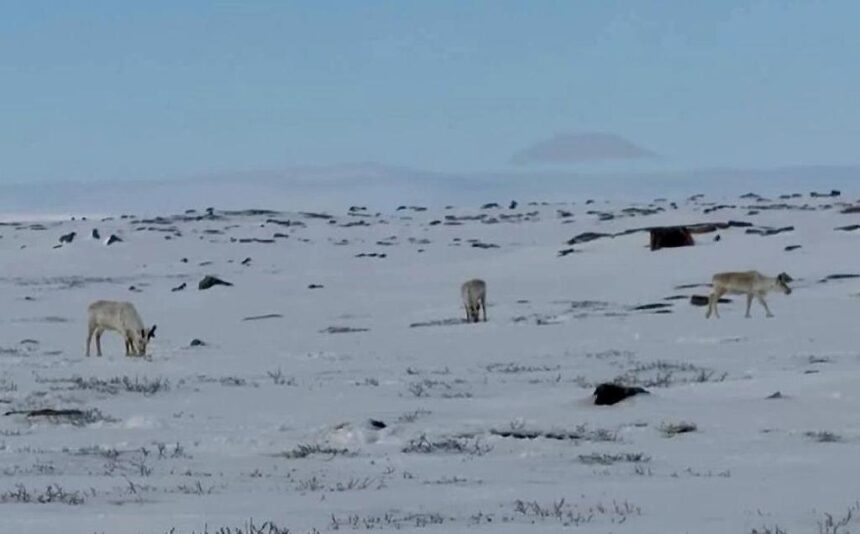
The Southampton Island caribou herd is showing encouraging signs of recovery after decades of population fluctuations, disease and harvesting pressures, but researchers say maintaining a healthy population requires a delicate balance. A Government of Nunavut study drawing on Inuit Qaujimajatuqangit (IQ) found that Coral Harbour hunters, Elders and other knowledge-holders are observing healthy animals, with strong calf survival and increasing numbers of caribou near the hamlet. Dr. Andrew Kadykalo, a social science researcher, drafted the ‘Documenting Inuit Qaujimjatuqangit (IQ) and Observations of the Southampton Island Barren-Ground Caribou (Rangifer tarandus) Herd, 2025’ findings. He said the island’s relatively isolated ecosystem makes managing the herd particularly challenging. “It’s a semi-closed ecosystem and it’s relatively small,” he said. Kadykalo said residents understand the importance of maintaining a balance between the number of animals and available forage. The herd’s history demonstrates how quickly that balance can change. The original Southampton Island caribou population was eliminated by the mid-1950s following overharvesting after European contact. At the request of Coral Harbour Inuit, 48 caribou were reintroduced from neighbouring Coats Island in 1967. With few predators, the population expanded rapidly, reaching nearly 30,000 animals in the late 1990s. Another substantial decline followed in the 2000s, attributed to brucellosis, severe winter weather and heavy harvesting pressure, including commercial harvesting and off-island meat sales. Management measures, including ending commercial harvesting and introducing a total allowable harvest, helped stabilize the herd. Aerial surveys estimated 12,054 caribou in 2019 and 12,651 in 2023, indicating a relatively stable population. The IQ study, conducted in May 2025 by the Department of Environment’s Wildlife Research Division, included 15 interviews with Elders, members of the Aiviit Hunters and Trappers Organization, and other knowledge-holders. Participants described generally healthy caribou, with fewer sick animals and strong calf survival. “The IQ study participants generally describe brucellosis as much less prevalent today than the major outbreak of the 2000s and early 2010s,” Kadykalo said. Predators were another concern raised by participants, who reported seeing more wolves and, to a lesser extent, wolverines. But Kadykalo said available aerial survey information suggests predation is not a significant constraint on overall herd abundance. “Participants did notice seeing more wolves, but not to the extent that they were very concerned that they were reducing herd numbers,” he said. Environmental conditions may pose a more serious challenge. Participants identified increasingly unpredictable winter weather, particularly rain followed by freezing temperatures, as a threat to caribou survival. When rain freezes over snow, Kadykalo said it can create ice layers that prevent caribou, particularly calves, from reaching vegetation beneath the surface. Severe icing conditions can contribute to calf mortality and die-offs, according to the study. Vital combination Beyond documenting the herd’s condition, the research highlights the importance of Inuit knowledge in understanding changes that scientific surveys alone cannot capture. “The IQ study is able to provide a little additional information and context around distribution, behaviour, body condition, environmental conditions, historical changes, especially going back in time,” said Kadykalo. While scientific monitoring has taken place over several decades, Inuit knowledge extends much further, through stories and observations passed between generations. Some participants recalled the original caribou herd and historical crossings between Southampton Island and the mainland over ice bridges. Kadykalo said one of the most memorable aspects of the research was hearing about the profound cultural impact of losing the island’s caribou. “You felt like a real sense of loss or grief,” he said. Elders and older harvesters described the years when caribou had disappeared, and people could no longer hunt them. Some remembered waiting many years after the herd was reintroduced before harvesting could resume. Kadykalo said those experiences reinforced the importance of ensuring the herd never disappears again. Caribou remain the most commonly consumed country food on Southampton Island, supporting food security, cultural practices and the sharing of food among families and communities. The study also revealed differing views about future harvesting opportunities. Some participants favoured maintaining existing restrictions, while others suggested increasing household tags from four to six as the herd’s condition improves. The current total allowable harvest is 1,000 animals, and Kadykalo said the Department of Environment is not recommending changes to existing management measures. He said the herd has remained relatively stable for about a decade and that co-management partners have approached harvesting cautiously. He suggested increased harvesting could eventually be considered if the population remains healthy and no significant new threats emerge. Participants also emphasized the need for improved enforcement and monitoring, particularly of harvesting by people travelling from other communities. Looking ahead, Kadykalo said Inuit knowledge could play an increasingly important role in monitoring the herd between costly aerial surveys. Community members could identify warning signs that warrant additional scientific investigation, while future IQ studies could help researchers understand changes as they occur. For Kadykalo, the research also demonstrated something that population counts alone cannot convey: the enduring relationship between Inuit and caribou. “I think a big piece, for example, is that the cultural context and importance between Inuit and these animals that can’t be captured in aerial survey.”
Inuit knowledge reveals encouraging signs for Southampton Island caribou herd