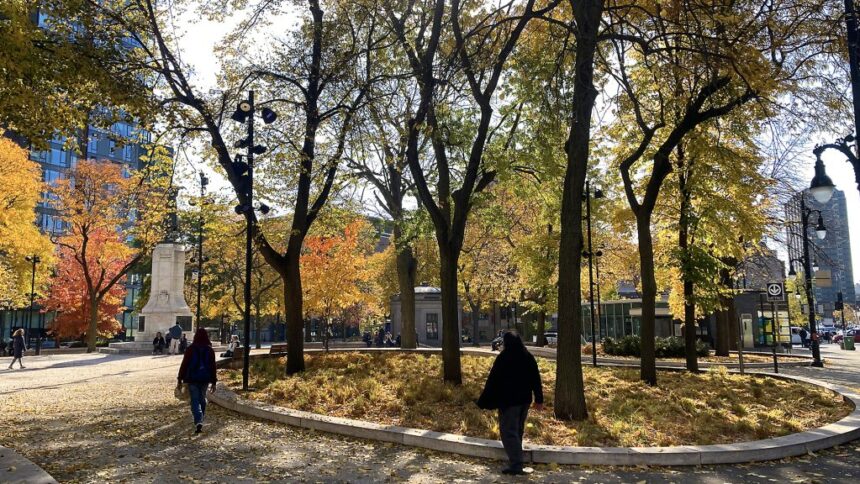
In Montreal’s Cabot Square, where homeless Indigenous people have gathered for decades, news that a member of the city’s police services (SPVM) had been suspended for urinating on homeless Montrealers was greeted largely without shock. Regular visitors, as well as outreach workers from the various organizations serving unhoused populations in the west of downtown, describe relations between homeless people and police in and around Cabot Square as marked by distrust and fear. People APTN News spoke with in Cabot Square over the last two weeks reported accumulating tickets, amounting to hundreds of dollars in fines, for fare evasion on the city’s transit system or jaywalking on Ste. Catherine Street. People who drink alcohol in the Square also said they’d received tickets for open containers. Few make any attempt to pay the tickets. For them, getting another ticket is simply a fact of life in Cabot Square, though one that may give police a reason to eventually arrest them. Cabot Square Measuring one block by one block, Cabot Square is the only significant piece of greenspace in the western end of downtown Montreal. Located on Ste. Catherine St. at the corner of Atwater Ave., the Square is directly across from the former Montreal Forum. For decades, the space has attracted homeless Indigenous people, thanks in part to a years-long provincial policy of housing Inuit from Nunavik, flown south for medical care, in the nearby YMCA. Though medical patients from Nunavik have been sent to the Ullivik residence in Montreal’s western suburbs since 2016, Cabot Square maintains a community of unhoused people with a strong Indigenous presence. During the golden years of Montreal hockey, crowds used to gather in Cabot Square ahead of the Montreal Canadiens’ many victory parades. The 1955 Rocket Richard Riot kicked off there when enraged French supporters of Canadiens’ great Maurice (Rocket) Richard gathered to protest his suspension by an Anglophone NHL president, which they believed to be ethnically motivated. Northeast view of Cabot Square from the corner of Ste. Catherine and Lambert-Closse. The former Montreal Forum is on the right, just out of frame. Photo: Jesse Staniforth/APTN Since the Forum closed in 1996, a city document about revitalizing the neighbourhood notes that “The disappearance of this important generator of traffic caused a marked deterioration of rue Sainte Catherine Ouest.” In practice, this has meant Cabot Square has largely been the domain of unhoused people. In 2013, the city redeveloped the Square, but by that point the homeless population was so stable that developers expected they would return. Designers maintained benches and low walls that denizens of the Square routinely sleep on, and the city renovated the small building known as the “Round House” that has become a café and office for outreach workers working with the square’s unhoused occupants. A small geography A mediator from the Cabot Square Project, an initiative started in 2014 by the Native Women’s Shelter of Montreal in collaboration with the local borough and the YMCA Homelessness Assistance Program, told APTN the Square tends to separate along linguistic and ethnic lines. In the eastern part of the park, there are more white people and more francophones. In the west of the Square, near the Round House, mostly Indigenous people gather, mixing with Black people, all speaking English. The seating space around the statue of Giovanni Caboto (John Cabot) in the centre of the park is shared by everyone, while the alley due east of the Square is where people go to smoke crack. On rainy days, Cabot Square empties, as regular visitors head to the Resilience day centre a few blocks down the hill on Atwater Ave., as well as nearby libraries and shopping centres. They used to go into the Metro, Montreal’s transit system, particularly the entrance to the Atwater Metro station adjacent to the Round House in the west end of the park. But in November 2024, Montreal’s public transit authority the Société de transport de Montréal (STM) sealed access to the station from the Square. The west side of Cabot Square, featuring the Round House (renovated in 2013) on the right, which has a small café and outreach office. On the left is the sealed entrance to Atwater Metro station, bearing the notice (in French), “Access closed to improve security at your station.” Photo: Jesse Staniforth/APTN News In a statement at the time, the STM said, “The closure will help reduce the incidence of mischief and undesirable or dangerous behaviour, such as intimidation and drug use.” This preceded the March 2025 launch of a “mandatory travel” order giving STM security officers called Special Constables the power to eject anyone from the city’s Metro system who are using the stations for reasons unrelated to travel — a move widely understood as a means of sweeping homeless people out of Metro stations they flocked to for warmth in the winter. But on sunny days, Cabot Square attracts several dozen people on the various benches and sitting spots, most of whom interact companionably. There are cliques of friends who routinely pass the day together — many of them also spend the night at the nearby Mitshuap shelter (locally known as “the Lighthouse”). Not everyone gets along, and the presence of alcohol and other drugs means there are occasional altercations and bouts of shouting, but these usually only involve one or two people. For the rest of those in the square, the days pass slowly and quietly, punctuated by the routine of services. At 7 a.m., the Mitshuap shelter closes for the day and everyone must clear out. At 8 a.m. Resilience opens and begins serving breakfast. Between 11:30 a.m. and 1:30 p.m, Resilience serves hot lunch, and at 2:00 p.m. they give out bagged suppers. The Mitshuap shelter opens again at 7 p.m., and many go there to turn in early. Elisapie One of those who like to bed down early is Elisapie, who’s originally from Kangiqsujuaq (formerly Wakeham Bay), a community of roughly 800 east of Salluit that’s one of the three northernmost villages in Nunavik in sub-Arctic Quebec. She said she finds the Mitshuap (like most in the Square she calls it “the Lighthouse”) a safe place to sleep, and “the food is okay.” Elisapie declines to give her family name, and doesn’t want to discuss in detail how she ended up on the street, except to say, “I started drinking. I couldn’t do it at home. I wanted to drink, so I left.” At various times in Elisapie’s life, both at home and in Montreal, she has held important jobs. Prior to COVID-19, she was working in the Raglan Mine in northern Quebec. She’s also managed a daycare in Kangiqsujuaq, and worked as a first responder, driving an ambulance. She told APTN that her first responder training has served her well in the 14 months she’s been on the street around Cabot Square. “I’m happy to help people around here,” she explains. “People are having seizures or getting cuts or having a heart attack, not waking up. When I help, it lifts me up. Because the next day, I see the person who went to the hospital, and when I see them, I’m happy. They’re okay. I worked on two people having a heart attack. That was hard. They’re both walking around.” She remembers one local who slept outdoors on the sidewalk at the corner of Ste. Catherine and Lambert-Closse. He cut his arm badly and was unable to keep it clean. “It was very swollen, infected,” she remembers. “So, I treat him. I bandage him. Give my antibiotics to him. I did not need them for anything more. There’s a van comes here, the clinic or something. So, I told him, ‘Look after your stuff. You go to the clinic.’ And he did. He started going to the hospital. It was getting better and better. He’s okay now.” Like many people, Elisapie says she finds it necessary to take a break from Cabot Square now and then. However, while others get tired of the boredom, the drinking and drugs, or the occasional outbursts of violence, Elisapie says what’s hardest for her is the way her first responder training keeps her on guard. “It’s tiring,” she tells APTN, “seeing a person almost dying. It’s like almost work. But I’m happy to help them out.” Elisapie (who declined to give her family name) is an experienced first-responder and former daycare manager from Kangiqsujuaq who has been homeless and staying near Cabot Square for over a year. Photo: Jesse Staniforth/APTN Alcohol and tickets Like most in the Square, Elisapie has accumulated multiple $159 tickets for having open alcohol containers. She hasn’t paid them, and has instead been supported by outreach workers from organizations like Resilience. But she plans to stop drinking, telling APTN she has to escort a person from back home for medical care at the Ullivik residence in a few weeks, and she wants to be sober for that. She set Oct. 31 as her last drinking day. “It’s hard,” she says of stopping drinking, “maybe [for] a couple of days.” But she knows she can do it, and has done it before. She previously stopped drinking for eight years when her daughters were young. After they grew up, she found herself in Montreal working a job that left her with plenty of spending money. “I thought I had so much money, so I start drinking,” she says ruefully. “And my girls were like over 18. That’s pretty much it.” Cabot Square is not always a welcoming space. Those without homes who spend their days there aren’t necessarily interested in passers-by, stray tourists or journalists asking questions. But many of those who occupy the Square survive on friendship, and some of the bonds between people in the Square seem strong. Most days Elisapie sits and laughs with her friend Anne-Rose, drinking 710ml tall cans of strong beer. The two are open about the fact that they drink, but say they draw the line at hard drugs, which they say have done too much damage to those they know. Anne-Rose Anne-Rose Gaze is Shuswap, originally from Salmon Arm, B.C., and a mother of three adult children. She tells APTN she left B.C. because she felt her family back home was using her for money. “I went away with my friend to Saskatchewan,” she says. “I worked there as a housekeeper at first and then I started feeling alone and I was like, ‘I want to leave.’ So I came here.” Her father, brothers and some sisters were already in Montreal. “My sister helped me with [women’s shelter] Chez Doris over there,” Gaze remembers. “She didn’t have room [for me] to live with her because she already has a husband and kids.” She says she stayed at Chez Doris off and on for three or four years. For a while she had an apartment, but a couple of years back her landlord kicked her out for sneaking a boyfriend in to live with her. Anne-Rose Gaze is originally from Salmon Arm, BC. She says she’s concerned that police and security guards do not understand homeless people are human beings. Photo: Jesse Staniforth/APTN “Now I’m out here,” Gaze says. She can’t sleep in the Mitshuap shelter because she snores and disturbs other sleepers. Gaze says she was arrested and jailed for nine days for punching an abusive boyfriend. “He was abusive and aggressive, mean and angry, and he lashed out at me a couple times,” she recalls. “But I was trying to walk away from him because we had a fight. I punched him because he wouldn’t leave me alone. And then I got the charges from the police. He didn’t lay charges on me, but the police did.” She hears stories from other people on the street about being treated as “non-people” by police. “We’re just trying to stay warm in the Metros,” she says, looking at the sealed Metro entrance in the park’s west end. “They see us as junkies and alcoholics, and I don’t think it’s very fair about how they’re treating people,” says Gaze. “Even the Metro cops and security guys, they’re a little bit aggressive and mean. I have a learning disability, so I have a hard time explaining stuff. “I don’t think they really give chances with people out here. They’re a little bit too harsh. The security guys are a little bit more harsher than the police.” Charlie Charlie Tookalook says his whole life he’s been “Charlie Boy” to friends and family, ever since he was a little kid in Kuujjuarapik. He says he’s had no shortage of harsh experiences with police, both at home and down in Montreal, where he’s been about seven months. When asked to explain how he became homeless, he shrugs: “Just drinking a lot of alcohol, instead of trying to look for an apartment.” Tookalook didn’t drink back home in Kuujjuarapik, the southernmost of the 14 Nunavik Inuit communities in northern Quebec and the closest fly-in community to Montreal. The town shares land with the Cree Nation of Whapmagoostui, the northernmost community of the Cree Nation of Eeyou Istchee. Unlike Cree Nations and most Nunavik communities, which are dry, Kuujjuarapik has a bar and has allowed limited alcohol retail since 2021. But Tookalook says alcohol is too expensive in the North. “Compared to my community,” Tookalook says, nodding toward the provincial liquor store across the street from Cabot Square, “here, everything’s cheap.” Charlie Tookalook was homeless growing up in Kuujjuarapik, and decided to come to Montreal because he had more opportunities here. Photo: Jesse Staniforth/APTN That was part of the appeal of coming to Montreal. “Back home,” he says, “I was looking for a job I couldn’t find. I said, ‘What the f**k am I doing here?’ I got nothing to do. I got a lot of things to do in Montreal. So I’d rather be here.” Since arriving, Tookalook says he’s slept outdoors and in shelters and he’s been accepting of the situation. “It’s just in my nature,” he says. “I grew up on it. I grew up homeless. Back home [in my] community, if you’re homeless there, you got no support whatsoever, no shelter, no f**king day shelter. F**king hard, man. Especially winter days. Just to keep warm, I walk around town.” It was too cold in Kuujjuarapik to sleep outdoors, Tookalook says, so he slept at friends’ houses. Rough justice Hearing discussions of Montreal police, Tookalook says he too has had unpleasant experiences. Ten years back, he moved to Montreal for the first time. Back then, he recalls, he was a soapstone carver. One day, he was walking through the city’s small Chinatown neighbourhood with his carving saw. “I was playing around with my saw like this,” he gestures, showing how he might swing a tool around his hand. “I was just having fun.” Someone felt threatened, though, he says, and called the police, who came with guns drawn. “I was like, ‘Okay, okay, okay, okay!’” he recalls. “They dropped me on the f**king side street. There was a little water [puddle on the ground]. That f**king cop went like this [splashing puddle water] on my face. What the f**k kind of police is that? Imagine two cops holding you down, and one of them with the water.” Tookalook searches his memory for a positive interaction with Montreal police, before saying that he feels Montreal police are less corrupt than the largely non-Inuit officers of the Nunavik Police Service he dealt with in Kuujjuarapik. “Power-tripping all the f**king time in our f**king villages,” he says. Once, Tookalook says, NPS officers arrested him for being very drunk and threw him into a cell like an object. “I couldn’t keep up with the balance,” he says. “I just fell down very hard. They threw me in the cell.” Growing up in the hybrid Inuit-Cree town of Kuujjuarapik–Whapmagoostui, Tookalook remembers hostility between his Inuit friends and the Cree youth. “Back in my teenage days,” he says, “me and Cree boys, we used to throw rocks at each other, like war… just for real.” He’s let bygones be bygones, however. He approaches another Cabot Square local, Ernest, who’s from the Cree Nation of Waskaganish, to ask him for a cigarette and a sip of his beer. They talk and share a couple of laughs. Ernest Ernest Hester-Moar used to earn a decent living as a Cree-English translator in the Waskaganish band office, more than 1,000 kilometres northwest of Montreal. He also worked with the Cree Nation Government. A former CNG executive recalls Hester-Moar as an intelligent young man and “a good communicator.” Translation was a natural trajectory for Hester-Moar, who remembers always being ahead of his peers in his high school Cree classes, where his fellow students struggled with Cree syllabics he found easy to understand. “It took like a whole week for them to finish one page,” he remembers. “I would just finish it in a minute, and then I would be sitting there, and then I was so bored.” Hester-Moar was the right fit for university, so he came to Montreal to study political science at McGill, from which he says he graduated with a BA. He is currently sleeping in a bus shelter on Ste. Catherine Street next to Cabot Square. Unfortunately, returning to Waskaganish is not an option Hester-Moar is considering. Ernest Hester-Moar, from Waskaganish Cree Nation, has been homeless and spending time around Cabot Square for two months. Photo: Jesse Staniforth/APTN Alone at home “There was discrimination because of my sexual orientation,” he says, “because people knew that I’m homosexual. I couldn’t take it anymore. I got attacked so many times. Assaulted. Just walking down to my home, people would say, ‘Ernest, you faggot’ and then they would throw rocks at me.” While some Crees, and some Cree communities, are accepting of 2SLGBTQ+ people, the increasing presence of Pentecostal Churches in Cree communities has encouraged others to adopt less supportive positions. There are a variety of approaches within the different offshoots of the Church, but the majority condemn homosexuality, which Pentecostal Churches generally see as sinful. Hester-Moar says his parents are devout Pentecostal church-goers, and they don’t accept his sexuality. That made living at home very difficult for him. “My mother went to go study, she went to university, and it was just me and my father,” he remembers. “Then we would eat at the table. We never spoke. He wouldn’t even look at me. It was one of the loneliest times of my life. To live with your father that doesn’t speak to you. So I spent most of my days, almost every day, every night, alone in my room. Just reading books and studying.” Like many northern communities, Waskaganish struggles to house all its members, and changing houses is a difficult proposition. Hester-Moar felt he was stuck in his father’s house. He says at least he had a secret boyfriend he could turn to for comfort — until the two were caught kissing. “People discovered us, and then people were posting everywhere on Facebook,” he recalls. “Waskaganish is very homophobic. He told everybody that he wanted to commit suicide, so I told people it’s my fault, it’s not him. “After that I left. I moved to Val d’Or after that.” Some 600 km south of Waskaganish, Val d’Or is a non-Indigenous community that functions as a business and shopping hub for the Cree Nation in particular, but also for neighbouring Algonquin/Anishinaabe and Atikamekw communities. Cleaned out Hester-Moar says he had a laptop and an apartment and was making decent money doing translations for the Cree Nation Government. He also got a Russian boyfriend he adored. “I still miss him a lot,” Hester-Moar recalls. “He was so good to me. He was homeless at that time, so I helped him — I made a resume for him. I took him to a couple of places, and then eventually I found him a job.” Things felt like they were going well, but that was because Hester-Moar didn’t know his boyfriend was using hard drugs, particularly crystal meth. Hester-Moar left town for a short period of time, and returned home to devastation. His boyfriend had robbed him. “When I came back, my apartment was practically empty,” he says, “Except my 60-inch screen smart TV. He couldn’t carry that out, I guess. After all I did for him to give him a place to sleep, he pawned all my stuff.” Among the items Hester-Moar’s boyfriend stole was the computer he used for his work. “After I lost everything,” he says, “I came to Montreal, because I lived here before.” Cabot Square on Oct. 26, seen from its southwest corner, with SPVM officers on horseback in the Square. Tents visible left of centre were removed on Oct. 29. Photo: Jesse Staniforth/APTN That was, by his reckoning, about two months ago. He has become close with Elisapie and Anne-Rose and often sits with them when it’s sunny out. On rainy days, he can be found napping in the nearby library, catching up on sleep he didn’t get in the bus shelter. At first, Hester-Moar slept in the Mitshuap shelter around the corner. However, while he was suffering from pneumonia, he had a confrontation with a shelter employee he considered a bully and was asked to leave. Since then, he’s been sleeping in the bus shelter on rainy nights, or outdoors behind a library when the weather is nicer. But sleeping outdoors comes with its own set of threats. “I’ve been traumatized,” Hester-Moar says. “PTSD. I was sleeping on Ste. Catharine St.— I woke up drenched. I thought it was raining, but the ground, everywhere around me was dry. I went to go dry my blanket, and once it dried, it was stinking like piss.” Hester-Moar says he has no idea who assaulted him, because he was asleep. But since he heard the news that an SPVM officer from Station 21 in the east of downtown was suspended with pay for urinating on a homeless person, he presumes the person who assaulted him was also police. “They’ve been doing that to people,” he says. If it wasn’t police, he’s sure it was a stranger, and not someone from Cabot Square. “Homeless people don’t do that to other people. We take care of each other.” Losing everything While the accumulation of tickets contributes to the atmosphere of distrust between police and Cabot Square locals, the distrust is also fuelled by stories of more unpleasant police interactions that make it easier to believe, as Hester-Moar does, that many police officers might be inclined to assault or degrade homeless strangers. Serge-André Rhéaume is a non-Indigenous man in his late 50s who’s been on the street for six months — he says due to his chronic epileptic seizures and strokes, combined with the increasing cost of housing. He spends his time in the west part of Cabot Square around the groups of Indigenous people. In the middle of the week, he says, he set up a tent in an out-of-the-way corner of the Square, since he saw a couple of others doing the same there. On the morning of Oct. 29, he left his tent and walked several blocks to eat breakfast at the Resilience Day Centre. When he returned, his tent and his belongings were gone, along with neighbouring tents. “The police took everything. My tent, my personal belongings,” Rhéaume told APTN in French. “My water heater, my backpack — my medication. They called in the city, and everything was taken away. “I called the police. I would have pressed charges against them for doing that. They say it’s prohibited [to be in the park] from midnight to 6 a.m. To me, prohibited means walking in the park. I’m not walking; I’m lying down in the park. And not only was I robbed, but I was robbed by police officers.” Rhéaume said he spent most of his life believing police were on his side. “Now I realize why they’re there,” he said. “How is it that they don’t like us? My God, what are you doing to me? This isn’t right. Who does this? The people around me couldn’t even say anything because these were police officers. Plus [they took] my medication — which means that at any moment, I could have a stroke or an epileptic seizure. “Even if I go look for my stuff, how do you expect me to find my stuff in a dump in the city of Montreal? With all the little things I have, plus my strokes, I have no memory of what I actually own.” Northwest view of Cabot Square showing the four condominium towers built around the Square in the past decade. The three buildings on the right occupy the site of the former Montreal Children’s Hospital, demolished in 2018. Photo: Jesse Staniforth/APTN News Escape Some in Cabot Square said nothing about the future. Tookalook and Gaze discussed their day-to-day experiences and the challenges they face, but did not bring up attempting to get off the street or preparing for the future. Others in the Square had specific plans. Tapia Apak from Igloolik, NU, spends time in Cabot Square with her mother, who is homeless. Though Apak dresses well and looks like a sporty young professional, she is also unhoused – for the moment. “Even though I’m living on the street, I take care of myself,” she says, noting how there are more resources for Inuit and other Indigenous people on the street around Cabot Square than there were ten years ago. Those resources are key to her plan to get off the street beginning Nov. 9, when she starts a new job and aims to get back to living in an apartment. “I have help,” she tells APTN. “I have a system. It’s confidential on my part.” Read more: Two Montreal police officers suspended, one allegedly urinated on a homeless person Montreal homeless shelter reopens with new space, Indigenous community members consulted With a McGill education to lean on, Hester-Moar tells APTN his plan to get off the street starts with beginning a PhD in January. If and when he begins school, the Cree School Board will pay his tuition and his books and give him a living allowance, which he can use to get back indoors. “It’s getting difficult to find an apartment around here,” Hester-Moar says, scanning the skyline of recently built luxury residences that surround Cabot Square. “You know, because of gentrification, all the condominiums.” Elisapie is already planning to quit drinking within the next few days to help escort someone for medical care, but her plan for sobriety is longer term, because one of her daughters is pregnant with her first child. Elisapie already has four grandsons, but this will be her first granddaughter. She says she has been talking with the Nunavik governance organization Makivvik and plans to arrange a flight home sometime in the next month, where she plans to remain with her daughter and extended family, fishing and hunting ptarmigan. “My daughters live up north,” she says. “With my [pregnant] daughter, I want her to learn how to be a mother, because it’s her first time.” Jesse StaniforthOnline Journalist | MontrealJesse joined APTN as a producer after 16 years as a print and web journalist. During seven of those years, he covered the Cree Nation of Eeyou Istchee for community newsmagazine The Nation. Jesse’s writing on Indigenous issues has also appeared in Canadian Geographic, the Toronto Star, the Rover, The Eastern Door, Metro, and the Huffington Post. Continue Reading
We take care of each other: Voices from Montreals Cabot Square



Leave a Comment