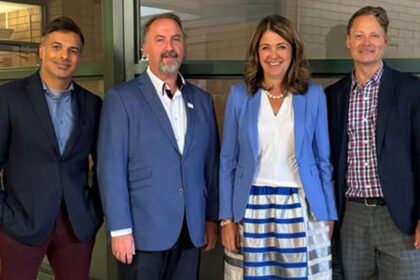
Cheryl Sinclair has been here before. Not this room, exactly — a conference room at Winnipeg’s Club Regent hotel — but it’s not the first time the Tyndall, Man., resident has shown up to a Sio Silica information session looking for answers. “My concern is drilling into the aquifer, taking out sand and putting filtered water back in,” she says in an interview. “Can Sio Silica guarantee that the ground, the aquifer, will not be contaminated?” On a Monday evening in mid-November, Sinclair is among the dozens of guests milling around at an open house hosted by the Alberta-based mining company that has spent the last decade devising a plan to extract silica sand from a southern Manitoba aquifer that serves more than 120,000 households. The company has set up a trove of polished material: glossy handouts touting the economic benefits of the mine, posterboards outlining technical details about the proposed — and as yet unproven — airlift extraction method and its potential impacts on the aquifer, disposable water bottles wrapped in Sio Silica branding. A handful of engineers are stationed throughout the room to answer questions; some attendees hold hand-painted signs declaring their support for the project and the “#Jobs” it hopes to create; Churchill, the polar bear mascot for Winnipeg’s professional basketball team, the Sea Bears, mingles with attendees, helping promote an entry draw for game tickets. Citizens attended an open house in November 2025 to learn about Sio Silica’s updated proposals for its sand mine southeast of Winnipeg. The company was denied an environmental licence to operate the mine in 2024. Now, it is applying again, this time with a revised plan that the company says will have a lower environmental impact. Photos: Svjetlana Mlinarevic / The Carillon “From my perspective, there’s an overwhelming amount of support,” Sio Silica president and East St. Paul Mayor Carla Devlin says, sitting in a small room across the hall from the event, with her private security guard at the door. “I think that a lot of people that had questions got answers, and I think that we probably changed some minds and corrected some misinformation.” This is Sio Silica’s second crack at convincing the government, and the community, to approve its controversy-laden mine. The company believes it’s found a uniquely high-quality sand deposit that’s already low in iron — a characteristic needed for technical and industrial applications like touch-screen glass, solar panels and aerospace technology. That trait makes the sand easier and cheaper to process without the need for chemical treatments, the company says. Once purified, Sio Silica says the sand can be used to make lithium-ion batteries, fibre optics, medical glass and other advanced technologies. “It’s like Frank’s hot sauce,” Devlin says. The proposal has been shot down once before, when a newly elected NDP government axed the company’s environmental licence application in February 2024. The decision was one of the first major acts for the government, and bucked a years-long trend wherein Manitoba’s environmental licensing process was all but a formality. For residents of Springfield, Anola, Vivian and other communities served by the aquifer, that rejection was a hard-fought victory after years of protests, petitions, environmental hearings and local council debates. Sio Silica has remained convinced its project has merit. In late October, more than a year and a half after the first environmental licence was denied, the company submitted a modified application — starting the licensing process from scratch. “I was angry,” Sinclair says of the new application. “It’s like we’ve got to go back to the battlefield and start protesting again.” Carla Devlin, who is both the president of Sio Silica and the mayor of a rural community near the company’s proposed mine, poses with a basketball mascot during a November 2025 open house regarding Sio Silica’s updated plans. Devlin says there’s “an overwhelming amount of support” for the mine. Photo: Svjetlana Mlinarevic / The Carillon Devlin says the revised application was designed to show Sio Silica is listening to the community’s concerns. The biggest change is a significant reduction in the amount of sand the company plans to extract. The original Vivian Sands project proposed extracting 1.36 million tonnes from more than 460 wells each year, with the wells arranged in clusters of seven. The new application, for the project now called “SiMBA,” proposes taking 100,000 tonnes in the first year and ramping up to a maximum of 500,000 tonnes by the fourth year. The company is now proposing to drill just 25 wells in Year 1 and scale up to 167 wells annually, this time in clusters of up to five. The overall footprint of the mine is projected to shrink, too. Sio Silica has access to more than 90,000 hectares of mineral claims across southern Manitoba, but plans to mine about 350 hectares in its first four years (a 45 per cent reduction from the original proposal) and 2,764 hectares over the lifetime of the project (a 66 per cent reduction). “We needed to show a gradual approach to build the trust and confidence,” Devlin says. Sio Silica has more than 400 mineral claims totalling over 1,000 square kilometres in central and southern Manitoba — more than twice the area of Winnipeg. Map: Julia-Simone Rutgers / The Narwhal & Winnipeg Free Press The company also plans to add filtering to its water treatment plan, to test its groundwater treatment process to “ensure compliance with provisions in an Environment Act licence,” and to draft plans to handle resident complaints and respond to any groundwater changes. Not everyone is convinced. Katharina Stieffenhofer, a Winnipeg resident who has followed the company’s plans for years, says she still has “grave concerns” about the proposal. “I’m concerned about the very likely injury — damage — to the aquifer, the drinking water, the landscape, the air, the roadways, and how it will impact the well-being and quality of life of Manitobans,” Stieffenhofer says. “I’m also really concerned about their, shall we call it, public relations.” Stieffenhofer says Sio Silica has been “greenwashing” its proposal. “Initially they were going to use the silica sand for fracking. Then all of a sudden, we’re not doing that anymore, now it’s going to be all wonderful green economy, we’re going to make solar panels. Now this latest version is going to be for fibre optics for data because that’s the newest thing,” she says, referring to the way the company has marketed the aquifer sand. “Who is really going to profit from this? I would say it’s not the people of Manitoba.” In its final report, the Clean Environment Commission noted Sio Silica’s open houses and community consultation efforts were “hampered” by a lack of detail about the mining plan. The commission recommended “more effective two-way communication” with affected communities and suggested the province require Sio Silica to strike a local advisory committee where residents can weigh in on the project. Devlin acknowledges Sio Silica’s community engagement hasn’t been perfect, but going forward the company wants to be “an open book,” including “having community involved in [environmental oversight] committees.” Stieffenhofer wants to see government-funded, independent analysis of the proposed extraction method to mitigate the risks to the drinking water source. “The silica sand acts as the kidneys and the liver. It filters our water, it has a function, and you take that away — what are we going to be left with, with 15 billion tonnes of silica sand missing?” Devlin says the company has conducted four years of environmental monitoring that shows “no adverse effect to the aquifer, no ground movement.” The company has partnered with Aquatic Life, a Manitoba tech startup developing groundwater monitoring tools, to provide realtime data about the Sandilands aquifer straight to community members and government. It also plans to work with a University of Manitoba’s hydrology professor and PhD students to research and monitor the aquifer. Devlin says Sio Silica plans to be a “big contributor to the university” by committing research and development funding. Manitoba has shown it’s not completely opposed to silica sand mining. The same week it denied Sio Silica’s Environment Act licence, it approved another mining company’s plan to dig for sand in the Wapinigow region on the eastern side of the province. In November, a third company, Silex Resources, submitted an application to mine for sand in a saline portion of the aquifer west of the Red River. Former Manitoba premier Heather Stefanson was found to have violated the province’s ethics laws when she attempted to push through an environmental licence for the Sio Silica sand mine in the days after her Progressive Conservatives lost the 2023 provincial election. Photo: Malak Abas / Winnipeg Free Press But Sio Silica’s project has been mired by political scandal: municipal council debates in Springfield unravelled to the point RCMP were called and the company’s lawyers threatened action against councillors; allegations that members of the former Progressive Conservative government pressured politicians to approve the project during the post-election transition period sparked a first-of-its-kind ethics investigation that ended with fines for the former premier and two MLAs. Two communities — Brokenhead Ojibway Nation and Springfield — have voted to reject the mine in referendums. Premier Wab Kinew has said the backroom political manoeuvring has left an air “of stink” around Sio Silica’s proposal, which needs clearing up before any further steps can be taken. After nearly a decade in the province, Sio Silica isn’t ready to back away. In fact, Devlin is more optimistic than ever the project meets Manitoba’s needs. “We check off all the boxes of a national interest project,” Devlin says, referring to the Carney government’s economic buzzword. “Everything written in [Manitoba’s] critical mineral strategy is Sio Silica. Everything the province is saying is everything that we offer, so I’m very optimistic we can move this province forward, build out our economy and boom like other provinces have.” For residents, it means their years-long fight to protect the aquifer isn’t over either. The fate of Sio Silica’s mine is yet to be decided. Public comments closed Dec. 1, and the technical advisory committee will review the application and pose questions to the company before a final licensing decision is made. While the environment department weighs the risks and rewards of the sand mine, The Narwhal and the Winnipeg Free Press look back on Sio Silica’s tumultuous time in Manitoba. Julia-Simone Rutgers is a reporter covering environmental issues in Manitoba. Her position is part of a partnership between The Narwhal and the Winnipeg Free Press. Recent Posts B.C.’s failure to fund flood response ‘troublesome’ as atmospheric river strikes again Dec. 12, 2025 7 min. read Rising waters closed highways and forced evacuations, prompting fresh criticism that the province has been… A decade of fighting over a controversial mining project in Manitoba — and still no decision Dec. 12, 2025 24 min. read The Sio Silica sand mine southeast of Winnipeg was proposed, then rejected, then reviewed, then… In Tlingit territory, the fight to protect herring is complicated Dec. 11, 2025 19 min. read An excerpt from “We Survived The Night” by Julian Brave NoiseCat
A decade of fighting over a controversial mining project in Manitoba and still no decision