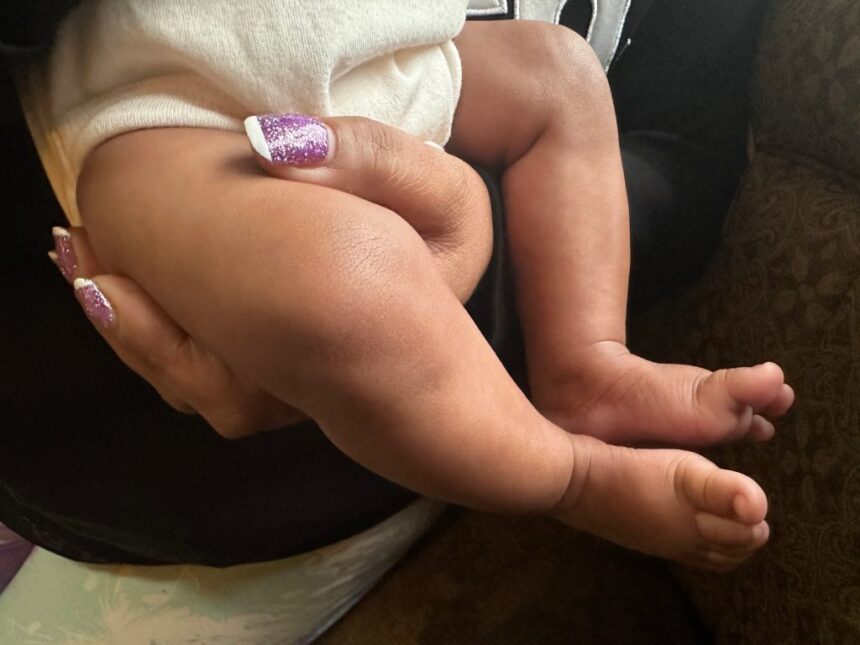
The Supreme Court of Canada has tossed an appeal from the child ‘welfare’ agency in favour of ‘Justine.’ Her lawyer says it’s now ‘the case that governs the issue in B.C.’ ‘Being a mother is just who I am; that’s my identity,’ says Justine, pictured holding her newborn baby girl on Nov. 25. Photo by Brielle Morgan Justine sits in her kitchen, cradling her new baby girl, while her 14-year-old camps out in a room down the hall. Another daughter bounces up the stairs after coming home from school and scoops up Denaro, their yappy chihuahua. Nine years ago, this family was torn apart after workers from the Vancouver Aboriginal Child and Family Services Society (VACFSS) decided it wasn’t in the girls’ best interests to live with their mom. Justine didn’t think so. The single mother — whom IndigiNews is identifying by a pseudonym to protect her children’s privacy — alleged she was discriminated against, filing a complaint with the B.C. Human Rights Tribunal against VACFSS. “In my heart, I knew I did nothing wrong,” Justine, an intergenerational survivor of both residential “school” and the child “welfare” system, told IndigiNews. “I thought if I sit here and allow them to continue doing this to me, then they’re going to do this to my children and my children’s children.” After a lengthy hearing, the tribunal found VACFSS — an Indigenous-led agency delegated by the provincial government to serve Indigenous families — had made decisions based on racial stereotypes and ordered it to pay her $150,000. A series of appeals followed, at taxpayers’ expense, culminating with a decision in Justine’s favour released by the B.C. Court of Appeal in May 2025. The Supreme Court of Canada finally put this case to rest on Nov. 20 — when it dismissed VACFSS’s appeal request, upholding the appeal court’s decision. This decision “really powerfully” shows that child welfare decisions need “to be grounded in the facts and not bias, stereotypical ideas or assumptions,” according to Kate Feeney. She’s the director of litigation for West Coast LEAF, one of several organizations to intervene in this case. “In bringing a human rights complaint and fighting for justice all the way up to the Supreme Court of Canada, [Justine] has really cleared the way for other parents to access the human rights system to seek justice and accountability from child welfare agencies.” “This case is now the case that governs this issue in B.C.,” added Danielle Sabelli, a lawyer from the Community Legal Assistance Society who acted as co-counsel for Justine. And it will have “a lot of weight in other jurisdictions.” ‘The more you speak up … the more they tighten the vice’ Aleks Vasiljević was one of the first people Justine called when she learned the appeal had been dismissed. He’s worked at community centres for 25 years, running programs for kids. In 2020, Vasiljević testified at the B.C. Human Rights Tribunal that he’d been working at RayCam Co-operative Centre in “Vancouver” four years earlier when someone from VACFSS called with a heads-up — they were coming to apprehend Justine’s three youngest children. “People can invoke this case as a precedent … the power is challenged,” said Aleks Vasiljević, pictured outside the B.C. Human Rights Tribunal on Feb. 24, 2020. Photo by Brielle Morgan The 2016 apprehension took place in RayCam’s “community living room,” he recalled. The girls were seven, five and three-and-a-half months old. VACFSS workers “asked her if she wants to give a last breastfeed before they take the baby,” he told IndigiNews.“I felt for the parent … for the baby, but also I felt for the social worker. I’m thinking … I wouldn’t want to do this job. This is horrible.” After bearing witness, Vasiljević attended several meetings between Justine, VACFSS and their respective lawyers and supports. He chose to get involved out of concern for the children, he told IndigiNews. The first meeting took place in May 2017, shortly after Justine’s daughter — who was eight at the time — tried to end her life by placing a bag over her head while at her foster placement. At this meeting, the children were “clearly not in the focus,” Vasiljević told the tribunal. Instead of “embracing” Justine, VACFSS workers were “going after her.” On Nov. 13, 2017, he attended another meeting where VACFSS workers told Justine they were completely cutting off her access to her middle children (then aged six and eight). Vasiljević told the tribunal it wasn’t clear why they were suspending the supervised visits. Tribunal member Cousineau likewise concluded that, “nothing that VACFSS said in the meeting to justify its decision made any sense.” While, according to Vasiljević, Justine presented as “reasonable” and “open” at this meeting, VACFSS was “completely shut off.” At one point, a “therapeutic access worker” for VACFSS appeared to become angry and swore, he recalled, saying: “I cancelled my [expletive] dinner plans!” “That was absolutely disrespectful and unprofessional,” Vasiljević said. “Therapeutic staff should not be swearing in a meeting. Period.” Ultimately, his takeaway from these meetings was “the more you speak up against [VACFSS], the more they tighten the vice.” Justine shows IndigiNews a spot on the ‘Fraser River’ where she goes when she ‘needs time and space.’ Photo by Brielle Morgan In a five-page letter to VACFSS’s executive director Bernadette Spence, he wrote he was “appalled by the conduct of specific VACFSS staff.” As of Dec. 5, he said he still hadn’t received a response. He said he’s hopeful this “groundbreaking” decision will force more transparency and accountability. IndigiNews reached out to VACFSS multiple times by phone and email, requesting comment, but they did not respond. In an emailed statement, the B.C. Ministry of Children and Family Development — which delegates responsibility to agencies like VACFSS — wrote: “We are aware of the decision, and we’re reviewing.” “We’re seeing the lowest number of children and youth in care in 30 years and the lowest number of Indigenous children and youth in care in over 20 years,” reads the statement. Nonetheless, thousands of Indigenous children are currently living in foster homes and group homes in “B.C.” — reflecting the ongoing intergenerational impacts of racist, colonial policies and practices that have long separated Indigenous kids from their family, culture and homelands. As of March, 68 per cent of all kids in care in “B.C.” were Indigenous, according to government data. ‘She just needed to be around kids — the noise of children’ After her daughters were placed in foster care, Justine was “just not herself,” said Laura Pinay. Pinay said Justine is a close friend, “like a sister.” She described herself as a single mom of five and a member of Peepeekisis Cree Nation in “Saskatchewan.” Justine “would come over and spend the night,” Pinay said. “She just needed to be around kids — the noise of children.” While Justine managed to get her kids back — after a years-long legal battle through the B.C. Provincial Court — the impacts of the separation are long-lasting. ‘It brings me great pride and joy knowing that my kids don’t have to grow up how I grew up,’ says Justine, pictured here with her daughters on May 10. Photo by Brielle Morgan While in “care,” the six-year-old sustained bruising which, according to a medical examination cited in the tribunal ruling, was likely caused by physical restraints. Justine said her daughter told her people would come into her room and hold her down by her arms and legs. In her decision, Cousineau wrote that VACFSS “ignored or downplayed the serious harm” Justine’s girls were experiencing in their foster placements, “which included self-harm, inter-sibling violence, violence with staff, and the application of physical restraints — while at the same time exaggerating the safety risks in [Justine’s] care.” “[Justine] wasn’t a child abuser,” said Pinay. “Her children were apprehended only to be abused in foster care, which is complete bullshit.” She said when the girls came home to their mom, “they definitely had more violent behaviour than before they were in care,” but “they’ve calmed down quite a bit now.” According to Justine, they’ve also struggled with anxiety, school and friendships. “At that crucial age, where they’re learning their ABCs and 123s … they weren’t able to focus on that,” she told IndigiNews, “because they were focusing on the next time they’re going to see their mom.” Her teenage daughter’s anger seems to come “from deep down and it’s coming out on little things,” she said. “For example, if I don’t wake her up on time for school and she has to go late, then it’s the end of the world. She’ll start screaming at the top of her lungs.” ‘I’m learning and trying to trust again’ The girls’ teachers are very supportive, Justine said. But it’s not easy for her to discuss concerns about the girls openly with them. She said that’s because when social workers seized her kids, it broke her trust in any authorities or professionals at hospitals, schools and even dental offices. Teachers and doctors have a duty to report perceived child welfare concerns, as per provincial law. To Justine, they’ve all become effectively the “eyes of the social workers.” And she fears the cost of their judgement. “When you get your kids back, you have serious trust issues,” she said. “I feel like I’m living in a glass house … but I’m learning and trying to trust again.” From Pinay’s perspective, Justine is “doing the best she can” to support her children and “give them a safe home.” Justine’s “case isn’t isolated,” she added. “It happens all the time to our people.” Justine hugs advocate Bernie Williams, who she calls one of her ‘biggest supports,’ outside the B.C. Human Rights Tribunal on Feb. 24, 2020. Photo by Brielle Morgan “She’s used her pain in a very positive way to help other people,” Pinay said. “She started a support group and connected mothers in the community.” Justine encourages other parents to “ask for help,” even though that can often feel “really hard.” “The system just drops you down in the worst part of the neighbourhood and expects you to bounce back,” she said. “I don’t even know how I did it. If it wasn’t for all the Elders and all the supports … Everybody just kept pushing me … ‘Come on, keep going, keep going.’” Justine holds her newborn baby on Nov. 25. ‘I’m so lucky that I didn’t fall between the cracks,’ she says. ‘Because there are parents that don’t have support or don’t know how to access support.’ Photo by Brielle Morgan She said she knows so many other women who have had their children apprehended. “They end up losing the battle for their lives, they end up self-medicating,” she said. “You can’t give up,” she said, encouraging other parents facing a similar situation. Although it’s been a long road, she’s proud of the parent she’s become. That person “I was looking for when I was a little girl … I’m able to be her now.” Now that this saga is behind her, she can “start healing in a good way.” “I love being a mom,” she said. “I never grew up with hugs, and I’m able to hug my kids now. It’s huge.” This story was produced as part of Spotlight: Child Welfare, a collaborative journalism project that aims to improve reporting on the child “welfare” system. Sensitivity edits were provided by Cheyanne Ratnam and Samantha Saksagiak. Tell us what you think about the story here.
Afro-Indigenous moms case against VACFSS has cleared the way for other parents, says expert