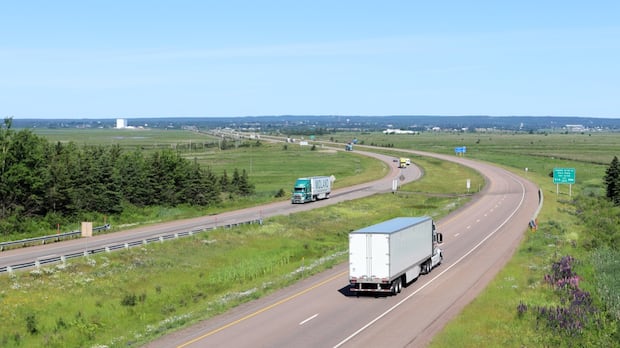
New Brunswick·UpdatedThe auditor general’s latest report finds that New Brunswick’s asphalt and chipseal projects were not selected based on data. It also found a lack of formal planning for highway safety and regular inspections of highway infrastructure.Auditor general says government not documenting rationale for decisions, questions credibility of data toolJacques Poitras · CBC News · Posted: Dec 09, 2025 2:01 PM EST | Last Updated: 17 minutes agoListen to this articleEstimated 6 minutesThe audio version of this article is generated by text-to-speech, a technology based on artificial intelligence.Paul Martin, New Brunswick’s auditor general, has found issues with the safety and management of the province’s highways in his most recent report. The report says work is being done without rationale and lack of regular inspections. (Shane Magee/CBC)Almost half the asphalt and chipseal projects chosen for provincial road funding were not selected by a data-driven tool that is supposed to objectively measure which repairs should be prioritized, a new report says.There was a “lack of documented rationale” for the decisions that “could result in work being performed that does not prioritize safety,” said the report by Auditor General Paul Martin.Between April 2023 and December 2024, 27 per cent of asphalt and chipseal projects selected for funding were not identified by the Department of Transportation and Infrastructure’s asset management system.And 22 per cent were selected despite that asset management system recommending they be done at a later date.”We reviewed 26 changes and found none had adequate documented rationale,” the audit said.It noted department staff “refine” the list of projects based in part on “local knowledge” and input from elected members of the legislature.A new report found that 27 per cent of the province’s asphalt and chipseal projects between April 2023 and December 2024 were not selected for funding by the Department of Transportation and Infrastructure’s asset management system. (Oliver Pearson/CBC)Martin said the findings did not cover the first capital budget introduced by the Holt Liberals in December 2024. The funding examined by Martin is separate from a smaller envelope of money that allows for MLA input and that came under scrutiny by Green MLA Megan Mitton last week.Mitton obtained and released data suggesting that the money allocated for electoral ridings tended to increase or decrease depending on whether the ridings were represented by government or opposition MLAs.Transportation and Infrastructure Minister Chuck Chiasson said last week he put an end to those fluctuations when he became minister last year, and the funding levels by riding are determined by how many kilometres of roads are in each riding.Martin said his audit steered clear of that $7 million pocket of money and only focused on projects in the much larger capital budget, purportedly chosen based on a formula that measures the condition of the roads and ranks projects by need.“If they are using this tool and it’s identifying the roads that need the repair, why are people overriding the decisions?” he said during a news conference.He said he couldn’t speculate whether the input from MLAs skewed those decisions as well.But he said his findings raised questions about the credibility of the asset management system.“If there’s a problem with their own data or their system to analyze this, they’re not telling us and they’re not telling you,” he said. “Why is the money not going to where it’s most needed?”Green MLA Megan Mitton recently obtained and released data suggesting that the money allocated for electoral ridings tended to increase or decrease depending on whether the ridings were represented by government or opposition MLAs. (CBC)Green Party Leader David Coon said the rate of changes was “massive … so I would say some of that very likely represents political decision-making.”Chiasson told reporters Tuesday that MLAs have no role in the decisions.He said “by and large” the asset management system works well, but “sometimes we have situations that arise that cause us to take something out of the queue, or put something into the queue” to address safety concerns.“We have aging infrastructure and priorities change … because of the conditions of the roads. Sometimes things deteriorate faster than we anticipate.”Progressive Conservative MLA Bill Oliver, a former transportation minister, said sometimes the asset management system prioritizes a road upgrade based only on how many years ago the road was built, not its actual condition.Martin’s audit said Transport Canada’s Canadian Motor Vehicle Traffic Collision Statistics for 2023 showed New Brunswick had the highest per capita fatality rate among provinces.But the department isn’t analyzing collision data provided by police promptly — with zero reports completed within a year and 80 per cent taking between one and two years.Martin’s overall conclusion was that the province isn’t doing enough to monitor and enforce safety on provincial highways, despite having the highest rate of fatal accidents.The department said in a response included with the audit that it agreed with all the recommendations, including on documenting the rationale for changes to road work priorities made by the asset management system.It said implementation was “ongoing,” with no specific timeline provided.New Brunswick Auditor General Paul Martin released three new reports on Tuesday. One of the reports covered highway safety, which showed that in 2023, New Brunswick had the highest per capita fatality rate among provinces. (Jacques Poitras/CBC)The audit said DTI doesn’t have the same repair standards on the highways it maintains itself as it requires of P3 highways — three major arteries operated as a partnership between the province and private companies.There is no timeline target to address pavement markings, warning signs or debris and obstructions on provincially maintained roads.The department also wasn’t meeting requirements for regular inspections of drainage, guiderail, wildlife fencing and highway signage, and not monitoring targets for winter snow plowing — even though a quarter of all collisions in slippery conditions led to injuries or death.In 2023, the overall surface condition of government-operated highways was poor or very poor in 43 per cent of cases.The audit noted, however, that the department hasn’t conducted 41 per cent of required audits of the P3 highways.Only 45 per cent of the 195-kilometre Fredericton to Moncton highway, privately operated by the Maritime Road Development Corporation, was in good or fair condition in 2023, Martin said.The target was 90 per cent.The auditor general’s report on highway safety showed the province wasn’t meeting requirements for regular inspections of drainage, guiderail, wildlife fencing and highway signage. (Guillaume Aubut/Radio-Canada)The department also did not receive any performance indicator reports, incident reports or maintenance activity reports from the development corporation in 2023, the audit said, and only completed 38 per cent of the site audits it was supposed to conduct.The two other P3 highways are the Trans-Canada Highway from Long’s Creek near Fredericton to the Quebec-New Brunswick border, operated by Brun-Way, and the Route 1 Gateway from River Glade near Moncton to the Canada-U.S. border at St. Stephen, operated by Gateway.While Brun-Way and Gateway addressed all the notices received from the province about problems, the Maritime Road Development Corporation did not address nine of the 29 it received.It didn’t respond or provide a timeline for addressing those nine problems, and three saw no action for more than a year, the audit said.Martin said the department also was not bothering to report “audit deficiencies” to the three private sector operators of P3 highways if they were observable from the highway.“The department informed us the reasoning behind this approach is that they assume the operator will notice issues themselves through daily patrols and correct it in accordance with contract standards,” Martin said. “By not informing P3 operators of observed deficiencies in a timely fashion, corrective action may be delayed or not taken.”ABOUT THE AUTHORJacques Poitras has been CBC’s provincial affairs reporter in New Brunswick since 2000. He grew up in Moncton and covered Parliament in Ottawa for the New Brunswick Telegraph-Journal. He has reported on every New Brunswick election since 1995 and won awards from the Radio Television Digital News Association, the National Newspaper Awards and Amnesty International. He is also the author of five non-fiction books about New Brunswick politics and history.
Almost half of asphalt, chipseal road projects not data-driven, report says