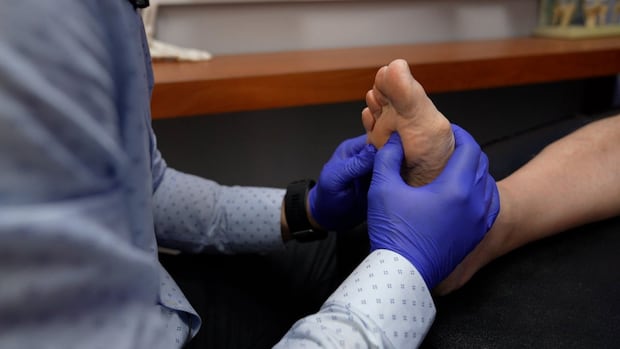
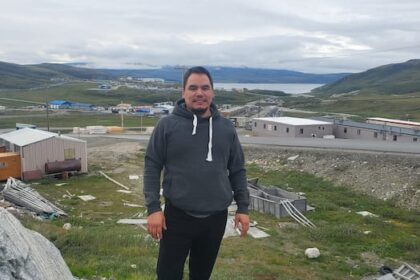
Nova ScotiaA U.S. podiatrist says he is leaving the province because his patients have to wait years to see a surgeon for procedures on their feet, even though he’s trained to do the procedures in his clinic.N.S. College of Physicians and Surgeons says it takes time to change systemCarolyn Ray · CBC News · Posted: Dec 01, 2025 5:00 AM EST | Last Updated: 44 minutes agoListen to this articleEstimated 5 minutesThe audio version of this article is generated by text-to-speech, a technology based on artificial intelligence.American podiatrist Dr. Ronald Barron said he had never seen patients waiting nearly three years to get a bunion removed until he moved to Nova Scotia. (CBC)An American surgical podiatrist says he has decided to leave Nova Scotia because he’s unable to fully treat his patients, which leaves them lingering on long waitlists. Dr. Ronald Barron said he’s fed up with dealing with the Nova Scotia College of Physicians and Surgeons and the provincial health department, which would not give him permission to perform some minimally invasive surgeries in his clinic. “I have not worked anywhere, especially in the United States, where you have to wait three years to have a bunion or a hammer toe repaired,” Barron said. “I could fix [these] issues very easily and very effectively if I were allowed to. But as it is with the government and college, I’m prevented from doing it. It was very hard.” Barron moved to Dartmouth to work in a clinic in early 2024 in hopes of staying long-term. His mother was from Guysborough County, and he said he spent many summers in the province. “It seemed like a very, very good opportunity,” he said. Dr. Ronald Barron says he’s fed up with dealing with the Nova Scotia College of Physicians and Surgeons and the provincial health department (Robert Barron)His arrival coincided with significant changes for podiatrists in the province. The change meant that for the first time, they could prescribe medications and order X-rays instead of asking primary care providers to do so on their behalf. In a statement to CBC News, Dr. Gus Grant, the head of the province’s college of physicians, said the move “brought accountability, structure, and appropriate recognition of the contributions that podiatry can make to N.S. health care.” But Barron said in his case, the changes didn’t go far enough. Unlike Canadian podiatrists, his U.S. training included minimally invasive surgeries such as treating bunions or hammer toes in his clinic instead of sending patients to a hospital operating room. “I had explained to the college in quite a bit of detail my background, they were aware of that. Initially they seemed very happy to have somebody with my skill set coming to the province.” He said he reached out to the provincial government and the college several times, asking for an expansion of his services, but received no reply. Barron said it felt like he was “passing the buck” as he saw patients with conditions he knew he could treat. He pointed to a case where a diabetic man in his 40s had a hammer toe and a wound on his foot. “It had been more than a year since he was able to walk regularly, he gained more weight. His diabetes, his blood sugars were particularly not well-managed. It was really having an impact on him, even his mental health was very much affected. This is not a unique situation.” According to wait times posted by the government of Nova Scotia, half of patients needing a bunionectomy wait nearly a year for a consult, and then wait another two and a half months for the actual surgery. Some patients are waiting more than three years for a consult, and then nearly six more months for the surgery. Barron said he was shocked that given those wait times, there was no urgency from the college or province to use his full skill-set. “I was very surprised and disappointed. I unfortunately just didn’t foresee any change.” Grant says the solution isn’t as easy as just allowing Barron to work. In his statement, he described the complex work that had to happen behind the scenes to allow podiatrists to expand their scope last year. Negotiations included the IWK, Nova Scotia Health, pharmacies, government, the Drug Information System and regulators. “There are system-wide changes to implement, not change simply to accommodate one outlying practitioner,” he said. The Department of Health and Wellness also sent a statement in response to inquiries from CBC News. It wrote that it was disappointed that Barron has decided to leave the province. “The department has been working closely with the College of Physicians and Surgeons Nova Scotia and the Nova Scotia Podiatry Association to explore expansions to the scope of podiatry practice, and integration with the public health care system in the province,” it wrote. “Any expansions of scope or integration must also account for the necessary resources to coordinate and integrate across the full health system.” Barron said he appreciates that it’s the responsibility of the college to ensure physicians are properly trained. “But I think, being an obstacle to prevent skilled practitioners from providing those services is not their role either. I think it’s important that they allow qualified medical practitioners to practice.” He said the lack of communication pushed him to move back to the U.S., where he is now pursuing job opportunities in New York. MORE TOP STORIES ABOUT THE AUTHORCarolyn Ray is a videojournalist who has reported out of three provinces and two territories, and is now based in Halifax. You can reach her at Carolyn.Ray@cbc.ca
American podiatrist leaving Nova Scotia over bureaucratic frustrations