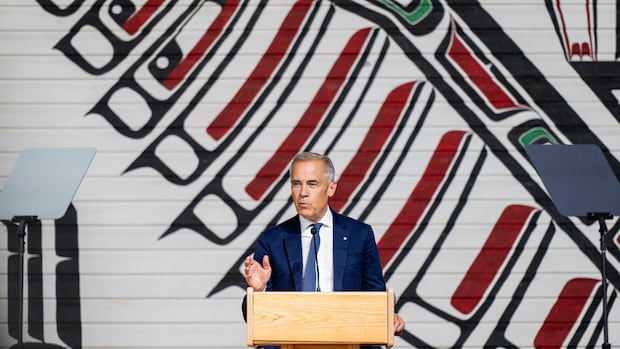
IndigenousAssembly of First Nations chiefs are demanding the withdrawal of Canada and Alberta’s recently announced new pipeline deal and expressing full support for First Nations on the British Columbia coast that strongly oppose the initiative.Chiefs unanimously pass emergency resolution backing oil tanker ban and First Nations on B.C. coastBrett Forester · CBC News · Posted: Dec 02, 2025 4:00 AM EST | Last Updated: 2 hours agoListen to this articleEstimated 4 minutesThe audio version of this article is generated by text-to-speech, a technology based on artificial intelligence.Prime Minister Mark Carney speaks during the First Nations Summit at the Canadian Museum of History in Gatineau, Que., on July 17. (Spencer Colby/The Canadian Press)Assembly of First Nations chiefs voted unanimously on Tuesday to demand the withdrawal of a new pipeline deal between Canada and Alberta, while expressing full support for First Nations on the British Columbia coast that strongly oppose the initiative.Hundreds of First Nations leaders are gathered this week in Ottawa for their annual December meeting, where high on the agenda was the federal-provincial memorandum of understanding for a bitumen pipeline to Asian markets announced last week.The deal contemplates changing the federal ban on oil tanker traffic in northern B.C. waters, but AFN delegates responded by passing an emergency resolution affirming their support for the moratorium. “A pipeline to B.C.’s coast is nothing but a pipe dream,” said Chief Donald Edgars of Old Massett Village Council in Haida Gwaii, who moved the resolution.The resolution also urges Canada, Alberta and B.C. to recognize the climate emergency and uphold the United Nations Declaration on the Rights of Indigenous Peoples. In an opening speech, AFN National Chief Cindy Woodhouse Nepinak said it was “as if First Nations rights can be wiped away with one federal-provincial MOU.””Canada can create all the MOUs, project offices, advisory groups that they want: the chiefs are united,” she told the group. “When it comes to approving large national projects on First Nations lands, there will not be getting around rights holders.”WATCH | Cindy Woodhouse Nepinak on federal budget:Carney’s budget a ‘significant setback’ with First Nations, AFN national chief saysAssembly of First Nations National Chief Cindy Woodhouse Nepinak, speaking at a national meeting in Ottawa on Tuesday, said the Liberal government’s fall budget was a chance to build back some trust with First Nations after the government ‘rammed through’ major projects legislation ‘without consultation.’The AFN advocates for more than 630 chiefs across Canada, who meet twice a year in person to set their policy priorities. Prime Minister Mark Carney is scheduled to address the assembly Tuesday afternoon, while several cabinet ministers will be in attendance over the three-day meeting. This would be Carney’s first time attending an official AFN assembly since winning a minority government in April, but not his first time facing First Nations leaders with questions about his agenda. The prime minister earned mixed reviews in July following a hastily called summit designed to ease First Nations’ concerns about the Building Canada Act, which empowers cabinet to fast-track approvals for major projects deemed to be in the national interest.Since then, the Carney government has referred two tranches of projects to the government’s new major projects office, on top of the pipeline agreement with the Alberta government.That memorandum of understanding mentions Indigenous co-ownership and economic benefits repeatedly as a goal, however First Nations groups in B.C. were quick to raise objections.Marilyn Slett, chief of the Heiltsuk Nation on the B.C. coast, said in a news release, “This pipeline project will never happen.” The B.C. AFN said it stands with the coastal First Nations and wants “all governments to abandon this pipeline project.”The pipeline deal commits Canada and Alberta to respecting Indigenous rights and treaty rights and “engaging in early, consistent, and meaningful consultation” with Indigenous peoples. Bill S-2 on agendaAccording to a draft agenda published by the AFN, the chiefs will hear directly from the major projects office and its Indigenous advisory committee on Wednesday.The chiefs are also slated to discuss Bill S-2, proposed legislation introduced in the Senate to make certain changes to the Indian Act, including eliminating the “second-generation cutoff” rule. This rule provides that children are not eligible for Indian status after two generations of one non-status parent.More than three dozen policy resolutions are also up for debate, and emergency resolutions are also typically brought forward to address urgent issues.
Assembly of First Nations calls for withdrawal of Canada-Alberta pipeline deal through B.C.