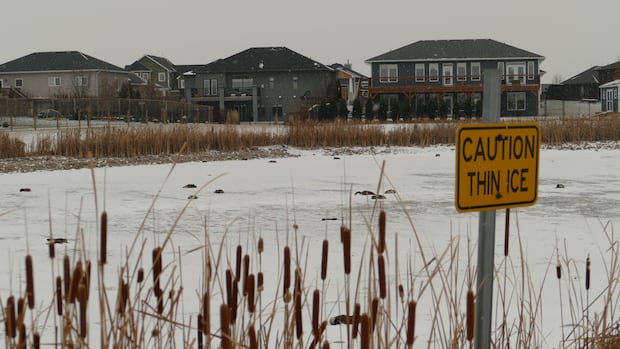
ManitobaDozens of Canada geese are dead in Niverville as a result of a confirmed avian flu outbreak.Resident concerned about goose left dead on his porch, others on pondJura McIlraith · CBC News · Posted: Dec 05, 2025 3:17 PM EST | Last Updated: 4 hours agoListen to this articleEstimated 4 minutesThe audio version of this article is generated by text-to-speech, a technology based on artificial intelligence.Dozens of geese are dead on the ice of a Niverville retention pond as a result of an avian flu outbreak. (Jura McIlraith/CBC)WARNING: This story contains an image of a dead goose.A Niverville resident is shocked to have seen scores of dead geese on the retention pond in his backyard — and even one on his back deck.All of them were killed by an avian flu outbreak.Mason Goulet noticed a handful of Canada geese on the ice, struggling to move, about three weeks ago.”Some of them we thought were maybe frozen into the ice,” Goulet said Thursday from his porch. “It turns out they were actually sick.”Mason Goulet found a dead goose on his porch after many of the birds died on the retention pond in his backyard. (Jura McIlraith/CBC)On Nov. 13, the town of Niverville released a statement advising residents the Manitoba Conservation Branch had detected avian flu in the local goose population. The virus has been found in surrounding communities before.Lab tests have confirmed it’s the H5 avian influenza virus. H5 circulates in wild bird populations. The subtype H5N1 is responsible for some human cases of the disease.Goulet was shocked to find the dead goose on his porch after going away for a couple days. He estimated it was there for three to five days.He was told by conservation to leave it where it was, and that could take another week before it was disposed of.Goulet said he and his neighbours are concerned about the goose population and the possibility of other animals getting sick. He’s seen eagles picking at the carcasses.”People’s dogs walking around — they could probably end up taking a bite or something like that, which would obviously be no good,” Goulet said.”Our cat likes to go out on the deck, so we have this goose here that we were told not to touch for now, so we can’t let him out on the deck.”Frank Baldwin, a Canadian Wildlife Service biologist, says it’s unusual to see high mortality rates from avian flu like this in Manitoba. (Jura McIlraith/CBC)Canadian Wildlife Service biologist Frank Baldwin said avian flu is naturally found in waterfowl. Immunity of a population wanes over time, he said. It’s unusual to see mortality rates this high in Manitoba, because the virus typically peaks after the geese have migrated for the season, Baldwin said.Other parts of Canada, such as southern Ontario and Quebec and some northern parts of the United States, have seen similar mortality rates, Baldwin said. Those outbreaks coincide with colder weather.”When birds get highly concentrated, the virus moves quickly through the population,” Baldwin said. “The birds also undergo some stress associated with cold weather, and so that leads to the mortality that we see here.”Baldwin and wildlife technician Owen Andrushuk visited retention ponds in Niverville on Thursday to plan out next steps.Frank Baldwin and Owen Andrushuk from the Canadian Wildlife Service assess the situation. (Jura McIlraith/CBC)The Canadian Wildlife Service worked with the provincial government and the Town of Niverville to clean up the carcasses.A total of 165 carcasses were removed Friday, including the goose on the deck, Baldwin later told the CBC.The Public Health Agency of Canada considers the virus low-risk to humans, but Baldwin said there are still some precautions to take.Dead birds should not be handled and pets should be kept away from them. He advises hunters to always make sure they pluck birds in open spaces, regularly wash their hands and make sure meat is fully cooked.Mason Goulet and his neighbours are concerned about the possibility other animals will get sick after multiple geese have died of avian influenza, including one on Goulet’s deck. (Jura McIlraith/CBC)”There is risk for scavengers like birds of prey, things like bald eagles and also some mammals that scavenge,” Baldwin said. “There have been cases confirmed in Manitoba this fall with coyotes, things like otters, foxes that have contracted the virus and died.”Across Canada, there is an active and serious avian flu outbreak in both wild and domestic poultry. Since December 2021, more than 16 million domestic birds have died or were culled.Those numbers include 300 ostriches culled in B.C. last month and 63,000 birds in southwestern Ontario.The only confirmed H5N1 human case that came from transmission within Canada last year was in B.C.Hannah Wallace, a University of Manitoba researcher with expertise in emerging viruses and viral immunology, said most human cases are not found in the general public.Hannah Wallace says the vast majority of avian flu cases found in humans are in poultry or dairy farm workers, not the general public. (Trevor Brine/CBC)”The vast majority are people that are either working on a poultry farm or dairy farms,” Wallace said.”It’s people that are in very, very close prolonged contact with infected animals.”It’s difficult to contain avian influenza in wild bird populations, Wallace said.Samples from the birds will be sent to the Canadian Food Inspection Agency for DNA sequencing, Wallace said.WATCH | Southern Manitoba town’s residents concerned about dead geese:Southern Manitoba town’s residents concerned about dead geeseAvian influenza has caused a large die-off of geese in Niverville, Man., part of an outbreak across the country. ABOUT THE AUTHORJura McIlraith is a CBC Manitoba reporter based in Steinbach. She started her journalism career covering stories in the southeast for The Carillon. Since then, she has worked for multiple print publications including the Winnipeg Free Press and in radio for 680 CJOB. You can reach her at jura.mcilraith@cbc.ca.With files from Karen Pauls
Avian flu kills dozens of Niverville geese