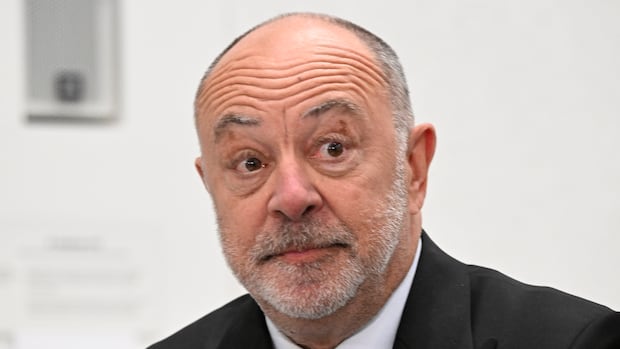
MontrealHundreds of millions of dollars meant to be invested in Quebec’s beleaguered health-care network remains in limbo more than a month after the Legault government abolished the institute overseeing the funds without warning. Bill 2 abolished institute mandated to reinvest in Quebec’s health networkHolly Cabrera · CBC News · Posted: Dec 11, 2025 4:00 AM EST | Last Updated: 2 hours agoListen to this articleEstimated 6 minutesThe audio version of this article is generated by text-to-speech, a technology based on artificial intelligence.Quebec Health Minister Christian Dubé looks on during a cabinet shuffle at the legislature in Quebec City, on Sept. 10, 2025. He tabled Bill 2, which ties a portion of physicians’ compensation to collective performance targets. (Jacques Boissinot/The Canadian Press)Hundreds of millions of dollars meant to be invested in Quebec’s beleaguered health-care network remains in limbo more than a month after the Legault government abolished the institute overseeing the funds without warning.The Institut de pertinence des actes médicaux (IPAM), which began operations in March 2020, was mandated to identify appropriate medical practices and savings to reinvest in projects that would improve Quebecers’ access to specialized medical services. IPAM identified $1.9 billion in savings since its inception — $1.6 billion of which are from cuts to the remuneration of specialized physicians agreed upon in 2019, according to the institute’s latest financial report.However, Bill 2, which ties a portion of physicians’ compensation to collective performance targets, marked the unceremonious end of the independent organization and now leaves these funds at the government’s discretion. The bill has been in place since Oct. 25, with the controversial changes it outlines set to go into effect on Jan. 1.About $1.5 billion of the funds has already been committed to 57 projects, the report says. Of that sum, less than half — $645 million — was spent on the initiatives as of March 31, and it is unclear whether the remainder will still go to the original projects. There is also about $450 million that was not yet earmarked and could be used to invest in medical services.Institute was supposed to exist for another year, says directorJean-François Foisy, director general of IPAM, said the institute was fulfilling its mandate, bearing in mind that the organization was expected to exist until Dec. 31, 2026.Jean-François Foisy is the director general of IPAM. (Submitted by Jean-François Foisy)He said that in the last year, IPAM, the Fédération des médecins spécialistes du Québec (FMSQ) and the government’s work had gained momentum, which made finding out that Bill 2 would put an end to the institute all the more shocking to him. “It’s no longer our responsibility, but our hope is that there will be a way so that the network, in collaboration with Quebec’s Health Ministry and medical specialists, can continue to work and implement projects that, frankly, were quite promising,” Foisy said. Above all, Foisy said he hopes that considerations over the appropriateness of care will be at the heart of discussions about the health network going forward. Innovation stifledDr. Julie Jomphe — a psychiatrist and associate professor at Université de Montréal — said the abolishment of IPAM jeopardizes the availability of specialized medical care for people in need who are living in remote regions of Quebec, where services are scarce. “Fundamentally, there’s inequity in Quebec. Some regions have specialized services, while others don’t,” Jomphe said in an interview. On the eve of Bill’s 2 adoption, she had pitched an online group therapy project for people suffering from borderline personality disorder. It is estimated to cost at most $30,000 per year and is the kind of initiative that IPAM could have subsidized, she said.“Technology exists. It’s proven. We can do this,” Jomphe said, noting that when left untreated mental health conditions, such as borderline personality disorder, can become “extremely expensive.”Doctor worries money will be ‘reallocated to cover the deficit’Federations in Quebec representing medical specialists, family doctors and medical students, along with the association representing pharmacy owners, have filed legal challenges against Bill 2, with many saying it will negatively impact patient care. The uncertainty about the funds’ future has made specialists like Jomphe fear the money will be repurposed by the government. Dr. Julie Jomphe says IPAM offered funding that made innovative and low-cost medical services possible, which helped address gaps in Quebec’s health network. (Submitted by Dr. Julie Jomphe)“We, doctors, cut our own funding to finance [health-care projects]; we were good sports. We collaborated,” Jomphe said of the 2019 agreement. “I’m worried that this money will be quote, unquote ‘stolen.’ You know, somehow reallocated to cover the deficit.” Following the Quebec economic update in November, the Legault government was criticized for planning to use the $1.8 billion surplus from the Green Fund, renamed the Fonds d’électrification et de changements climatiques, to pay down the province’s debt. That envelope was specifically intended for climate action. Projects under reviewThe FMSQ and the Coalition Avenir Québec (CAQ) government negotiations have been stalled since October 2025, leading to the government invoking closure and adopting Bill 2. While formal negotiations between the federation and the government have not restarted, FMSQ president Dr. Vincent Oliva met with Premier François Legault on Monday. It’s still unclear what came out of that meeting. Negotiations between family doctors and the government resumed over the weekend after the Fédération des médecins omnipraticiens du Québec walked out of talks last Thursday.Pâris Psychogyios, director of public affairs for the FMSQ, said in an email on Tuesday that the federation learned of the demise of IPAM when Health Minister Christian Dubé tabled Bill 2.“At present, we do not know what will happen to IPAM projects and funding agreements, since the law contains no provisions on this matter,” Psychogyios said, noting that the federation would not comment further due to the state of negotiations with the government.WATCH | Quebec bar raises concern over 3 CAQ bills :Quebec bar association condemns recent CAQ government laws in rare political moveThe Barreau du Québec rarely gets involved in politics, but it’s publicly calling elements of three recent provincial government bills “concerning.”Marie-Christine Patry, director of communications for the Health Ministry, said in an email on Friday that work is underway at the ministry to determine which projects will be maintained “based on their relevance and clinical impact.”In November, Quebec’s bar association, the Barreau du Québec, criticized Bill 2 as one of three bills recently tabled by the Legault government containing provisions that “deviate significantly from the values and traditions of Quebec society.”
Bill 2 didn’t just anger doctors. It left hundreds of millions in health-care funding in limbo