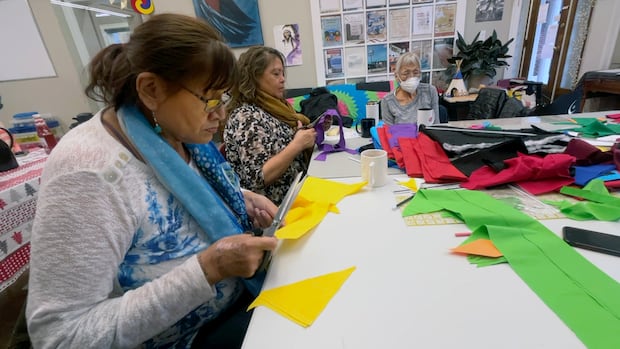
ManitobaThe Brandon Friendship Centre has grown from a small group of volunteers in 1965 to an umbrella of programs stretching from prenatal care to seniors’ support, cultural revitalization, drop-ins and housing assistance.’Big hearts and loving souls’ mark 60-year legacy, says memberChelsea Kemp · CBC News · Posted: Dec 06, 2025 7:00 AM EST | Last Updated: 2 hours agoListen to this articleEstimated 5 minutesThe audio version of this article is generated by text-to-speech, a technology based on artificial intelligence.The Brandon Friendship Centre, which began with a group of volunteers in 1965, now has a staff of almost 130 operating in 11 buildings in the city. (Chelsea Kemp/CBC)When women come together at the Brandon Friendship Centre, they share more than Indigenous cultures, traditions and stories — they’re building on a legacy six decades in the making.Audrey Graham, who has been sewing medicine bags, beading, going to sweats and making friends at the centre for more than 10 years, says its welcoming atmosphere is key.”This is where you find people who have big hearts and loving souls,” said Graham. “It’s a great place to be, especially if you’re on your own and you’re new to the city.”Friendship centres first started in the 1950s in Canada to help welcome First Nations and Métis people to cities, offering support and friendship with non-Indigenous residents. People walk in as strangers but quickly end up among friends and found family, Graham said. Audrey Graham, right, helps cut star piece patterns at the Brandon Friendship Centre’s Eagle Healing Lodge. (Chelsea Kemp/CBC)That sense of community is what’s helped the Brandon Friendship Centre — which marked its official 60th anniversary last month — thrive, says board president Aldin Foy.The non-profit helps fill critical programming gaps for Indigenous people in the southwestern Manitoba city and surrounding region, but is also dedicated to strengthening culture and identity by offering a place where no one is judged or turned away, he said.”If we didn’t exist, there would be a huge, huge hole within the city, within the community.”Evolving to meet needsFor many longtime members, the organization’s power comes from its ability to evolve and meet current needs while maintaining the spirit it was founded on, said Foy.Three local women — Audrey Silvius, Grace Godmaire and Jean Halliday — came together in the early 1960s to create a place to welcome and support Indigenous people arriving in Brandon, Foy said.The first friendship centre in Brandon opened in 1964, but it wasn’t incorporated until the following year, according to its website.An image from the Manitoba Historical Society website shows the Brandon Friendship Centre’s first official board, which replaced a volunteer board, in 1966. (Manitoba Historical Society Archives)Since then, it’s grown from a small volunteer board to a staff of nearly 130, along with numerous volunteers, working in 11 buildings.Its umbrella of programs ranges from prenatal care to seniors’ support, cultural revitalization, drop-ins, food programs and housing assistance, offering 127 units, among other resources.That means the centre can help people when they land in the city, where it may be hard to find a job, housing and friends, said Foy. “They can come into our doors and access some of the programs that are available to empower them,” and those community connections help the centre to keep growing, he said.Board president Aldin Foy says the Brandon Friendship Centre helps fill major programming gaps in the area. (Chelsea Kemp/CBC)Sioux Valley Dakota Nation’s Claudette Chaske says walking into the centre more than 20 years ago meant reconnecting with traditions she lost as a child. She moved away from her community when she was 11. At the friendship centre’s Eagle Healing Lodge — which began as a program for Sixties Scoop survivors and has since expanded — she’s been able to pick up crafts she hadn’t done in more than 40 years.”I love that. It just felt like my mother was close by beside me, watching me create,” Chaske said. “You do good things … things you missed out on in childhood.”Priscilla Ireland said visiting feels like a homecoming, and the centre helps fill some painful gaps, especially for Indigenous people separated from their culture through the Sixties Scoop or residential schools. She values its everyday supports — computers for reconnecting with relatives, help with paperwork and access to elders who share teachings.”[You] relearn the things which you lost,” she said. “I’m really thankful this centre is up.”Claudette Chaske, left, and Priscilla Ireland help cut star piece patterns at the Brandon Friendship Centre’s Eagle Healing Lodge. (Chelsea Kemp/CBC)Board member and past president Jason Gobeil said one of the beautiful things at the centre is its work with ceremonies and reviving traditions, whether Dakota, Ojibwe, Cree or Métis. “This is where we truly see the fabric of society coming together,” he said. “The friendship centre truly is a quilt.”It’s also believed to now be the oldest operational centre in Manitoba, according to Park and the National Association of Friendship Centres, opening soon after the Winnipeg Indian and Métis Friendship Centre, which closed in 2018 due to financial issues. Plans for a new Winnipeg centre were announced in 2023.Youth involvement needed to keep centre goingJack Park, president of the Manitoba Association of Friendship Centres, said Brandon’s is unique because it’s in the heart of an urban centre, but connects with rural people around the city.The centre’s passionate staff — including executive director Gail Cullen, who has served for more than 40 years — have helped the non-profit grow into an “empire” and an important problem-solver in the community, said Park.But Brandon’s friendship centre, like others around the country, needs youth engagement to keep going, he said.”We’re all aging out,” said Park. “We need to have our youth become more involved … to take over the leadership roles. “If the youth don’t become involved, we could be in trouble.”For now, Graham is among those helping pass on knowledge, including how to make a star blanket. Working at the table with a dozen other women, she said everyone has stories and teachings to share with the friendship centre’s growing community.”Everybody helps each other out,” she said. “We get to know each other for who we are, and we don’t judge.”WATCH | Brandon Friendship Centre celebrates 60 years of bringing people together:Brandon Friendship Centre celebrates 60 years of bringing people togetherFor 60 years, the Brandon Friendship Centre has been a cultural hub, bringing people together to connect with Indigenous culture and support programs in the southwestern Manitoba city.ABOUT THE AUTHORChelsea Kemp is a multimedia journalist with CBC Manitoba. She is based in CBC’s bureau in Brandon, covering stories focused on rural Manitoba. Share your story ideas, tips and feedback with chelsea.kemp@cbc.ca.
Brandon Friendship Centre celebrates 60 years of building community, culture and support